


The story of the College, as with many experiences at Findhorn, is both an objective, factual narrative and a subjective, personal one running parallel. I’ll try to explain and please be patient with the way I weave in my own story because I believe it will be the best way to introduce the college and its aims. I also use the Findhorn Community Semester, just one of the college offerings, as my prime example, mainly because that programme was where my real learning happened. I can’t offer the full history of the College because it continued for years after I left but I can describe the start in 2001 because I helped to get it launched.
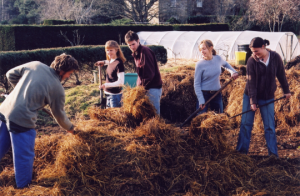
Hay kids – during Findhorn College Semester Study programme
Before I came to Findhorn I was a lecturer in a Performing Arts Department of what is now Salford University in Northern England. I remember being very dissatisfied with the education we were offering the students who came to study at Salford. The Performing Arts do not sit comfortably in a system that is based on intellectual grading and assessment, a system that demands an intellectual framework whether it is appropriate or not. Our higher education system as a whole has the same fault – it cannot come to grips with creative subjects without inhibiting them or sending the students down an intellectual dead end. And, at the time, I couldn’t understand why this was so. This puzzle kick-started my own journey to find something else, a system that would enable the non-intellectual (ie non-mental) part of the student to flourish. But where did, for example, the creative drive reside in the student if not in the intellect? This was the big question. I was pretty sure creativity wasn’t a purely mental function and hence it was somewhere outside the scope of conventional education.
Here’s an example. Within my building there were students who were studying TV and Video Production (my department, fairly hands-on), Theatre (ie acting for both stage and camera) and Music including a new course in Popular Music attracting talented young musicians from all over the country. I heard from one of the Music staff that students were being set essays on subjects like The Guitar Solos of Jimi Hendrix, a topic that had me laughing out loud when I heard it. I’m sure Jimi himself couldn’t write an essay about his solos and I’m also sure that he wouldn’t want to. His guitar solos were not an intellectual pursuit. In my own department we were trying to grade wildly different student projects – things like abstract music videos, versus factual documentary films. There was no intellectual criteria that could be applied to these wildly different videos and the grading became a farce, with the staff who were assessing them in quite strong disagreements about the grade that should be merited for each piece. Again, why was this so hard to do? What were we missing?
In my private life I was busy attending workshops on all sorts of personal development subjects – co-counselling, rebirth, group dynamics, massage techniques and so on, and these were making me see more of myself as a person comprised of mind, body, spirit and emotions. Co-counselling showed me that in the emotional arena, there were very definite things to learn and live by. Suppressing emotions, as had been the theme of my entire education, was not good for me. Expressing emotions could be done in a respectful way that was brand new to me. In the world of emotions I felt like an absolute beginner. Why hadn’t this stuff been taught at school? Far more useful, I would have thought, than learning to list the Kings and Queens of England in date order. So what else wasn’t being taught, what other areas of the whole person were being neglected?
Cue my move to Findhorn in 1992. I was heartily frustrated by my work in education and needed to be somewhere different. On a visit to Findhorn during my long summer break in 1992, I became convinced that things were very different in the Community. I was learning a lot from my experiences and by working with others. I was learning what a spirit-led existence was like, and I liked it. And it suddenly clicked that the spirit was the part of the person where the creative drive and impulses belonged. The performing arts were a spiritual endeavour first and foremost – relying on intuition and hidden talents that could not be defined on paper in an essay. Inspiration was something that was given to the creative person if they stopped thinking too hard about it. The mind and the intellectual process just got in the way. No wonder we couldn’t teach it back at Salford – we had a whole heavy-handed intellectual procedure to apply to it. Pull a flower apart to analyse and list its components, and you end up with a pile of petals and leaves and a dead thing with no perfume, not the wonderfully vibrant thing that attracted you in the first place. This is how my educational experience felt to me – like a pile of dead old petals and leaves. I wanted to be able to teach without killing things.
When I came to live at Findhorn, my work centred around the Universal Hall and I soon became focaliser of that department of the Foundation. It was rewarding work and included the Performing Arts but had nothing to do with education. I wasn’t particularly sorry – I wasn’t ready to go back into that arena and I didn’t have the new tools that I would need. I worked in the Hall until 1998 when I married Veralyn, a New Yorker, and she was keen to leave the Community and explore the big city. We lived first in London and then New York but I wasn’t happy in either place. I’d left something unfinished at Findhorn and there seemed very few places on the planet that could answer my questions as effectively as living the spirit-led life on offer in the Community.
In 2001 I was unhappily trying to co-ordinate after school programmes for schools in Queens in New York and finding the experience frustrating and pointless again. I wanted to be involved in whole person education. What would that look like? Via Findhorn emails I learned that academic Malcolm Hollick was trying to get the new Findhorn Foundation College off the ground and he needed someone to help him. It seemed like this was a job that was made for me, particularly as the college was going to offer accredited education and interact with higher education students who were studying for their degrees. Malcolm said the job was mine if I wanted it, and I persuaded my reluctant wife to return to Findhorn. Now at last I might start to come to grips with a spirit-led educational process.
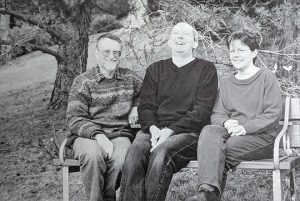
Findhorn College staff 2001 with Malcolm Hollick and Jean Flloyd photo Findhorn Foundation
My wife and I returned to Findhorn, set up home in Cluny Hill College and I joined Malcolm in Room 7 to set up the systems we needed to start up the College and operate as an Educational Charity. We inherited existing courses like English in Community and workshops like Conflict and Change. My own area of responsibility was to be the FCS Programme (Findhorn Community Semester) – where US students on existing degree courses would come to Findhorn for a study abroad semester and receive academic credits for their time here.
The programme had been set up some years before by Laurie Gold, Findhorn friend and teacher at Pacific Lutheran University on the West Coast in Washington state, and was now being marketed by Daniel Greenberg at Living Routes in Massachusetts. Living Routes would recruit the students and send them over from the States. Seemed like a perfect opportunity to explore more about a spirit-led curriculum. As part of the programme students would have some time in their week in a Foundation work department, and some time in classes studying elements of ecology, intentional community, creative writing and art, if I remember rightly.
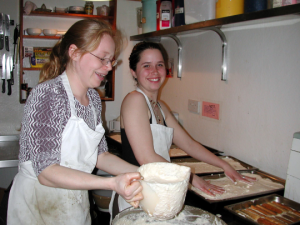
Findhorn College Semester student working with Desie in the Park kitchen
This wasn’t the first time the Foundation had tried to set up a college offering accredited Higher Education. Back in the 1990’s there was the short-lived attempt by US academic Andrew Arthur to set up a college at Findhorn. Money was invested but the college never saw the first student with the overambitious plans falling apart before it was established. This had left a bitter taste for some Foundation staff because funds had been wasted on it and Malcolm had a tough time trying to make the new college land with folk who remembered the failed old one. Fortunately, and because of Malcolm’s persistence, the Findhorn Foundation College did land in 2001 and was to continue roughly up to the Covid pandemic, if I remember rightly. My time with it lasted just three years, from 2001 to 2004, but they were a fine three years for me, with answers to my educational questions falling into place quite naturally as we explored a new style curriculum.
Let me be clear from the start – we were only scratching at the surface of a whole person educational style. What we were exploring was not another branch of higher education, it was a whole different tree that conventional academia knew nothing about. We moved forward by intuition and by making mistakes but we treated the students as whole people with mind, body and spirit and they seemed to take to this approach really well. They seemed to thrive and grow as people, something that had never happened when I taught in a conventional university. It became a hugely rewarding experience for me and healed some of the past hurts.
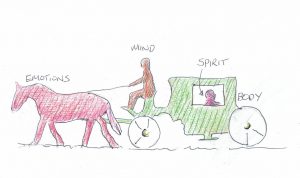
Representing my Holistic Model with Spiritual Lead
This diagram illustrates the holistic model. I share my thoughts about my holistic model in more detail in my post entitled Curriculum.
So, what were we doing that was so different? First of all we encouraged the students to form a ‘learning community’ where the ‘teacher’ was a role that could move around the group. At any one time a student could take on the role of teacher if they had a relevant insight. The actual teacher became more of a coordinator or focaliser. In practice the coordinators were teaching for most of the time but they often knew when to give up the role and see what the students themselves could contribute. It’s a very liberating system.
The students formed a natural group when they arrived and had group sessions every week, usually with a staff member who was familiar with group dynamics. The staff member would highlight these dynamics as they came up, e.g. making sure the extroverts were not dominating the session and speaking the most – making sure everyone found their voice. This was something we were all familiar with from the Findhorn ethos of ‘sharing’ before a work session. With the students however we encouraged them to use the sharing time to explore their emotional lives and to be generous with what they shared because it was likely to resonate with others. And we, the staff would watch what dynamics were naturally developing around the students.
One group found that their boundaries were being tested in their spare time because the Community teenagers had latched on to them and would hang out, often uninvited, in one of their residential bungalows. This was fun for a time but the students collectively realised that it was getting too much and they needed to be firmer with the teenagers and shoo them away at times. Hence a theme developed about defining the boundaries around the group and, importantly, enforcing them. The issue of personal boundaries followed on from that and students discovered they had wildly different tolerance levels when their boundaries were being tested. (If this wasn’t a good life lesson then I don’t know what is!).
Another group were so ‘right on’, so careful about what they said and how they said it, about what foods they ate, and what ideas they believed in, that they came across to the staff members as just that bit phony. And the lack of authenticity was getting in the way of their learning. We were at a loss as to what to do about it but, as often happened, the students solved the problem themselves. One night, spontaneously, they threw a big party, drank far too much, and woke up with a bunch of hangovers, their bungalow a complete tip and their worthy self-image completely shattered. They had punctured their own idea of how ‘right on’ they were and they became more humble and much easier as a group. They were also demonstrating the Scott Peck model of group development and we were able to point this out to them. The staff breathed a sigh of relief. God works in wondrous ways and we were witnessing them. Every aspect of the students’ lives was becoming part of their learning. This is the magic of holistic education of any kind.
There is so much more to explain about this educational style that I could write thousands more words about it but that wouldn’t be appropriate here. However, to summarise, we were delving into elements of conflict resolution, learning contracts, meditation, attunement, developing a spiritual practice, developing meta skills, bodywork, co-creation with nature and encouraging staff supervision – a whole menu of styles that are part of personal development in a holistic setting. In addition, we were also including academic subjects but in a different way.
If a teacher was offering a conventional theory session, a mental session, they would interrupt it by changing modes and getting the students to stand and move and play games as a break from the sitting and listening. I began to notice that the average time of concentration on a mental subject was about 35 minutes and then students would need to do something physical. We had a lot of fun with beanbag games as a way to break from a theory session. Ten minutes or so of ‘changing mode’ and the students would be ready for more theory. This simple practice alone would do wonders for conventional education.
Unfortunately the FCS programme would not survive. The parent institutions, firstly, Pacific Lutheran and subsequently UMass, didn’t know the details of what we were doing and as long as we graded the students for the academic credits awarded by the parent institutions for the Study Abroad time then they seemed happy – until the day that they weren’t. It was bound to happen. We weren’t working within their systems, we weren’t offering anything that they truly understood. The students railed against the grading process – claimed it was meaningless in the light of personal development – and we agreed but explained that we had to do it. Without the grades we couldn’t offer the accreditation. The two systems were beginning to show their true differences.
My own story ended when, seeing the numbers of students dropping, I took on a promotional tour of American colleges with my wife, Veralyn. We were successful and the FCS numbers increased for a while but the writing was already on the wall and I had a difficult time getting any sense of autonomy on the tour, with the staff back at Cluny fretting about what my wife and I were doing in the USA. On my return I was unable to find a place in the College again.
However, my experiences had been like seeing a door open into a whole new world of higher education, and then watching the door shut again. But that world is out there and I certainly hope more educators start to use it. Whole person education is the education of the future without a doubt. Just look at what is happening now with Artificial Intelligence. Students are using AI to write their academic essays and their dissertations. AI is brilliant at regurgitating old facts and that is often the way that our current education system assesses student progress. AI alone is making that system look pointless. A new system is needed and elements of that new system have been part of the working life at Findhorn for 60 years. Time that they hit the mainstream – time that spirit-led, whole person education became the norm.

Dave Till is a community member since 1992. He worked for many years in the Universal Hall and helped to form the Findhorn Foundation College. He has an ongoing interest in holistic education.



Leave A Comment