

Curriculum – the short read.
I’m sure there is a curriculum for living here and it is good to accept that this intentional community was set up for a purpose – to deepen the connection to the God Within (or to your Higher Self if you prefer to avoid the ‘G’ word). If you move here you are invited to become part of that movement. In order to do that, you need to develop your own practice. The practice is threefold:
1. Time spent daily on ‘listening within’ This is usually meditation and it helps the individual to differentiate between the mind or the ego and the Higher Self.
2. Time spent in service or ‘love in action’ – offering your skills and talents. Service is based on an attitude rather than a task, and can be either paid or unpaid.
3. Time spent on co-creation with nature. This is again primarily an internal experience – nature reflects back our essence. When this is fully appreciated a ‘green’ life is almost inevitable and a respect and love for the planet follows. Green activism and politics may also follow – that’s up to you. (But activism without an inner intent seems like missing the point to me).
All three of these practices are consciousness raising. They all lead back to the same goal – to connect with the Higher Self.
The spirit-first approach of this community is the emphasis that galvanises the ‘whole person’ or ‘human potential’ movement that has been developing since the 1960’s – coincidentally, the decade that this community started. A whole person approach including mind, body, spirit, emotions and relationships has been rooted here and elsewhere in pockets in mainstream society. It really needs to be the foundation of organizational development and human politics in the future. We have had a chance to practice this approach for many years and it is the work of the founders, Eileen, Peter and Dorothy in putting spirit or consciousness first that really makes the difference here.
See the longer read if you are interested in a more detailed explanation. These are my own ideas and experiences and are not meant to represent anyone else. They may well be faulty in parts and they may well be controversial. (I hope they are). I’m open to feedback and corrections. And I do know that the real curriculum cannot be written because it is an internal experience.
One of the best ways forward to rebuild this community, after the traumatic effects of Covid, mass redundancies and the burning down of key buildings, is to engage in small group projects. We can initiate or join them and we have the methods to do this now. See ‘service projects’ at the end of the longer read below.
Telling stories and reading poems, always full of quirky humour, is a favourites past time
Dave Till
Curriculum – the longer read
What is the curriculum for living in the Findhorn Community? If you move here, are you supposed to be doing something special? Well – yes. The founders set up a principle that still applies today – the purpose of living here is to ‘deepen your connection with the God within.’ Those words aren’t mine – they’re Dorothy Maclean’s. Some years ago, I’d heard a rumour that she’d been saying that the Findhorn Community was not a place to live long term. As a long-term resident I was disturbed by this, so I went to see her to ask if this was true. She said that she’d been misquoted. What she’d really been saying was that this was not a place to live long term just because it was nice and peaceful or full of nice, peaceful people with a spiritual aim. There is work to be done and that work is firstly on the inner. So, what is that work? Is there a curriculum that can guide us?
Yes and no. There is work to be done primarily on one level – the level of the Higher Self. And a curriculum is a mental structure so it’s not on the same level. But a curriculum can be a useful signpost if you keep in mind the signpost is not the destination.
My own interest in curriculum started when I worked in higher education at University level. I was working in a School of Performing Arts and, as with many creative subjects, the curricula for the disciplines being taught were woefully out of touch with the creative process. The curricula seemed to me to be stifling the creative process. Why? It took me years to work out that this was because thecreative process was on a different level to the mental constraints of the curriculum. And the mind-led approach of conventional higher education didn’t suit education with creative subjects. So obvious when I saw it! You can’t apply all the criteria for testing the quality of a block of wood, say, on a block of cheese. Two wildly different things – different criteria.
After some time at Findhorn and some time away, I came back and helped Malcolm Hollick set up the Findhorn Foundation College in 2001. Because the college hosted students for a residential semester in the Findhorn Community as part of their degree, Malcolm and I had to get interested and tackle the issue of a curriculum for the students. It was fascinating work and the more I worked on curriculum, the more I realised that we were working on a separate model of higher education. We weren’t working on an interesting branch of conventional higher education, we were working on a whole new tree. We were trying to come to terms with a spirit-led approach and it’s aims are different from the start. And that work with the college got me thinking about curriculum for the community and now, many years after I first put fingers to keyboard, this is end result.
Holistic model with spiritual lead
The model I like the best to help understand how a spiritual curriculum works is illustrated by this simple idea first mooted by Ouspensky, a follower of the teacher Gurdjieff – see the illustration below. If we assume a holistic approach for an individual is included in the new model, the diagram represents the whole person and the relationships of the parts of that person. So the carriage represents the body; the horses – emotions; driver – the mind; the owner of the carriage (inside) is the spirit. We want to get the carriage to go somewhere in life we had better be aware of the hierarchy – the spirit, the owner, should set the direction. The spirit leads – this isn’t a group process, this isn’t a majority decision. The spirit is first. And if that basic rule is set, then everything else starts to click into place. (I feel a biblical quote coming on but I’ll resist!)
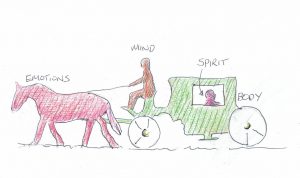 I’ve been aware since the early seventies that the holistic model was taking root in the mainstream. There is much more attention paid now to physical, emotional and mental health as ingredients for wellbeing. The many areas of personal growth and human potential have been explored heavily since the sixties and have created a whole new alternative culture that is quite familiar in this community. A mental approach to living now seems out of touch with nature, creativity, emotions and physical health. In the Ouspensky model (see below), the suggestion is that if the driver (mind) sets the pace, (s)he will overwork the horses and they will rebel. And yet the entire model of our modern society seems mentally based. What are capitalism or communism if not purely mental models? Both seem to make no room for feelings, no room for selfless service, no room for nature except as a raw material for products. To answer the challenges of the future, we need, in my opinion, political systems that are holistic and spirit led.
How does a spirit-led model influence the course of the world
If we move to a spirit led model then we are moving away from mainstream culture into a much more interesting and I think evolved way of living. Almost all the really good, interesting, and ecstatic moments in life are on a spiritual level – we just may name them differently. To put it another way, the realm of the Higher Self is the place where life becomes worth living in my opinion. Example of where mind takes a back seat can include things like listening to favourite music, watching a sunset, spending a day in seclusion in nature, seeing a baby born, and having an orgasm (though not necessarily in that order).
However, what demands attention first is Abraham Maslow’s hierarchy of needs. He suggests that human beings have needs in this order: physiological (food and clothing), safety (job security), love and belonging needs (friendship), esteem, and self-actualization. Needs lower down in the hierarchy must be satisfied before individuals can attend to needs higher up this pyramid. Self-actualization is high up in human needs and assumes we already have enough to eat, good homes and a society free from oppression. We are very lucky indeed here that we can attend to self-actualization but we need to keep awareness, compassion and ideally a helping hand for others who don’t have their fundamental needs met – and this includes many, many people on the planet right now.
Spiritual Practices
If you live in the Findhorn Community you will need a spiritual practice. No two ways about it. The reason this is so vital is that it is entirely possible to live in the realm of the mind and thoughts and never go beyond them except by accident. But the spiritual realm, the realm of the Higher Self is revealed when the mind goes quiet and it is no easy task to get the mind to quieten down. Like my favourite game, tennis, it takes practice. It takes dedicated time. It takes some discipline.
Meditation
I have been meditating (with a break of a few years) as a daily practice since 1973 and, strangely, I feel no better at it than I did when I started. I’m just able to accept whatever it throws up much better than I did at first. But it still seems to me that meditation is the most direct and accessible way to either find directions from the higher self or, if those aren’t forthcoming, to see the patterns and thought forms that the mind throws up and to disassociate from them. These aren’t always telling you the truth and frankly, the unapplied mind is a poor guide through life. Here’s a little story to illustrate that. A man borrows a hosepipe from his neighbour with the request that he returns it by the weekend when his neighbour will use it again. But come the weekend the man forgets about the return deadline. Midway through the next week he remembers he still has it. A scenario runs through his mind – he will take it back, his neighbour will answer the door and be upset with him about its late return. He bundles up the hosepipe and, on his way to return it, he starts to resent the telling off he assumes he will get. Who is his neighbour to treat him like that? What right does the man have to be so indignant? He is not perfect by any means, he has his faults too. By the time he reaches his neighbour’s door, our hero has worked up a head of steam. His neighbour answers the door and before he can speak, our hero hurls the hosepipe at the man’s feet and says, “and what’s more, you can keep your bloody hosepipe!”
Communal meditation, meditating with others is a hugely valuable part of this community. It not only helps personal practice and, in my experience, is often a stronger experience. Meditating with others every day is my favourite way of keeping up this practice and having a set time and place helps to avoid the temptation of your mind finding ways to wriggle out of doing it! By the way, I think it is essential to have a technique when meditating – a technique to bring the wandering mind back. A mantra, or following and counting the breath at least at the start. Get some teacher to show you if you are a novice.
Service
Service is a great thing. And if you do service for your community you create a win/win scenario. Others benefit but you benefit too. Eileen Caddy called it ‘work as love in action.’ Yes, indeed. And service is not dependent on the action but is much more dependent on your attitude. You do it to alter your own consciousness and in the process you might create a fine meal, plant a garden, organize an event, build a village, change the world. But there are one or two things I’ve discovered in my love affair with service. You can either offer your service for free or earn money from it. It is the attitude with which you approach it that counts, not the lack of cash. (read Zen and the Art of Motorcycle Maintenance to discover how crucial your attitude becomes when tackling any task, however humble) And, for the same reason, you cannot assume that because you are doing a ‘worthwhile’ thing that it will be service. Love in action. Need the love part first or, if you are feeling particularly under the weather, you dedicate your perhaps less than loving frame of mind from the start. That’s what I do anyway.
Nature
Being out in nature or working with nature in your own garden is a great route to a calmer mind. Co-creation with nature is emphasized in this community and this is manifest in the many wonderful gardens around the place. The whole idea behind co-creation is that you work in harmony with nature rather than trying to subdue it. You recognize that the force behind all nature is the same thing that is inside you. You are a part of nature and your ‘natural’ part is found in your Higher Self. I’m a fairly useless gardener but I absolutely love walking on one of the many trails around Moray, or along the Findhorn River or by the coast on the Moray Coastal Trail. Immersion in nature is a consciousness changer and ultimately that’s the point for me. The fact that it keeps me physically fit is a bonus.
You may notice that all three basic practices – meditation, service and co-creation with nature ultimately do the same thing – they change your consciousness and put you in touch with the Higher Self – the God within.
Holistic Practices
Mind
The applied mind is a wonderful thing. It can create and invent. It can solve problems. It can write books or spot the faults in a car engine, create software, calculate the stresses on a building in advance. It defines us as human beings. However the unapplied mind – the monkey mind – the ego – is a nuisance that loves getting us into trouble. I’m bored so I have half a packet of chocolate biscuits, take up smoking, break open the wine, get a heroin habit. My unapplied mind wants something to do and it really doesn’t care if those things are ultimately no good for the whole of me. In addition, it projects my own faults onto others. It finds an argument, starts a war, decides that ethnic cleansing is a good idea. It is the brainbox who decided that nature was to be conquered and the human race can milk the planet indefinitely. This is why we need to move to finding a spiritual basis for living. We need a better direction-setter for this carriage. Our practice should be to discriminate between the applied mind and the unapplied one. Our practice should be to make directions and take decisions by consulting the higher self. On a daily basis. For everything. We should be looking for the small, still voice within that Eileen Caddy calls it. And once we find that voice, we should follow it. Actually, I don’t hear a voice but I do often get an intuitive sense of what to do next. And if I’m not sure, I slow down and take time until I’m more clear. I try to ignore the urgency of the mind. If I can, I meditate before I make that choice.
Body
Keeping the body healthy is fairly widely understood and written about. A balanced diet (lots of natural food), exercise reducing stress, tackling addictive behaviour and so on. However what is less written about is how to exercise, the body and deal with the monkey mind at the same time. For instance when I go the gym and do reps on equipment I tend to get a bit bored. When I go for my walks I don’t. And when I play sports I’m banishing the boredom too. My sport, tennis, is a game that has techniques, sophistication, grace and fluidity that can override and banish boredom. I play it with others and enter into a relationship with them because of it. And it keeps me fit. Keeping our bodies fit is part of our holistic practice and sport is part of my practice too, mainly because it takes care of my monkey mind. So much has been written about taking care of the body, I hardly need to repeat it here.
Emotions
As an Englishman brought up in a middle-class, suburban household in the sixties and early seventies, I was almost bound to be emotionally repressed. And that’s exactly the way it turned out. Emotional expression wasn’t encouraged in our house and the one emotion I saw revealed the most frequently was explosive anger. It was the way my parents broke free of the emotional straitjacket. When I left home I was not an emotionally balanced person. I had work to do. Fortunately, I discovered the world of alternative therapy workshops that were available to me in Manchester, my home town. I am particularly grateful to John Heron and his work with Co-counselling that became my most useful tool when getting a practical understanding of where my emotions were and how to express them safely. I learned much more about my own anger and how it was often a gateway to real grief. Eventually I could even express that grief. What progress! Much later, I took part in the Hoffman programme which proved to be a hugely useful way to experience past hurts, understand where they came from, and ultimately to forgive my parents. I’d recommend it if it wasn’t so damned expensive and hence such a tool of privilege. There are lots of therapists in our area and it is good to make use of them. The work never stops. If you are living with a weird or repressed emotional response to life then this will impede your spiritual progress. You can’t just brush your emotions under the proverbial carpet because community relations will bring them out into the open again.
Living in community we need an understanding of our own emotions. For instance, I needed to tone down my own easily-accessed anger because of its negative effect on others (and I’m still working on that one!) I needed my colleagues to read the emails I wrote when I was angry, to point out their ‘edges’ and to then leave them as drafts for at least a whole day before I inevitably edited them. I had to learn that my existential fear of a loss of control was a response to my upbringing rather than an appropriate response to my current life.
In the Ouspensky model if the emotions are tightly curbed by the mind (the driver holding the horses reins too tightly) then the horses will not be happy and compliant. They will not be willing to pull the carriage smoothly. A poor relationship between my mind and emotions is the defining story of my early life. It’s a defining story of the human world.
Relationships
When Malcolm Hollick and I were trying to outline the spirit-led curriculum for Higher Education, Malcolm came up with the notion that the holistic model had five subdivisions: Spirit, Mind, Body, Emotions and Relationships. The ‘relationships’ part is how we work in community. It is how we relate to others. It is how we develop human systems of fair governance and power-sharing. It is how we work together to celebrate, to look after the elderly and infirm, to raise children in a community setting. It is a big deal. And I believe spirit-led systems have an evolution – that the human systems can get better if we allow them to evolve along with us.
This Community as a Support
Up to the Individual
The community can be very supportive of your aims if you want to deepen your relationship with the God within. But it won’t give you those aims. That’s the bit you have to do for yourself. Find those aims for yourself and do that ideally before you move here. You have to have a plan and a practice, and then the community can be of benefit. It won’t give you the plan, it won’t give you the practice. It won’t stand over you like a parent making sure you do the work.
Power of groups
One of the great things I learned whilst working for the Findhorn Foundation was the power and effectiveness of the ‘attunement process’ Let me explain. Working groups would ‘attune’ in the following ways – meditate together, do a round of personal sharing and then plan their business. This was the major attunement of the week and would take a half day. And it was well worth it. The smaller sessions of tuning in together before every work shift – a moment of meditation, a brief sharing often characterized by holding hands in a circle was also great for group building and reminding each person why they were working.
The great thing about this process is that any group can do it. This is terrifically empowering for small groups who have a project in mind. I think of the recent work on the stone mural in the paving outside the Phoenix Café. This was done as a conscious act of service, a proof of work as love in action. At one point I looked over to see who was working on it when it was half-way through, and I saw three or four community members, all over 75, busy on the project. We can do community projects at any age. We can serve at any age but our service is much more powerful if we group together to do it. And we have a tried and tested methodology in the attunement process. Why not use that now on something you’d like to achieve for the benefit of all? All you need are four or five willing helpers and a methodology. That’s how this community
was built in the first place.
Challenge area – money
There are challenges to our evolution in this community and they are worth highlighting or, better still, solving. Unacknowledged wealth is one of them. I have been here so long that I naturally got poorer by working for so long on the minimum wage when, if I had stayed in Higher Education, I would have had a different life. (No regrets though). So, I now find myself as one the community’s renters rather than a home owner and, as such, I’ve been allocated a flat in one of the social housing groups in West Whins. I pay a social rent rather than a market rent and for that I’m grateful. But I notice money and I notice the discrepancies between the home owners and the renters. I notice when money has a bearing and when it doesn’t. For instance, when there was talk of raising income when I worked in the Foundation, I often heard the argument that we are not here for money. That we are not here to get rich, we are here to serve. And if that argument was put forward by someone who obviously had plenty of private money, maybe their own home and a home to let, then the argument had much less weight because it was not acknowledging the rank that money is giving the person saying it.
Challenge area – housing
The lack of affordable housing within the Park is a challenge area to a sustainable community. Housing prices in the Park match those in Findhorn village and the latter has, reportedly, the most expensive property in Scotland outside of Edinburgh. The community would do well in investing in more affordable housing particularly rental properties. If more housing was let at an affordable rent governed by what Moray will pay in Housing Benefit (currently a max of £425/month for a single person) then more young people could be attracted to live here. If the norm was to rent out property at an affordable rent rather than a market rent then this shift would really help to include younger people. What about it landlords? Another great project would be a scheme to invite those with money to invest in low cost housing and let the dwellings out at an affordable rent. This is a real win/win scenario – the investor gets a decent return on their money (at a time when interest rates are tiny) and the community and particularly younger people get affordable housing.
Challenge area – written rules like Common Ground
There is nothing wrong with the rules in the Common Ground statement other than the fact they are written. Eileen Caddy always used to tell us to go inside to get our direction. She didn’t say read a rule book. The Common Ground statement is an external set of guidelines and as such could (if we let it) take our attention away from finding answers to questions within. It could undermine that practice if we assume all we have to do is to obey written guidelines. However, the guidelines in Common Ground make perfect sense to me and seem sound. I just don’t assume they are my method for negotiating a path through this community or through life. For that I need an inner connection and a way to intuit my next direction.
Challenge area – expecting no conflict or perfect agreement
I’ve met a number of folk who assumed that in a perfect community there would be perfect harmony with no disagreements or disharmony and this is the state we should be aiming for. In practice conflict here is common. I’ve been involved in lots of conflicts and this has frequently resulted in supervision with a trained therapist who can work with conflict. In the words of Arnold Mindell “conflict is neither good or bad it is just inevitable.” Conflict can be a great teacher and should be treated with respect and learned from. No point in trying to avoid it or assuming it shouldn’t be present here. Need I mention the incinerated buildings folks!
Challenge area – role of the FF
The role of the Findhorn Foundation used to be central to the community. Now I’m not so sure that it is. The FF has shrunk down in size and seems (from the outside) to be pursuing a corporate, top-down style that doesn’t sit well with a lot of community people. In my opinion, the FF had a chance to move into a new organizational culture and instead seemed to slip backwards into the older and less evolved corporate style. (Dear FF folk, that’s how the FF now looks from the outside – orange in Spiral Dynamic colours – feel free to correct me if you think I’m misreading this). Maybe it is now up to the wider community to pursue a new model which will welcome autonomous groups getting on with their own projects.
Service Projects
One legacy from the work of the older Foundation is the sense (for me) that a new cultural direction is opening up. I spent a lot of time looking at the ‘green’ culture of the FF and was waiting for it to evolve into the ‘teal’ culture that was emerging on the threshold and ready to come in. Let me explain – these colour schemes are used by Integral Theory or Spiral Dynamics to explain and define how organisational culture can evolve. The ‘green’ culture (nothing to do with good-for-the-planet green) is characterised by equality and inclusion. It has negative characteristics – it can disempower the individual and decisions are slow to arrive and the process of making decisions is cumbersome and wears you out. The ‘teal’ culture keeps the positives of ‘green’ and makes decisions and actions easier by devolving them out to self-empowered groups. The ‘orange’ represents a corporate, top-down style structure and is one level below the green.
So – here is our opportunity. We can use a grass roots movement to start to move into the teal culture. As community members, we set up our own service projects and invite or friends and neighbours to join us. Either that or we join another project that we like the sound of. We can use the attunement structure (already defined here) to dedicate our actions and then get cracking using dedicated service to both change our consciousness and to take the community forward into a new era. No use in waiting for someone else to offer the new direction – we have the tools, we have the structure and the experience so let’s do it now. Let’s do this in small ways in small groups.
Here’s a possible method:
– advertise your own idea for a service project or join someone else’s.
– set up an attunement group of around 5 people.
– set an initial time scale – five weeks is a good start and if the project is longer then recommit after 5 weeks.
– Set up an attunement process. Rotate the location (each other’s houses and flats usually). Rotate the person holding the attunement and the agenda for that week. Meditate together briefly and use personal sharing to acknowledge and include your emotional life. Make time for the business of that week – the practical planning you need to do to get your project grounded.
– Commit to what you know you can do personally.
– Dedicate your project to the higher good.
Easy peasy. Anyone can do it. If we have a spiritual practice, service projects will help us and make us stronger. In addition they will offer some positive practical results and will help this community evolve.
Dave Till
Feb 2022

Dave Till is a community member since 1992. He worked for many years in the Universal Hall and helped to form the Findhorn Foundation College. He has an ongoing interest in holistic education.





Really interesting, informative and inspiring article Dave.