


The Findhorn Garden Story has captured the imagination of many people ever since Peter Caddy started to talk about it during his travels around the UK in 1965.
This post tells the story of the publication with that name.

In the late 1960s the fledgling community had started to send out booklets such as God Spoke to Me by Eileen Caddy as well as photocopied guidance by Dorothy Maclean. In 1969 the setting up of the Findhorn Trust allowed for more formal publications and this included The Findhorn Garden Parts 1-4 An experiment in the co-operation between three kingdoms. It was a lovingly produced book of almost 100 pages with beautiful line drawings. We are so pleased to have this historical gem in our eBook Library (Please click on the title above).

By the mid ’70s the community had grown dramatically and it was time to reflect that development in a new edition. THE FINDHORN GARDEN Pioneering a New Vision of Man and Nature in Cooperation was first published in 1976. Whilst a similar thread was maintained, it was expanded significantly and also contained writings by David Spangler and a ‘sequel’ describing ‘The Garden Today’. A large number of black-and-white photographs documented community life at the time.
The book was published by Turnstone Books/Wildwood House Ltd. in London. Anniese Worth Guintini remembers the trip to London for the book launch in her chapter Unbelievable Love: The I.C.A. Institute of Contemporary Arts [in London], is an impressive building that looks like a palace and stands at the end of the Mall, […] As well as being the perfect venue for the newly published book launch of the ‘The Findhorn Garden’, Peter thought it should be a lecture format, an audio visual followed by a panel discussion answering questions from the audience, but at the last minute he felt an injection of creative energy by P.A. [Performing Arts] would enhance things and invited us along. Only ten days before the 26th, a small group of us met, Michael, Ian, Andrew, Simon and myself. Ian suggested we take a small section from the book and create a short multimedia presentation with slides (Simon,) Music (Ian), narrative (Andrew) and dance (me.) The theme – our relationship with the Devic realm, we were inspired by this idea and duly, the inspiration began to flow.
In the front of the book we read:
THE FINDHORN GARDEN book is an expression of the love and energy of the entire Findhorn family. Except for the final printing, all aspects of the work have taken place within the community. This has given many of us the opportunity to participate directly in the alchemy of the creative process.
And the back cover states:
Since its founding fourteen years ago, the Findhorn Community in the north of Scotland has attracted attention – from curious horticulturalists to ordinary folk in search of spiritual regeneration.
This book is the Community’s own story (with 150 remarkable photographs) of the transformation of an offbeat group producing extraordinary vegetables on poor soil, into one of the world’s most successful New Age communities.
The Findhorn Community has demonstrated, through its cooperation with the spirits and energies of nature, that it is love which nurtures plants as well as people.
THE FINDHORN GARDEN became quite legendary – and more than one community member would recount how this was the book that fell into their hands/jumped off the shelf in a bookshop … and represented to them the ‘call to Findhorn’. One of those was Alan Watson Featherstone who writes in Love, Magic & Miracles – Accessing inner wisdom and power: “I came to Findhorn having been inspired by The Findhorn Garden book, and specifically the experience of communing and co- creating with the intelligence and consciousness within Nature.” That inspiration continued, so much so that Alan had a part to play in the next major revision of the book.
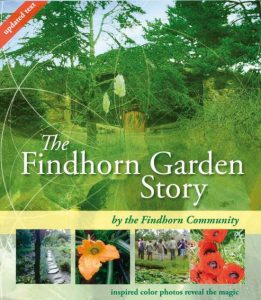
In 2008 a new edition was published by Findhorn Press and this is still in print in 2025. Whilst the text is presented as it was in the 1975 version, a chapter by Alan Watson Featherstone entitled C0-creation with Nature in the 21st Century gave an idea of more recent developments in the community and how they related to movements in the wider world. Many stunning colour photographs by Adriana Sjan Bijman also added a whole new dimension.
This edition is still in print and available: in the UK Amazon is the easiest way for most UK customers to find the book online. In the US: please go to the Findhorn Press website, Findhorn Press now functions as an imprint of Inner Traditions.
***
As was common at the time, in the book (and therefore in the above quotes) the name “Findhorn” was used to describe the Findhorn Foundation Community. We acknowledge that Findhorn is the name of the traditional Scottish village and we apologise to our local neighbours for the upset this appropriation of their name may cause.

Inspired by CommUnity, a group of NFA volunteers, manages this website. Hearing each others stories, and learning about the history of this community can help us all to find more cohesion and a sense of belonging. Read more.<


Leave A Comment