

 ARTS, MUSIC, DANCE AND THEATRE

50 Years of Participatory Sacred Dance
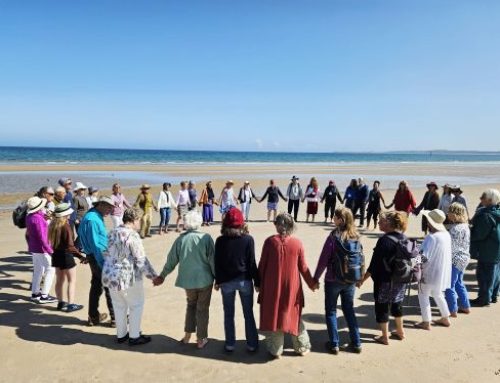
I believe you can tell the health of a community by how much it dances. Traditional communities, who live close to the earth, dance at times of birth and death, sunrise and sunset, sowing and harvest, marriage and fertility festivals. Here at Findhorn dance is also used at such occasions in the Community’s cycle.

Peter Caddy was a keen Scottish country dancer and ceilidhs were a regular part of life at Cluny when it was a hotel. In May 1975 Peter Caddy met Bernhard Wosien and invited him to Findhorn telling him, This is just what we need up at Findhorn. As Sacred Dance developed and eventually moved outwards from Findhorn it took the Community’s way of attunement, sharing and blessing out into the world.
The Sacred Circle Dance community is a worldwide tribe of dancers who share deeply at many levels. The Dance Camp movement in the south of Britain from the mid-1980s onwards did much to focus and develop this community of dancers. After participating in a Findhorn outdoor ritual which involved taped music, Kate Hollingberry (later O’Connell) vowed that she would create a band so that never again would taped music have to be used at such events. This led to her initiating the Festival of Sacred Dance, Music and Song in 1991 which has always had live music at its heart.
At the same time, supported by community musicians, I began to celebrate the Celtic festivals, beginning with a Brigid celebration in the Universal Hall in 1990. After some events in the Hall, particularly those which incorporated Ecstatic Dance to live music, I invited people to sleep in a circle in the Hall and awaken in the morning to share their dreams. One older community member shared, “I saw myself as a shriveled up loaf or cake, but in the dream I cut a slice off the end and saw that inside I was moist and rich and able to provide nourishment to others.”
 Today we offer Sacred Circle Dance, 5Rhythms, Biodanza, Astroshamanic Trance Dance, Ecstatic Dance, Tribal Belly Dance, the work of Anna Halprin, Contact Improvisation, Ceilidh Dance, Feldenkrais or just celebrate the movement of the body in free disco dance. All these forms have international tribes whose members pass through Findhorn to teach and learn. In 1972 David Spangler received this from Saint Germain: At some point in the fairly near future the art forms (created here at Findhorn) will reach out into the world to communicate the New Age vision.
Whilst it is not necessarily true that Findhorn has developed new art forms I think Findhorn’s contribution to the worldwide dancing tribes is considerable. As the Zuni people of Turtle Island say, We dance not only for ourselves, but for the good of the people.
Peter Vallance

Digital Routes is a web design and development company based in beautiful Lossiemouth on the Moray Firth of Scotland



Leave A Comment