

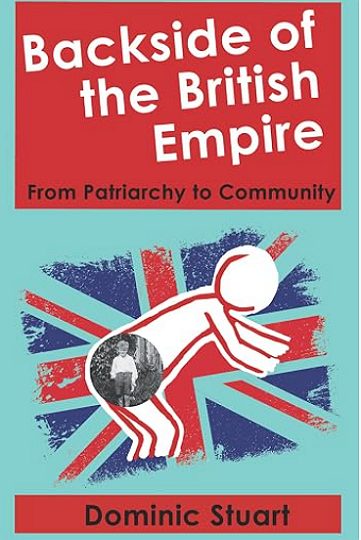
Editor’s Note: This post gives the last chapter from Dominic’s memoir Backside of the British Empire describing his return to Findhorn and his leaving to live with his wife Gay on Salt Spring Island.
***
I have been living out here for the last year, having travelled back and forth between Vancouver and Britain since 2016. I live with my wife, Gay, and our dog, Lucy-Fyfe, water access only, between forest and ocean. Back in 2013, I managed to buy a house close to Findhorn and reconnect with the community. The community had just celebrated its fiftieth birthday.
From 2002, and the onset of M.E. (Myalgic Encephalomyelitis), I had continued to live in East Dulwich, south-east London, almost as a recluse, barely able to do more than walk round the block or go to a local shop. For several years, I couldn’t even do that. I developed friendships with kind neighbours: Bennie and Lorrayne, who shopped for me regularly and would welcome me into their home, David, who hung out with me in my flat and regularly drove me to Peckham Rye Park, Cecelia, across the road who gave me drawing lessons and my friend Robert, who flew in from Australia every summer and stayed for a month. I continued with my analyst Billie, and to explore the healing of trauma and abuse held in my body through recovery programs. Another friend, Arianne, from Australia, helped me to travel up to Scotland and stay there, initially for a month. I hadn’t been up there for seven years.
My sister Vanessa picked me up from Inverness Airport to take me to stay in her house near Forres. When her son, Joe, saw me, I hadn’t seen him since he was ten years old. Now he was seventeen. He welcomed me with the words: “Holy fuck, it’s Uncle Dominic!!”
The move to Scotland took a huge effort for me. At first, I could barely do more than lie down, with the occasional trip out. My stepmother Marian was living up there. Our relationship had been rocky for years. By now, I had enough inner strength to build a more honest relationship with her, beyond all the barriers which I had put up in order to heal. I was privileged to be with her when she passed away in 2017, having struggled with lung cancer for several years. Similarly, I was more able to build relationships with my siblings. Some of my old friends, and many new ones, in the Findhorn Foundation community, came into my life. The community had aged along with the people in it. Gone was the youthful dynamism of the ‘70s and ‘80s. By the 2020s, challenges were coming thick and fast. Through these challenges, a close group of fine, mostly older, people were determined to preserve and develop an eco-village and spiritual community in line with the principles laid down by the founders fifty plus years earlier.
It was heartening to be around. The Covid pandemic had a pretty devastating impact on the community. Their income was decimated because people could no longer travel to attend their courses. Staff had to be laid off and one enraged ex-employee set fire to the community centre and meditation sanctuary, burning them to the ground. It was miraculous that none of the neighbouring bungalows caught fire as they would have gone up like tinder boxes. The community allied themselves to the image of the Phoenix rising from the ashes, even making a mosaic depicting this in front of the Universal Hall. Now, within five years they have a new, much more permanent Sanctuary building, and are refashioning themselves to embody their vision and message in a World which cries out for such centres of wisdom and hope.
All of these factors and many more, including reconnecting with my roots in Moray and the beautiful proximity of Findhorn Bay and village, all contributed to my gradual recovery of health. It wasn’t a linear process. There were many fluctuations. Trauma healing techniques such as Peter Levine’s Somatic Experiencing, Ashok Gupta’s Amygdala Retraining for Chronic Illness, Eugene Gendlin’s Focusing, along with Psychodrama and Playback Theatre, and my work with Billy, underpinned by the twelve-step community, have all been vital ingredients in my healing. I also benefitted for years from homeopathy, despite the allopathic myth that it doesn’t work. While still in London, I had spent many hours in Chi Gong postures and movements, barefoot in my local park, connecting with the earth, and always feeling energised and revived afterwards. Sometimes I just sat and enjoyed the trees.
Having once returned to live in Moray, I was soon lulled into a sense, once again, that I would remain close to Findhorn for the rest of my days. Then a letter fell through my letter box with a Canadian stamp. Somehow, I knew that it was from Gay, whom I had met in an Experience Week in the community thirty-six years earlier. She had separated from two husbands in that time, given birth to a son from the second marriage and now had two young grandsons.
After eighteen months of contact by email, phone and Skype, Gay flew over from British Columbia to visit. By this time, we were in our late sixties, and the magic was still there. Despite living five thousand miles apart, we decided to explore a couple relationship. She visited again five months later, and we travelled down to Cambridge to meet my sister Serena, along with her husband Malcolm, their two daughters, and one son-in-law. To celebrate one hundred years since my mother, Grizel’s, birth, we visited the little graveyard in Longstowe, near Cambridge, and Longstowe Hall, where Dicky’s school had been evacuated during the WWII. It was also where my grandfather, Theodore Fyfe, had drowned in the lake next to the house. Serena hadn’t been back there since 1947, when she was nine years old. The three cherry trees had been cut down. The graves were only marked with one small War Grave for Serena’s father, so we planted lots of spring flowers on all the graves. It was a deeply touching experience, particularly to have my mother’s two grandchildren, Jessica and Flora with us. There are now five great-grandchildren. Her legacy.
The following year, I travelled to Canada. This was only possible for me thanks to Airport Assistance provided at all of the airports. Gay met me in Toronto, and we visited my original nanny, Edith, now well into her nineties. She entertained us lavishly, saying: “I have plenty of money. I can’t take it with me.” She had received hundreds of thousands of dollars in compensation from Holocaust survivors’ funds. After that I travelled on to Moss Mountain, Gay’s water-access-only home on Salt Spring Island, close to Vancouver Island—in fact we can see it clearly from the house across the Sansum Narrows, a narrow straight.
The Findhorn Foundation community was founded on a belief that there are invisible allies available to assist in our work and our lives, on planes beyond the physical level. Originally, it was the devas and nature spirits with whose help the community was built, particularly in the gardens, but not just there. There is a core belief in a life-force in everything—trees, rocks, houses, machines—all of which can be attuned with and blessed. A group of members left the community in 1973, moved to north America and formed an association called the Lorians. A central teacher in this group, David Spangler, has received much material from what he calls “subtle allies”, and has written many books on how we can partner with these allies in more balanced, wholistic consciousness and attitudes in a very troubled World. I have a strong resonance with these teachings where the Divine, or Sacred, is seen as beyond any specific religion, and with which we can attune, or pray, and co-create in our lives if we choose to. It means that even in our homes, whatever our physical state or limitations, we can make a contribution to creating a better world.
And inwardly, it can be very rewarding. I am discovering that I can consciously work with the trees in the vast forest here as allies to bring greater harmony in myself, and out to the wider world. Canada may not be as powerful economically or politically as our neighbour to the South but it has huge power in terms of natural resources and energy, physically and subtly.
In August of 2025, my brother, Andy, died.
As the sister who informed me on the telephone told me that “it was intentional.”
Andy had grown into a handsome, tall, strong, athletic and extremely talented man. He was sent away from our home in North Wales to Langton aged seven. He hated it there and felt that he was scapegoated because he was my brother. He didn’t pass his Common Entrance exam to Eton and went to Stowe. That gave him a sense of failure even though from my perspective Stowe was a superior school to Eton. Certainly, more liberal and informal, including with girls in the sixth form. In his mid-twenties Andy started a restaurant in the small Scottish town of Forres, with seriously good food and an ambitious menu. When, after five years, he discovered that it was very hard work with very little financial return, he turned his hand to juggling, developing into an accomplished professional juggler, clown, unicyclist and fire eater. All self-taught. He performed around the World. From France to Crete; from Dubai to Southern Africa, Andy entertained crowds, in the streets, at events and festivals, and, especially, at children’s parties. His childhood hero, Tommy Cooper, shone through his personality. Unfortunately and increasingly the darker side of the creative person came along too. The family patterns of addiction took hold. Apart from that he was taking a toll on his body. Crashing down from high unicycles, possibly also from repeated bungee jumping, damaged his body, mainly his hips. He was in a lot of pain, living in harsh conditions and finally decided that it was all too much. He left behind him a lovely son and two grandsons, a family and friends; all of us feeling a deep sense of sadness and loss. I couldn’t help but notice that men in three consecutive generations in my family had, for whatever reason, decided that life was too much for them. I am also left with an abiding sense that although suicide was his choice, I could have done more to love and support him as an older brother.
This year, 2026, is the fiftieth anniversary of my joining the Findhorn Foundation community. Life here on Salt Spring Island is very quiet, with an abundance of nature—seals, sea lions, eagles, ravens, otters, hummingbirds, the occasional whales in our front yard, with dense Canadian forest behind. Periods of rough weather, power outages, water shortages, and the need to travel out by boat keep us on our toes. Having spent forty years of my life living in cities, it is restorative to body and soul to be here. It reminds me, in many ways, of my life in Scotland, particularly Mull, in the 1970s. M.E. still accompanies me, and yet it has mostly faded into the background. The old patriarchal, boarding school, abuse-inculcated patterns persist and surface at times.
The backside of the British Empire is giving way to the greater powers of recovery and healing, the company of a patient, wise partner and wife, and the beauty of maritime British Columbia.
***

Click here for Dominic Stuart’s memoir

I come from a Moray family, although I grew up primarily in England and North Wales. I first came to Findhorn in 1951 and it has been a constant in my life ever since. I love Findhorn, in all its many facets. I joined the Foundation community in January 1976, and left to live in London in July 1979. I worked in business in London. mostly green businesses, and later as a green financial adviser. I burnt out with ME in 2002. Since then I have been involved in writing, and trauma healing, initially for myself, and later with others.


Leave A Comment