


This article was first published in One Earth magazine No 7 in Summer 1979.
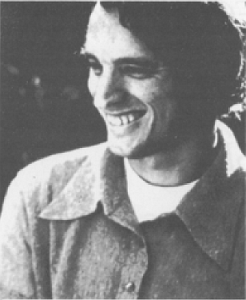
David Spangler is a philosopher, educator and writer on New Age themes. A resident of Findhorn for three years, he is presently founder-director of the Lorian Association in North America. He is the author of several books, including ‘Revelation· The Birth of a New Age’.
I am not an economist, but I am very interested in ourselves as spiritual beings and as physical beings attempting to function with wisdom, with balance and with wholeness. I would like to begin by talking about the way of the spirit and use that as my lead-in to a consideration of economics.
Consider what the challenges of the spirit may be. Consider yourself as a point of infinite potential and possibility. Consider yourself as a radiant kind of manifestation, somewhat like an inexhaustible Arabian oil field. You are the source of energy, not its consumer.
You are then faced with two particular problems: first. how to be a human being who is a focused, personalized, partial expression of your wholeness; second, how to be a human being on the planet Earth – which means having to take into account the will and directives of this world, what it is trying to achieve.
My soul did not create the entity called human-beingness, it is simply energizing it. Somebody else had the idea first of creating the human species. Without following that idea back too far, we can say that our world had this idea. In some way the human species fulfils a function within the beingness of our planet. So, when I as a soul attempt to relate to this world and to being a ‘persona’, when I am attempting as a soul to establish my branch office down here, I must take into account the conditions by which this branch office itself has become necessary. What is Earth attempting to do?
One way of looking at this is to say that our world is attempting to individualize itself. I am drawing on a human psychological analogy by which we learn to become thinking, reasoning, wilful, aware, loving, wise, whole, functioning individuals and suggesting that our planet may be going through a very similar kind of process. Our particular part of that process we call human history and human evolution.
I don’t want to make all this too esoteric but simply suggest that one of the experiences of the human species is to learn to think on behalf of our planet, or to think on behalf of wholeness. So there is a ‘pressure’ upon the human species which does not originate within its own boundaries. It is not something we are doing to ourselves as much as it is something which is happening within us and to us as a species, as part of an evolving world: and that is to learn how to think, act, feel and be in a state of wholeness with each other and with our planet.
Within that framework my soul faces the challenge of individualizing itself through me, so that in some fashion David Spangler becomes a reasonably well-focused, well-balanced, well-manifested expression of this greater energy – and can do so in a way that fulfils not only my own personal needs, but also the needs of all my species and of all my world.
The soul is involved, therefore, in a real process of economics. It 1s involved in the task of taking X amount of energy, working with it to externalize a human individuality, and setting up a resonance between me and itself so that there is a flow of energy, a flow of being, a flow of life between us. Hopefully, this investment of its energy in relationship to the Earth and the environment will generate enough profit, enough overflow, that it can relate to other people in a way that fulfils the desires, the will and the purposes of Earth.
The soul is attempting to externalize us as points of focus within the body of the Earth. The Earth is attempting to externalize us as something like cells in the brain – a point relating to other points to create a larger whole. I call that process ‘universalization’. There is an impulse acting upon us to break down our individuality in order that we can then relate without barriers so that at some point along the evolutionary chain we can all begin thinking, feeling and acting in resonance in order to manifest the wholeness of this world. This does not mean that we will all think, feel, or act the same, but that whatever our thoughts, feelings, and actions are they will come out of a resonating commonality.
Here a subtle balance is required between the forces of individualization and the forces of universalization. If I become too individualized, I may become so bound up with the forces of my particular focus – forces of desire, forces of self-identification, all the economics of building a self and establishing my boundaries between my self and the not-self – that those boundaries become a fortress to me and I become isolated. This isolation is not only in terms of me and my world but also of me and my soul, like becoming enmeshed in a shell.
On the other hand, I may become so attuned to planetary processes, to the universalizing processes, that I do not become a truly individuated person. My edges are too fuzzy, or certain parts of me are incomplete. I may be very developed on mental levels, but not very developed emotionally, or vice versa. I may be wholly a thinker, but not very much a doer, or vice versa. I may tune in to an energy of outpouring, planetary bliss and good fellowship, where I am very open to the forces of group-think, but do not manifest myself as an individual thinker, feeler and actor. I may simply sway like a sea-weed with the currents of whatever thoughts and feelings are moving through my society or my planet. At the extreme, I may simply bliss out into realms of spiritual glory and lose touch with the reality of being a human being.
So the challenge of my soul is to strike a balance between the energies of individualization and involution (which are the energies of accumulation and condensation), and the energies of universalization and evolution (which are the energies of release, of sharing, of expansion). How to be limited and limitless at the same time – this is the basic, paradoxical challenge of my soul.
In the spiritual traditions, the human soul goes through a process of involution where its primary interest is to accumulate what it needs in order to get this focus, to have definition and individual beingness. Then it reaches the bottom of that [involutionary] swing and begins to move to where that [individuality] becomes synthesized within itself. It becomes nourished; it becomes dynamic; and then, like a seed, it wants to unfold, to give. This is like a person who has a great ‘need’ for wealth, and puts all his or her energy into success, accumulates money, possessions, literally condenses himself or herself into consumption and ownership. Finally that person is satiated and reaches a point where this no longer fulfils him. He or she begins to become unattached, to use his or her wealth, wants to give it away, invest it, release himself or herself of possessions and become freer, more mobile, more expansive.
Hold, for a moment, these images of the soul as meeting this challenge of finding the middle path between creating a focus through which it can function, and yet that focus in turn being part of a universalizing principle, part of a larger world to which it owes its energy and from which it receives energy. It is an economic unit in the broadest possible sense.
Let us now shift our attention to something that deals more directly with economic experience as we usually think of that term, in the sense of the manifestation of financial relationship. In the United States, I have the pleasure of working with a group called Community Service Incorporated, which was founded by Arthur Morgan, one of the leading figures in American education. He was a president of Antioch College, which has the reputation of being a pioneer in a more open and progressive educational philosophy. Arthur Morgan was profoundly disturbed at the destruction of small communities, and at the concentration of power, finance, capital and personnel in cities, large corporations and conglomerates. What he was observing was the impact of the process of universalization, the unfoldment of a new level of social reality out of a previous level which had been characterized by the village, the small community and the small town. He described the impact of nationalization upon these small units in a number of works, one of which is called The Simplicity of Economic Reality.
He saw this process as one in which what had been an individual focus (the identity of the community) was exposed to the next level of universalization (the nation and the planet) through national advertising, through national currencies, through things like the stock market, all of which had a dispersing effect upon the individual community in this way: If I belong to the community and I see advertised a car from Detroit, or milk produced by a national dairy conglomerate, or food shipped from some other part of the country, I will tend to buy these things. So my money goes out of the community.
My educational system trains me, not for community life, but for service in industry, business, cities and in what some call ‘civilization’ – which again takes me out of the community. When I want to invest money, my mind tends to go to the stock market which is in New York or San Francisco, I invest in large national and international corporations, and my money goes out from the community. Also, jobs go out and away from the community. So there is this flow of finance and people out of the community, and when the community looks upon its own needs and attempts to do something about them, it does not have the resources, because very little flows back. If this trend continues it would mean the destruction of small communities as viable economic and social units.
Morgan proposed a number of solutions to this, or practical movements towards solutions. All of them are in a way mirrors of the soul’s attempt and need to individualize. They are all saying: there must be attention given to the immediate environment, to the small economic unit, whether it is the household, or community – and this must be built before you attempt to expand to a national level of exchange.
He draws out of history the example of a period from the 12th to the 15th century when there was no unemployment in Europe. There was no inflation and no recession largely because of the way currency was handled, which was quite different from the way we use currency today. We use our money, this manifestation, not only as a medium of exchange but as a medium of saving. And most of us want to save, which is being ‘into’ the process of involution, accumulation and focus. I’m not saying this is wrong. I’m only saying that we are working with part of the energy that is at our disposal. So we save this, and it goes out of circulation. And when money goes out of circulation various things happen. Many of you know this much better than I, because I’m not a trained economist. But I know what happens to me when my money goes out of circulation.
In the Middle Ages, during the time of the great guild system, money that was saved was taxed, so that it paid to keep money in circulation. Such a proposal was made in the United States Congress, to set up a system whereby all forms of saving were taxed, which would make it impractical for people to use money to save with. Of course, then they find other things, and in the Middle Ages they used land. It was the hoarding of land that helped build up the feudal system. So everything has its pros and its cons.
But during the depression, and this is still going on, there were small communities in the U.S. where the bankers instituted this system. They simply did not allow people to save money in their banks but put the money back into circulation within the community. One way this was done was for the community to print its own money and charge a differential in which it was cheaper to use the community’s money than to use the national money. For example, 10 Scottish pounds would buy 11 community pounds, but it would be more expensive to go from community pounds back into national pounds.
The tendency, then, is to keep money in forms that can only be used within the community and to finance and invest in community projects which build up the economic base, provide employment and develop the community as the economic focus. When the community is strong, it engages in financial interaction with the larger social structure as a whole unit. This is a very interesting concept. It addresses itself to the fact that the tendency of our world is towards universalization, but in a way that disrupts the functioning of the individual.
In the United States – and it’s probably true in Britain, too there is an economic unit which is more powerful, uses more money, and has more capital than all of the U.S. corporations put together. If you lump together General Motors, IBM, IT&T and all their resources, there is still one other economic unit which is more powerful: the American household. In the U.S. there is a developing movement in fact, there’s a book on it called Home, Inc. – to turn the attention of people back to the realization of the amount of capital, investment and economic power that exist in the average household. This ties in to Dr. Schumacher’s suggestion about developing appropriate technologies that a household could use.
At the moment many households do not recognize themselves as a functioning individual unit. They surrender, as it were, to the process of universalization without the balance of the individual focus. So we have things done for us. We go out to the plumber, the doctor. the professional, when not so very long ago the average household did many things for itself. It made much of its own clothing, much of its own food. The father and mother took care of many of the medical chores for which we now would go to a doctor – often with less results.
Throughout our society we see this movement of giving energy out to some larger unit, without the equal, balanced inflow to maintain the individual units. Often, the consequence is that the individual units begin to feel starved and become frantic. The reaction is not towards a balanced individuality, but towards an imbalanced individuality of further greed, further desire – a sense of ‘I must compete and get what I need because I have to in some way resist all these forces that are taking everything from me and concentrating it in centres of power’.
I am overdramatizing this, but I want you to think of economics not only in terms of finance, buying and selling, goods and services, but to think of economics as energy flow, and to think of yourself, your family, your community and your nation each as an energy system. And I want you to consider how these energy systems interrelate creatively.
In the U.S. and Canada, a culture has been created that is very little in touch with the land. An overwhelming percentage of our population lives in cities. Now I feel this is a good thing, in one sense, because part of the challenge of human consciousness is to learn to see itself apart from its world, so that it can then more skilfully integrate with its world. There is an experiment in human consciousness going on as part of our evolutionary process. Part of what we’re calling the New Age is the evaluation of this experiment and its transition into a new way of relating the fruits of that experiment back to the earth.
illustration by Roberto Terra Costa
An example of this would be the New Alchemists, a group in Massachusetts, Canada and South America developing small technology systems which enable an average family to become completely self-sufficient on a very small amount of land. One of the devices being developed by the New Alchemists is a device called the ‘Eye’, which is nothing more than a specially designed pond of water that concentrates light. There doesn’t even have to be direct sunlight, but the ‘Eye’ concentrates it in such a way that in a number of days this water is boiling, and continues to boil and generates electricity. One of these devices can generate all the electrical needs of the average American household, and more.
One of the exciting things about the New Alchemists, when they opened their experimental Bio-shelter on Prince Edward Island off the east coast of Canada (which is a building run entirely by solar energy and wind power), was that they not only generated sufficient electricity for their own needs but fed electricity back into the power grid of the island.
The vision of the New Alchemists is homes which generate their own power, their own food, and generate a surplus so that you have the household generating electricity which it can sell to the community – and whole neighbourhoods of households generating the electricity which the community requires.
At any rate, to run a New Alchemist project requires a return to the consciousness of attunement to nature, but a different kind of consciousness than the traditional farmer would have; it is a more ecologically-minded, in some ways a more scientific consciousness in which the individual should see himself not just as a farmer but as part of an eco-system.
To return to our main points: there is a culture developing in North America which is distinct from the land on which it is surviving. I feel this has profound meanings in terms of what is being explored on the level of the human spirit, both positive and negative. We see this economically in the development of large international corporations, or in a corporation in general, because a corporation is not a land-based entity, it is an abstraction. Where is General Motors, IT&T, Phillips, British Petroleum? They have their headquarters in different cities. They have their factories, their places of work and production. But the corporation itself does not exist in the same sense that San Francisco London or Findhorn exists. It is not a place; it is an entity. an abstraction with great power. And an abstraction which is, to a considerable degree, divorced from the planet on which it is functioning. This has both positive and negative ramifications.
We are looking at the flow of the spirit to transform our society, looking at the continuous process by which our souls are learning to externalise more balanced, focused and whole human beings, but also learning to move with the process of planetary development, which requires the development of group consciousness, which requires the development, really, of consciousnesses which span the planet.
For example, what is the community of Findhorn now? Is it just the people living here? There are hundreds of people in the United States now who have been at Findhorn for varying lengths of time. Many of these people feel deeply dedicated to this centre and part of it. If we think of Findhorn as having a consciousness, surely it includes these individuals as well. And surely the demand of our time and the demand of the planetary crises that confront us, especially on the economic level, demand an ability to think of ourselves as part of the human species, not just as human beings confined to a particular geographic point.
This process of viewing the planet just as a resource must be reversed, causing us to focus on new ways to deal with economic disparity of distribution and pollution. This focus must go all the way back down to the individual, to the nourishment of small units which can carry this focus into a new reality. How can a multi-national corporation embody the wholeness of the planet? How can a city, community or family embody this wholeness? How can you and I embody it and not lose our individuality in the process? How can we learn to spend planetary money and not devalue our own currency, the currency of our own being?
illustration by Roberto Terra Costa
On every level I feel this problem of balancing the energies of individualisation and universalisation is one way of describing this transitional period. It requires us to look at these processes. Do we want corporations to become simply vehicles through which we express or project our individual economic self? That is, is the corporation simply a way of making money for us? Or can we begin seeing corporations as ways of serving the planet— strategies of establishing planetary consciousness? What would this do to a corporation? Can there continue to be individual ownership or corporations? Or should corporations become communities in their own right owned by ‘place’ communities like Findhorn, Auroville, San Francisco or conglomerates of people who use the corporation as a means of extending their own corporate economic power once they have established it within the wellbeing of their own community?
In the United States we see this struggle going on between what could loosely be called the spectre of greater governmental centralization and the idea of decentralization through states’ power. Where does this power lie and how do we express it? Am I the source of power? Is my community? These are questions I feel we need to look at again in the light of seeing ourselves as a strategy in planetary evolution and human evolution moving in two directions at once: the deepening of our individual power to be a point of resource, and our communal power to blend and synthesize these resources in the creation of group wholeness.
My soul is not a consumer. My soul is a generator of energy. My personality, however, may think of itself as a consumer. The New Alchemist model reverses this and says: the home is not just a consumer, it is the economic unit of production. It produces the electricity, the food, the wherewithal of life. So we have this power, this generation of energy moving from the individual unit to the family unit to the collective group unit and on out, an arising of energy, a release of that which has been involuted and accumulated, as opposed to looking out to some larger entity to supply our needs, whether that larger entity is God, the nation, the multi-national corporation, or what is fed to us by advertising and other means of causing our consciousness to move away from the centre and to the periphery.
To study economics, to me, is to study the processes by which we become individualized and, complementary to that, harmonized with our environment. How do I become myself? How do I focus and take what I need to maintain myself in existence? How do I then become a generating, producing entity who can share with freedom and courage with his or her world?
The study of economics is the study of energy flow, and so is the study of spiritual laws. I believe, in looking at economics, we are looking at basic processes of soul and form, relationships between universal energy and crystallized energy which makes the study of economics and the continual resolution of our economic problems truly a yoga for the human consciousness: a yoga of understanding what it means to be both an incarnating entity and a divine entity at once.
I would like to open to any questions you may have, recognizing that if they get too heavily into economic theory I may have to refer you to someone else.
The question was asked if I could elaborate on the fact that during the American Depression certain communities printed their own currency and established an exchange rate between their currency and the national currency. Under this exchange rate ten American dollars can buy eleven community dollars, so it is more profitable to exchange American money into community money than take money out of the community and put it into the larger national network. This makes me stop and think about where I want my energy to go, what I am trying to build. We are talking about creating semipermeable membranes. All organisms have membranes that control and regulate the flow of energy between themselves and the environment. But these membranes do not block that flow nor allow it to be unrestricted, or you cease to have life on a cellular level; the cell is ruptured, everything flows out and that’s it. If it is too restricted, death occurs through lack of nourishment.
Economically, that kind of cell wall could be built around a community, encouraging the members to invest in community means of production and community services. If the community cannot meet certain services, it must either find ways in which it can develop the means of meeting them, or reach out to participate in the larger national network. But it must not look for everything from the national network.
I am now going to fantasize with you. I believe, in the New Age, this question of identity is going to be seen more in terms of creating semipermeable membranes, which allow both creative, harmonious interaction and a certain creative, focused space between us. So that I have an individuality, but it is fluid in a very loving and wise way. These membranes will develop around cultural and geographical boundaries, what could be called the natural energy flows and patterns of the human planet and of Earth. An example of something analogous to what I mean is that Africa was divided up into large tribal units. When the colonial powers took over and arbitrarily drew their boundaries, many of these boundaries cut through the tribal units, so you had a tribe existing in two countries. This has created considerable problems in Africa now.
The earth is divided into its own kind of organic geography, where, for example, the energy of Scotland is different from the energy of England which is different from the energy of Wales. These are not the same place even though they are the same island. Is it possible, with sensitivity and insight to perceive what these differences are and work to nourish Scotland, Wales or England—and out of that nourishment create membranes which then link into a larger orqanism which is the individualitv of the British Isles?
Although I don’t think they have much chance at the moment, there are, in tact, some plans in the United States for breaking down the large nation states into smaller, more manageable units based on geography, culture, language, productive capacities—in short, the identity of a region, which is whole in itself. Out of that wholeness the region can blend with other regions. Perhaps the multi-national corporations, which transcend nation states, may be some of the evolving structures that can help bring this about. I do not know. It depends on how these structures evolve and how we help them to evolve.
[Question from Peter Caddy, regarding the place of debt in a community such as Findhorn when money is regarded as an energy flow.]I pause for a moment while I sink into the depths of my economic brilliance. Debt is a very real kind of thing, but there is also an unreal manifestation. Debt represents, really, a connecting link which enables the bank to become part of Findhorn. It is probably all part of God’s plan to take over the British financial system. The community as a productive unit is in debt when its energy outflow falls below the energy intake, when it is taking in more than it is giving out. When a community borrows money it is, in a sense, playing a game with time. It is saying: ‘My energy outflow now is being viewed temporally as well as in terms of product; I have sufficient energy outflow now to incorporate X pounds of energy for five years.’ And the bank says: ‘All right, we will collapse those five years into this moment, and I will give you X pounds for this five years of energy.’ The community energy outflow must be more than it is taking in. If it is generating that kind of surplus, then it is not in debt, talking now in terms of energy flow. By the bank lending money to Findhorn, it generates money itself, through interest, and that money becomes available in other ways, part of a circulation of energy in a larger sense.
But we have to be careful about debt, because it can play tricks with us when measuring our energy resources in terms of time. We may fail to think in the number of dimensions necessary, and our input may begin to override our outflow. Then we truly fall into a situation of debt. If Findhorn borrowed money, and the money did not generate anything, then you would have problems. But if this intake of energy allows the community to expand, to increase its output, then from the energy standpoint there is no debt.
Debt is a human social institution. If we were in a different kind of socio-economic consciousness, one where we did not have the consciousness of scarcity, we would not have the consciousness of indebtedness. My soul gives to me continually, and I am not in debt to my soul. I can give love to you endlessly, and the more I give the more I have to give you. You are not indebted to me by the qualities of life that I give to you, because out of that giving I create an openness through which more pours into me. I expand, because now I am in relationship with you.
What Findhorn is dealing with in terms of energy flow is: can it take what it has—Cluny Hill, buses, University Hall, etc.—and generate energy with it? Can it give back to its world? If it does, the problem of debt becomes dealt with. If it cannot, if Findhorn doesn’t generate and give back in service, eventually the bank will say: ‘Hey, that’s enough. Time to let it bounce back.’
If I give you love and you take it only to yourself, then you begin to stagnate, and eventually will become cut off even from my love. This is an esoteric principle. My love will begin to rebound to me. Now I love you so much that we are going to stop and get ready for dinner. Thank you.
Featured Image illustration by Roberto Terra Costa

I have been a teacher of subtle realities for sixty years. I am married with four children, all of whom live in the Pacific Northwest. I have a granddaughter and a grandson.


Leave A Comment