


Editor’s Note: The following document is the prospectus for Project Cullerne written in September 1982. We offer it both as facsimile in form of a flipbook and as text below.
Project Cullerne was also described in Gordon Cutler’s article in One Earth Magazine.
To browse through the flipbook please use the arrows at the bottom left of the window,
use Zoom or Toggle Fullscreen for easier reading.
To expand the text please click on the arrow to the left.
PROJECT CULLERNE
An evolving eclectic experiment in rural development
The Project, which is one result of the cell like growth of the Findhorn Foundation is introduced by its director, Alan D Barton.
‘Dick’ Barton was born in north London, England in 1936 and spent his early years in the countryside of Devonshire in the southwest of the British Isles. After the end of the second World War he returned to London and at the age of eighteen joined the Royal Air Force where he served as an officer till his retirement in 1974.
During 1972 whilst stationed at RAF Kinloss he escorted a group from the Findhorn Foundation who were visiting the airbase. A return visit initiated the change in his life that resulted in him joining the Community on his retirement. Dick became a member of the Core Group and the General Secretary. He was responsible for administration until 1977 when he moved to the land and gardening operation of the Foundation. In 1978 he became the director and initiator of the scheme at Cullerne House to set up an educational or training system in organic gardening.
INTRODUCTION
The ongoing project at Cullerne House, which includes ten acres of the sandy Findhorn peninsula, is not a development of the Foundation’s community of people. It is not simply an expansion of activity nor even the realisation of a long held concept of physical growth. It is the result of a return to the basic spiritual principles that initiated the Findhorn Centre.
Project Cullerne springs from the very soil and is a new growth from the deepest roots of the Foundation. It shares the aspirations and inspiration of the Foundation but does not necessarily find itself destined to develop to any predetermined shape or form.
It is, therefore a daunting task to describe Project Cullerne. It has all the hallmarks of the Findhorn Foundation but like the Foundation it is energised by the Light Centre at Findhorn. A Centre of the Spirit than defies description in words. Only its effects are definite enough or tangible enough to be contained within the logical sequences of language.
I shall therefore endeavour to explain Project Cullerne from that phenomenal viewpoint. Where a sensed spiritual principle lies close to the form through which it may be expressed, I shall comment upon it. Where there is a direct link with the parent body, the Foundation, I shall include it. There are many such links for in truth, we have but recently realised what has been going on at Cullerne during the last three years.
There is a common denominator or perhaps a highest common factor of all developments around a Centre of Light. Once the sensed Plan of God is followed in faith, many things happen ahead of our ability to fully understand them. We have not acted blindly. We have made our plans and acted from clear vision. However clear the vision though, we can still see only what God chooses to reveal to us.
This prospectus is written to report on what has been seen, what has been understood and what has been achieved so far. It does not go into the finest detail but I indicate where events are summarised. It does not include the promises of purpose beyond the Earth and even beyond the boundaries of time, but they are here, between the lines, in the poetry of the inner vision. This prospectus is then a material document to describe the material development of a spiritual enterprise.
A BRIEF HISTORY
The property lies about three hundred yards northwest of the place where Peter and Eileen Caddy placed their caravan in 1962. It abounds the eastern side of the road to Findhorn village and actually lies within the village boundary.
People have lived here for a long time. A few yards to the north, towards the coast of the Moray Firth, a hoard of Bronze Age artefacts was discovered. The present house however was built during the last century and the soil, being mostly blown sand, is also a relative newcomer.
The property was purchased by the Foundation in 1978. Even this purchase indicated the spiritual purpose and intent, for there was no obvious finance available at the time. Nevertheless with the aid of a local bank the title deeds were transferred and in November 1978 Project Cullerne was conceived.
The initial plan was to use the land to grow food crops in a manner that would express the principles of Cooperation with Nature and at the same time create a learning environment. In this way we hoped to set in motion an operation that would generate a College of Enlightened Horticulture.
The house itself was excluded at this time, since it was earmarked to be one of the places to demonstrate the ‘simple elegance’ qualities of the new culture that the Foundation aimed to exemplify.
During the first year the land operation was mainly concerned with removing grass and planting crops for an annual return. The property had been set up for animal husbandry and during 1979 the two staff, four apprentice members and the ex gardener of Cullerne, set out to change the facilities so that a horticultural operation was possible.
We experienced the common impact of the Spirit during this initial period. Paths we were not to take were blocked and gaps were left inviting us to choose again. The brickwall and gateway guidance. Effective but painful if you do not learn quickly which is wall and which is gate. By the beginning of 1980 we had learnt that the house was to be included in the land operation and that the whole Cullerne project had its own function to fulfil that was larger than simply being a vegetable farm with animal connections.
In essence we discovered that we were to be concerned with the development of the embryo Local Nature Reserve which includes the whole of Findhorn Bay and the tidal marshes. There is a special quality about these reserves that is, so it seems, crucial to the evolution of the whole world. At that time however our part in this was only potential. We were invited to continue the physical development of the Project by simply responding to the needs of the moment.
These needs became somewhat urgent during the later part of 1980 when the very survival of the project seemed in grave doubt. The problem had two heads. Firstly, the Community in general did not recognise what was happen ing at Cullerne. They were mostly aware of us when we bumped into our guiding walls, and were not at all impressed by our performance. Secondly the financial support required from the Foundation was causing severe cash-flow difficulties. The result was that just as we were planting out the spring cabbages, the property was put up for sale. That was a real test of faith.
The members working at Cullerne responded by creating a scheme to attract support for the project and to energise the learning aspect. By the end of 1980 the Findhorn Foundation Garden School was in being and we had received about £65,000 of support from donations and investments. The embryo Nursery had begun to trade,and there were six students booked in for March 81. The original name, Project Cullerne, sank into the background and we became known as the Findhorn Garden School.
The first pilot course for students was actually run in 1980 and by March 1981 there were ten full time people in residence. Naturally the land operation increased in scale during this period until by September we found ourselves with about three acres under intense cultivation. There were also fifteen greenhouse structures covering over ten thousand square feet.
It seemed that we would continue accepting students three times a year and simply let things unfold, but during 1982 it became clear that we had to make definite changes to clarify the identity of the project. The reasons are omitted because it calls for personal experience of the events of the time to fully understand the reasoning. The result was a change to rename the whole operation and to raise the four subsidiary activities that had emerged to equal status with the School. Thus in September 1982 Project Cullerne came into being with major Areas of Activity comprising twenty four individual projects.
The overriding quality of Cullerne is its drive to survive by being aware of its environment and to act by selecting from the whole repertoire of human knowledge and understanding, those things that are in accord with its Spirit. Hence the subtitle:
PROJECT CULLERNE IS AN EVOLVING ECLECTIC EXPERIMENT IN RURAL DEVELOPMENT
*************************
THE SITUATION IN SEPTEMBER 1982
The first of the Areas of Activity is the School which is the primary human training vehicle. The second, the Nursery, naturally contains the production, care and sale of plants and produce. It also attracts many people to Cullerne who know nothing of the Foundation. It is thus a bridge to and from the larger society.
The third Area is the Meditation Garden which is the focus for the development of cooperation with the forces of Nature. The fourth is the Land Trust operating through a company called Project Cullerne Limited. This serves to permit investors to finance the project’s capital needs. The company system was devised to permit us to offer Investors secured loans, which we could not do through the Trust system of the Foundation.
The fifth Area is the Tree Programme which is designed to help people to discover the practical and sacred nature of trees. It also aims to increase the tree population of the world by growing as many trees of as many species as possible.
The Project is run by a staff of six permanent members of the Foundation. They have varying levels of direct involvement with the land. Three are full-time, two are part-time and one, the financial link with the Foundation’s money system, does not work the land at all. Only those who till the soil are involved in decision making that affects it.
In addition to the staff there are several other persons working at Cullerne. The students of course, feature prominently, but there are occasional guests and our resident consultant, Fred Barton, who has sixty years of gardening experience to call upon. There are two apprentices at present.
The present students will finish their courses and from then on the Project will be manned by staff and apprentices until the new year when the new course structure begins. The new courses will be limited to the spring, summer and autumn. We have found out that the Scottish winter although busy, is not suitable for new students. The time without such direct responsibility for people, will be used by the staff to consolidate and plan the coming season.
All the activity is organised into discrete projects and each one con tributes to the overall purpose of the whole operation. This system is designed to express a major principle. Cullerne is committed to the improvement of communion with the Angelic or Devic realm for this is one of the sensed purposes that we have accepted.
Such a communion requires the human beings to learn to think coherently and to be able to direct their emotions to complement their thought patterns. To complete the process they must act to an end in a manner that does not counter nor disrupt their synergetic thoughts and feelings. The Project system enables coherent and definite thoughts applied to any one action to be readily applied to all others of the greater operation. It is important that even the smallest action may be seen as a necessary contribution to a known whole. If this is not so—it will contribute to an unknown one and the seeds of chaos are soon sown.
There are twenty four active projects at present which often span more than one Area of Activity. This overlapping is intended for the projects are an organ in the whole organism. They clothe the Areas like the flesh on the skeleton of sensed purpose. I cannot overemphasize the significance of this structure. The spiritual purpose cannot be defined. It is indefinite, being Spirit. We can only plan according to our limited sensing of the true purpose, but from these plans we come to action.
It is at this point of action that we either express the inner purpose or miss it and express something else. The plans we make are merely aids to point us in a common direction. The Spirit rarely vetoes a plan, for until we act, it has nothing to respond to. Action is taken by individual people. The responsibility therefore of expressing the Purpose of God rests on anyone and every one who actually does anything at all. The management here can only suggest guidelines and create situations where action is possible, and this is the project system.
Since the whole Project depends on the people who act here, we are careful about who is selected. Choosing between human beings is a task that demands greater wisdom than we have at our personal disposal. This is one area where we have to ask for help, and the courage to follow the advice we may receive. The Project is a hard one to work in. The benefits to anyone involved are great provided it is truly the right experience for them.
We are very clear now that everyone here should have attained a level of self discipline enabling them to operate for long periods physically without undue internal strife. They must have sufficient emotional control to remain at peace during the most intense personal experiences, and enough emotional maturity to accept the feelings that these experiences generate.
I am speaking then about a trained human being, usually self trained, who can not only commit herself or himself to service, but can also produce the activity to meet the commitment.
Cullerne is based on the Love and Wisdom aspect of God. Love not in the personal exclusive sense but in the inclusive general one that includes all personal feelings in proper relationship to all else. Love expressed not as sentimentality nor as compassion since both are a response to the object’s state, a reflection…. but active Love that acts before the event and works to sanctify and bless all it touches. Love that needs no object to fasten itself upon. Love that precedes the form and creates the vortex wherein things may be born.
Cullerne needs lovers of this ilk, even if they are new to such experience. The tests of love are strong when you tend the land. Compassion demands you kill the suffering animal whose pain calls out to you. Love secures the act before the pain is so great. Love releases similarly a fellow member of the group from following a path through desire before desire turns to despair.
The selection of students is by interview and by their activity whilst they are here. Whenever it is clear to the staff that anyone should no longer remain at Cullerne, they are advised of the fact and arrangements are made to act upon the decision. Similarly every student has the right to end a course and reclaim the remaining portion of any fees paid. This may seem a harsh and abrupt system but it is applied lovingly. Once the spirit has gone out of the relationship between a person and the place they are in, there is nothing of value likely to be generated. We have learnt this through our experiences over the years within the Foundation itself.
Ending a person’s stay is however not an easy decision, even when it is advised by all the inner sources you are aware of. We never make such a decision lightly. There is always a discussion with the person con cerned and then time to see whether any change may occur. Lastly we always seek some inner direction assist the process. Usually however it is that inner direction that initiates it.
The learning system at Cullerne is worthy of some comment. During the last thirty years or so, great changes have come about in the science of education. Generally today people seem to almost expect to be educated by the injection of knowledge into their conscious systems by some teaching force external to themselves. This is usually accompanied by the desire for a new off the shelf, plug in tape program for the brain and body so that the new information can be used. This new system is perhaps more a Technology of education rather than the Science.
Whatever it is it has brought about a reaction from many young people who sense that something is wrong. But without the skill of learning from inside yourself, it is very difficult to assimilate new information that emerges from there. The common educative system seems to be trying to poke information into the students ears. Which is only likely to succeed if there is nothing inside in the way!
At Cullerne we use a much more exciting technique and a much simpler one. It is based on an overall concept of education where the student’s ability is as important or maybe more important than the teacher’s. The result is that the staff create a learning environment and the students are invited to use it. The first problem is to discover the part of the environment that is your lesson area. The next is how on earth to use it. Solve these two and the learning rate adjusts itself to the student’s needs. It is always faster than expected and achievement is attained without any imposed theoretical study. In fact quite often there is no verbal instruction at all.
Students will ask questions. The staff will answer them, but the onus is on the student or the learner. The system seems slow at first but once it gets underway it is the most delightful experience, for you learn only what you set up for yourself. The really successful student learns how to learn and then the whole cosmos becomes the teacher. Every stick or passing insect can explain something to a person who has learned to perceive and to think coherently about the perception.
There is a deeper aspect to this process that involves a metaphysical approach. Put in simple terms it is like this. When a student uses a learning environment he generates energy which changes his perception of the world and reinforces the environment. The strengthening quality of this environment then offers energy back to the teacher who created it. The teacher will find his or her intuitive faculties assisted and thus he or she is enabled to improve the system and increase its effects.
This is a superstable feedback loop since the inclusion of the intuitive level gives it the ability to rationalise the feedback which is then maintained at a level to promote coherent and pertinent growth.
The students are a vital factor in the process since they control the quality of the system’s growth and life support energy.
This is why we are so aware of the nature of the student body. The staff are the gardeners. They cannot make anything grow. But they are responsible for what is planted ……………and for the weeding!
Our business is horticulture so naturally students will mainly learn about growing plants and the needs of the vegetable kingdom. They will also become aware of themselves too, for this type of learning experience, in close touch with the plants, tends to open a person up. The masks fall away and the biggest challenge is to accept yourself as you are and not as you thought you were.
There is a temptation to spend so much time putting yourself right or adjusting someone else, that there is no time left to do anything else at all. We therefore encourage students to keep their personal processes in perspective.
As I said at the beginning, Project Cullerne is not an easy thing to describe. So far I have told you more about why it is happening than what is happening. The detail of the day to day operation is covered in two ways. Firstly by a description of the various sites and growing plots and secondly by a discourse on the 24 projects which are in process or planned for the near future.
The details of courses and something of the vision of the next few years, are contained in appendices which may change as the time approaches for their implementation.
Project Cullerne is part of the Western Esoteric Tradition. It is a ‘class room’ in a modern mystery school. Nothing is hidden. The teacher however, does not stand out front in the expected way. The real instruction in a school of this type is given by the inner truth, the soul of the student. There is no esoteric teaching on the curriculum at Cullerne but there is an environment that enables a student to strip the veils from hidden knowledge. It promotes learning. In fact it enforces learning. The student may only choose what to study. The staff therefore must remain vigilant and perceptive to ensure that they are aware of the subjects being studied. Not all subjects chosen by human beings are relevant or beneficial to this Centre of Light and some are of no benefit to those studying them!
This is a difficult area to comment upon and I trust I have been clear. Cullerne is a place for people who have emerged from the dark age of pure materialism but it is not comfortable for those who have become so heavenly that they are no earthly use. If you have any direct questions, please ask them. We treat each person as an individual and this general statement of our policies in no way limits the agreements we make from time to time with people who have special needs.
We need to arrive at a deep sharing of our feelings and thoughts and courageous expression of our aspirations, inspirations and insights so that this crucial human aspect of Project Cullerne can flourish as the plants do. If what I have written has touched some point of communion. If the meaning hidden between the lines has sparked off some half remembered truth or if it simply sounds like the sort of place you would like to join or help in some way, then write to us and we will move ahead from there.
A D Barton
Director Project Cullerne
THE 1982 SITE AND GROWING SPACE LAYOUT
The property contains about ten acres (3.7 hectares) which have been divided into areas that have been named after the planets, the sun, and two fairly well known star systems Sirius and Canopus. The sketch map on the front cover illustrates this. The names are not intended to invoke any qualities but are more to promote amusing conversation against a serious back ground. These areas nevertheless do have some correspondences with the astrological qualities whose name they bear.
THE SUN
This is the heart of the operation. It contains: the machine and tool rooms, the Shop, the storeroom, the wash area, the sales area, the main propagation houses and the soft fruit.
This is also the place for the daily meeting to discuss the days activity.
THE MOON
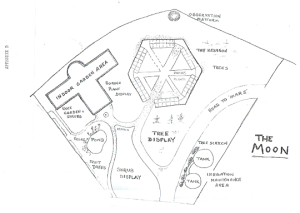
Here stands the Hexagon, a six sided construction of net and plastic covered tunnels that includes the gravel standing out ground for all the new trees, shrubs and perennial plants. The irrigation tank and the sewage system share the rest of the space with the main composting area for both Cullerne and the Findhorn Garden.
MARS
The martian landscape is ‘just grass’, that is, it is just surviving the natural tendency of land here to revert to a sand dune. The chickens live on its boundary and do their best to make the desert return even faster. They receive much of the fresh green weed to help their compost making business which produces about four tons of straw compost each year.
PLUTO
No one goes to Pluto very often. It is grass and is part of a distant hardly conceived plan for an alpine garden once the irrigation system is complete.
MERCURY
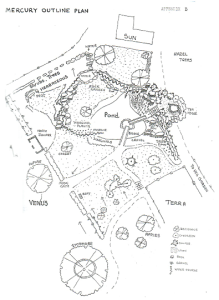
The old paddock is the site of the next great expansion of the ornamental displays. This will begin early in 1983 with the initiation of the water energising rock garden. The grass has been kept cut to prepare it for its new role.
VENUS
The House sits on Venus which also holds the present ornamental garden. This year the large rock garden was rebuilt. Next year there will be a major redesign needed to mate Venus to Mercury. This is the primary focus of the Meditation Garden aspect of the Project.
TERRA
As the name suggests here is an intense and active area. One half is surrounded by a twelve foot high windbreak fence, the other shelters behind a ten foot high leylandii hedge. There are five covered growing houses on Terra which are used for vegetables and the non commercial flowering and stock plants.
JUPITER
The first of the large areas, Jupiter carries the largest growing house, the 130 by 27 foot Filclair tunnel from France. The rest of its 1/3 acre is taken up with the outside tree nursery.
SATURN
An all vegetable plot. The first to be reclaimed from the original cow pasture, Saturn produces the heaviest returns. It bears the trial willow windbreaks while the road end is planted with flowers.
URANUS
The third large plot has two permanent areas. The asparagus bed is in its third year and should be cropping well by 1983. The pea system with its three foot high fences every 4 feet is used to grow cabbage when the peas have finished. It needs a good supply of compost.
NEPTUNE
Last of all Neptune was carved out of the grassy sand. It was reluctant to grow anything but creeping grass. A heavy mulch of straw resulted in a massive crop of all the other sorts of weeds. Turned in as a green crop it has started the process and Neptune is offering a good stand of leeks.
SIRIUS
The pine trees live on Sirius but the plan is to reduce their number and introduce some deciduous varieties. Forty chickens are pioneering here in a straw eco-shelter. The trees removed so far have provided lumber for many of the other areas.
CANOPUS
Too far away to be considered as a productive area at present. Canopus is a grassy observation platform that watches the Project take shape.
BRIEF PROJECT DETAIL
During 1982 the work to maintain the five Areas of Activity has been focused into the following 24 projects.
1. The House. Cullerne can house up to seven people and still provide space for a daily workshop of 20 persons. It is managed by a staff member and cared for by the residents. This project is concerned with the day to day use and the development of the most pertinent life style for the people who live in the house.
2. General Maintenance. The whole property must be kept in a state of good repair. This requires a fairly constant vigilance to ensure that the small jobs are not allowed to accumulate into a major problem. Work is done by staff and students where possible.
3. General Appearance. The largest of all the projects in some ways since it has effect in all areas and on all other activities. The general appearance of the property determines the initial response of anyone entering the place, whether they be visitor or staff. There is no doubt that when everything is in a proper relationship creating an harmonious whole, then the response from people is at its best. The ‘inner’ things seem to work better when the ‘outer’ appearance is in order. A great deal of effort is put into this project.
3. Machine Maintenance. A specialised area that deals with all the machines tools and mechanical devices on the property.
4. Chickens. These birds provide eggs and manure. They are housed in a large covered space with permanent access to outside. Their food is supplied under cover to ensure that the droppings are mostly saved to generate the maximum manure output. The hens shred the straw which covers their floor and between four and five tons of good compost can be collect ed each year. The 300 hens can lay up to 230 eggs a day, but this is a seasonal peak for during the long cold winter many of the ‘girls’ give up. Whatever the yield it takes two people at least three hours a day to tend these birds, seven days a week.
5. Ornamental Garden: Maintenance. The only ornamental area of any size is Venus which requires constant work during the growing season and perhaps three hours a week during the winter. Since it must remain in good order all the year round and is the centre piece of the Meditative approach to the land, it is given a high priority.
7. Ornamental Development. The extension of the flower gardens into Mercury which will double their size, brings in another project for the new garden will be also the water energising system for the borehole water supply that will feed the irrigation process. This project will obviously take several years to complete. The Venusian garden will require consider able redesign so that there is an harmonious flow from the Mercurial and vice versa. These ornamental areas are important for the plants here are grown for their own sake and not to produce anything.
8.Alpine & Herbaceous Perennials. The Nursery and the Ornamental areas both require a regular supply of plants and this project provides the facility and planning to achieve this. The species concerned here are usually grown for at least one year before they are transferred to their permanent sites. The many stock plants that are the source of many of the varieties that do not come from seed, are also housed here.
This is mainly a staff project but occasionally a keen student finds the way in!
9. Shrubs & Ornamental Trees. This project is close to the main tree programme but includes the very small decorative woody varieties commonly used in rock gardens. This project is set to propagate and care for many species in small numbers for use in our own gardens and for the Nursery. It is sited mainly on Terra but shares the Tree Programme’s facilities on the Moon, where relevant.
10. Deciduous and Coniferous Tree Propagation. This is the main activity of the Tree Programme at present. It is concerned with all the trees from seed or cutting until they are either established in ‘growing ON’ containers or planted out in the tree nursery. The project uses the Hexagon on the Moon and the heated Solar Dome on the Sun. It is managed by a staff member with student involvement.
11. Covered Crops. Cullerne is situated at 57º 45′ N about level with south Alaska. Despite the warming effects of the Gulf Stream it still enjoys a cold maritime climate that does not suit many of the food crops. The solution is to create ‘micro-climates’ that permit these plants to flourish. This project provides the management and labour to look after the plants and the environments they need. It is a large project and an ongoing one that needs constant innovation and research.
The varieties involved include; tomatoes, peppers, cucumber, celery, carrots, beans, courgettes, melons, lettuce, calabrese and onions. There are many others that are only involved at their germination stage.
This project provides a set of very special conditions for the development of cooperation between Man and the Nature of plants. It also provides a supply of food plants that can not be grown here any other way. This work is done extensively by students.
12. Protected Crop Facilities. The Covered Crop system obviously requires a vast range of facilities, which have to be kept in working order as well as being simply provided. This project has been responsible for producing all the fifteen growing houses which range from the large 130 X 27 foot Filclair tunnel on Jupiter to the minute 16 X 8 foot alpine house on Terra. It is also concerned with the heating and watering needs, the windbreaks composts tools and anything else that could conceivably affect the Covered growing system.
13. Spring Bedding Plants. This is primarily a Nursery project to provide a good supply of plants ready for sale by May. Many are used internally in other Foundation gardens. This is the spearhead of annual process of ‘meeting the public’ and the sales season really starts with an ‘Open Day’ for the spring bedding. Things actually start in October or November when the bulbs are planted but the main sowing is not begun till January. Everyone is involved at some time. It is a popular project in winter as the work is all inside the heated solar dome, at 55°F. Plants are nearly all presented in small containers to reduce the shock of transplanting.
14. Summer Outdoor Plants. Although this is nearly a continuation of the spring programme it does vary in some major factors. The greatest of these being the extensive use of outdoor cold frames and standing ground once the plants have been hardened off. Also there are many species in this project that are not propagated from seed but may be either biennials or herbaceous perennials of the half hardy kind.
Varieties include begonias, dahlias, geraniums, petunias, pansies and so on, there are over 500 to choose from in general use.
15. Indoor Plants. This project is a response to an increasing demand. There is great interest in a plant that can share the same space as its owner. The development of proper relationships between people and plants is central to the principles of the Foundation and therefore to Cullerne. This project is an expression of a spiritual purpose that also generates a positive cash flow. A fairly rare situation that calls for special care that the commercial pressures do not overshadow the true reason for organising it.
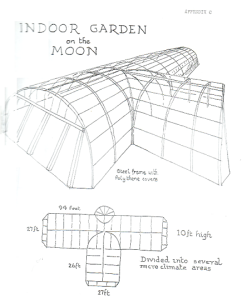
16. Indoor Gardening. This recently initiated project should be fully underway in 1983. It is planned to erect a new insulated tunnel on the Moon measuring some 2800 square feet. It will set out to demon strate a number of indoor garden layouts. It is not intended to be a commercial venture in itself but more one to stimulate the ‘close to nature’ trend. However since it may also stimulate a desire to imitate there is also a plan to increase plant production to meet a possible demand. The project is long term for many of the plants take several years to grow big enough to be used. It will be sited on the Moon area and forms a part of a general development programme that is described later on.
17. Field Vegetable Crops. This is the main food production operation and is active throughout the year. The primary plots concerned are Saturn, Uranus, Neptune and Terra. Sowing and planting begins in January under cover and in March outside. Harvesting is virtually constant since many of the crops stand the winter. The peak time is however in July and August. This is the main project for students. Husbandry is mainly with hand tools and at a high intensity. The methods used are ‘organic’ but there is no dogmatic insistence on the total exclusion of all ‘chemicals’ From time to time the odd inorganic food may be used if there is no viable alternative. The soil is almost totally fine sand, with no clay at all. Heavy leaching of nutrients can occur which can leave a plant at starvation level at a critical period. Under such a situation an inorganic food may be used. It is the policy however to learn not to permit such conditions to arise. At present the programme of soil improvement has not been going long enough to make this a reality.
Herbicides are not used and only organic pesticides where necessary. This means usually indoors and only when no other control has been effective.
18. Fruit. Very little is grown yet. There are a few apple trees but this is not a good apple area. The best varieties of fruit are raspberries and strawberries. The acid sand would it seems suit the blueberry and some are under trial at the moment. The local animals deer, rabbits and collared doves can create havoc in soft fruit areas. The commercial growing of small areas of fruit requires some protection from these natural hazards. It is planned to increase the fruit grown but at a gentle non-commercial rate at present.
19. Research Into Ancient Cereals. This three year old project is evaluating an ancient wheat variety. So far results have been good and in 1983 we hope to grow an area large enough to make some flour. It will still be a trial amount but sufficient to discover the food content. The straw is long and strong which may lead to other possibilities.
20. Solar Soil Heating. The limiting factor for growth after low light is the soil temperature especially when organic fertilisers are used that depend on bacterial activity to release the nutrients the plants need. A research program was run in 1981/2 to use the solar gain available inside a plastic growing house. The heat was collected by a transparent collector and transferred to the soil. This trial is fully reported in the ATEC Technical Bulletin published in 1982 by Findhorn Press. It is planned to continue this line of research in 1983.
21. Fencing. Not a major project but a vital one. The boundary fence in particular has to restrain rabbits, deer and unfortunately the passing wayfarer who likes to pick or jump on flowers and generally break things. The overall appearance also suffers if the fencing is falling to pieces. This can be an expensive project in both money and labour terms. It also calls for special skills.
22. Irrigation. The annual rainfall is said to be about 20 inches a year but our records show that only some 13 inches actually fell last year and this year between February and June a mere 1.25 ins damped the soil. The outside plants therefore have to be watered as well as the covered crops.
A suitable system has been started which uses a 5000 gallon tank with 2 inch pipes to all growing plots. Water at present comes from the local main supply but as soon as the sponsorship comes for phase two of the system, the new 12000 gallon tank can be erected. Then the system will be connect ed to the borehole drilled at the Universal Hall.. The water from the tank is delivered to the main tunnel by gravity and to the plants through a drip feed system. Outside delivery requires an 8hp pump and a self propelled raingun. There is a major development programme planned for this aspect of the Project which is described in the section on The Future.
23. Administration and Management. The whole project is managed by a Committee of Management set up by the Foundation. It is responsible for all that occurs on the property and reports to the Trustees and the Core Group, which is the central authority of the Community. The Company, Project Cullerne Ltd, is not involved with the day to day running apart from its watchdog duty to check that the property’s value is maintained. The Management Committee consists of the Director and the Management staff plus the Foundations Finance Director.
Administration is a staff matter but at present all external money trans actions are accounted for in the central accounts system of the Foundation. Internal journals and cash books account for internal money flows.
Personnel management is done by the Project staff in consultation with the Foundations Department.
Day to day management is informal and by agreement between the people doing the work. It is basically hierarchical founded on who knows the job the best and has the more effective attunement to it at the time.
24. Property Finance. The property is owned by the Findhorn Foundation but mortgaged to the Company, Project Cullerne Limited. The company has a trust declaration with the investors who have lent money to finance the capital costs. The mortgage is equal to the amount of money on loan to the Foundation from time to time. This method was arrived at after exhaustive investigation by the lawyers, as the only way that investors could have their investments secured by the value of the property. Interest can be paid up to 12% per annum and investors are asked to make long term agreements.
An ‘open’ market is maintained so that new investors may join in by, in effect, purchasing a ‘share’ that someone else wants to sell. In this way the investors in the Project may consider that they have a share in it, a debenture-like involvement. Every ‘shareholder’ receives a Certificate that may be transferred to another person, provided that the company has been informed and decides not to purchase it itself.
Usually this is the case. The retiring lender is repaid by us, and we issue a new Certificate to the new supporter.
The loan level is not allowed to rise above £65,000 which is the highest percentage that is felt to be correct at the last evaluation which was £85,500. Naturally donations to this fund are particularly welcome since they remove much of the pressure towards commercial activity that has always to be balanced with the spiritual directions that do not always seem to consider this mundane aspect of human affairs. So far the Project has received over £10,000 of donations into the capital fund. If you are interested in this area please write for details.
THE FUTURE
Project Cullerne is ‘present’ oriented, with few discrete future plans. The impact of spiritual direction can create such rapid changes that too much energy spent on planning is a waste of time. This section of the prospectus therefore briefly explains the general sense of trends rather than any fixed goal to be attained.
Organisation. The rapid development of the business aspect has indicated the vacuum that the Project is filling. There is a huge gap in this part of the world between demand and locally produced supply.
Most of the vegetables and plants travel between 500 and 1500 miles before their sale. During the next few months the Nursery will be stabilised by the formal creation of the Apprentice-Scheme for selected ex-course members. It is envisaged that they will complete at least one full year and contribute the same as the Foundation members, at present £125 per month.
The School will offer two main Courses a year:,
- The Long Course, a thirty five week session from February to October.
- The Short Course, a seventeen week session from April to August.
Both these courses are detailed in the appendix.
A small guest programme has been started and this will be continued on a trial basis to evaluate its potential. At present it is limited to people who are already visiting the Foundation. This programme is intended for those who are interested in becoming a student. It gives the staff and the guest a better chance to check each other out and to reduce the risk of mistake. For, however clear a document is, there is no substitute for the personal experience.
Tree Programme Development. This urgent project has been given a high priority as one we can do with the minimum major facility increase. The required development is however fairly extensive and to contin ue at the optimum rate we need sponsorship of about £7000 during 1983. The money is needed to purchase the seeds and composts and containers and also to finance a tree handling system. These plants are soon large and require life support systems beyond the spade and wheel-barrow capability.
The project is an educative one as well as a horticultural procedure. There is therefore a need to provide books, documents, liaison visits and some travel for the resident staff.
The whole project requires good administration to respond to the world-wide interest. The present cost of postage and phone communication must now be counted a major expense.
Provided the inflow of funds is available, this project can produce results that dollar for dollar exceed those usually expected from average research or commercial enterprise.
This development programme is also published as a separate proposal and is available on request.
Project Cullerne Limited. The company has been incorporated but there are still some legal details to be completed. Once these are finalized, the present investors will be informed of all the details that have now fulfilled the promise that was made in 1980. That all loans would be generally secured by the property.
Once that is done the next step will be to initiate the long awaited project to build the accommodation for the students. The outline planning approval has been obtained and there seems to be no barrier in the way. This will be a capital project since it will directly increase the value of the property.
The essential simplicity of the organisation will be maintained and the addition of the company will not be allowed to cause a slide into bureaucracy.
Nursery development. The main aspect to be developed is the ornamentals. There is spare capacity in the Hexagon and room to extend the sales area. The re-landscaped Moon will become the centre for display where customers may be offered an experience of the plants in real settings. This will allow the Art of Gardening some expression.
The vegetable side can develop only by growing more intensively. The limiting factor is one of ensuring that the plants have enough space to express their qualities into the earth before they are eaten. They grow in service to the human kingdom so that we may also live and serve. We may not, it seems, use the plants to fuel our misuse of the planet. Thus vegetable growing for sale has to be done very carefully and with wisdom.
There will be an increase of research into vegetable varieties that thrive this far north and it is intended to communicate the findings and methods to anyone needing them. The intention is to discover the practical maximum that can be produced and then to enjoy maintaining that level into the future. The financial return will continue to be a major factor in this area but monetary considerations will not be permitted to dominate. There will always be plants at Cullerne that are growing because it feels right for them to be there.
The Nursery Development aims to increase income by 100% over the next year. This will mean an income of around £4000 in the 1983 season.
The Mercury Garden. This new ornamental area is being planned and will start being built in early 1983. The main feature will be the water system which includes a 30 foot wide pond and extensive rock, scree and moraine sections. The site is a dell shaped piece of ground about 200 feet square. There is a diagram in the appendix.
The atmosphere to be generated is a blend of east and west with even a Zen type of expression leading to a ‘tea house’ space; There will be many ornamental trees and the sound of water running over rocks. This garden will be landscaped to enhance the existing one on Venus. It will require sponsorship since even the initial rocks will cost over £500.
Indoor Gardening. Project Cullerne strives to increase the natural tendency of people to be close to plants. In the cooler climates the indoor garden offers the best way to achieve this. It is felt that a trail should be blazed towards a situation where every house has an indoor garden as a requirement for peaceful living. Once upon a time people were feeling the same about bathrooms. This is not a new idea of course, but it is one that has been forgotten through the technological age’s predilection for mechanical devices.
The plan is to erect a tunnel of about 2800 sq ft in the shape of a tau cross. The inside will be laid out to demonstrate how humans and plants can share the same space in a way that is beneficial to both, a half way house between living room and garden. This project will take several years to complete. There is a sketch of the type of structure in mind.
Irrigation. The drip feed system in use in the large tunnel has proved to be so successful that it is planned to extend this type of feed to any other place where it can be used. The main development however is to connect up to the borehole so we can have our own water. This means constructing a new storage tank because the water is too alkaline to be used directly from the ground. It has also been there for over 15000 years and we feel that it should be energised a little, to wake it up before the plants have a drink. The new tank will hold 12000 gallons (57000 litres) and the water will be fed through the rock garden system on Mercury to give it air and into the pond to give it an organic flavour. After that it will be pumped into the existing 5000 gallon tank and then to the crops.
Solar Trial 83. The trial of 81/82 produced such promising results that it is intended to continue this line of research. We were able to grow an extra crop in the early part of the year. During 1983 a new collector panel will be installed so that we can heat a 1700 sq ft area of soil. The technical details are too complicated for this paper but in simple terms the new design will allow better collection and monitoring, greater trial life and less light restriction. Water will remain the transfer agent and the heat will be stored in the soil.
Integrated Energy Project. This is the most ambitious project to date. It is at the initial planning stage and will require a large amount of commitment and capital to complete. The returns however could be highly beneficial far beyond the scope of Project Cullerne.
It is intended to install a furnace that can burn straw to produce enough heat to satisfy the needs of the whole property. The ash will be used as fertiliser and the fuel shredder to make compost from spare straw. A second aspect is to grow a heavy straw cereal to feed the human beings or the animals and the fire. It is hoped to do this on poor ground as a demonstration of how to produce the self regenerating energy system needed for rural development. This project will have its own de tailed proposal early in 1983.
CONCLUSION BY THE DIRECTOR
I hope the foregoing prospectus has given you some insight into this exciting Project and I should like to round it up by saying a little more about the most well known aspect of the gardening at the Findhorn Foundation, the Nature Spirits, the Devas and communication with entities beyond the normal comprehension of Man. And little, in fact needs be said. If you have no experience of these phenomena then words will be nought but fairy stories. If you have experience then words are superfluous.
The controlled emotion or feeling nature of a human being can make a connection with forms of life not usually perceptible to the five senses. When the mind is clear and trained in this field then information rele vant to both life streams may be generated through the contact. If however these two essential criteria, controlled emotion and clear mind are not present, the seeker of phenomena will create within himself or herself whatever is required. The hallucinations of the spiritually inclined are legion. It is not cur intention to add to this babble.
The chance of a true communion and a creative interface with these inner forces is greatly increased at Cullerne, and indeed anywhere within the auric field of a Light Centre. Where and when these occur we make a space and give time to assist understanding as we are able. It should however be clearly understood that the Findhorn Foundation in general and Project Cullerne in particular are not centres for psychic research nor peep shows of the elemental world. We do not dabble in magic either psuedo or real. We do not invoke spirits or evoke events that break the laws of the physical world.
This is a place of service and if in service we are given some revelatory experience then it is accepted gratefully as a tool to our understanding so we may perhaps serve the better.
A.D.Barton, Sept. 82
APPENDIX A – COURSES AT THE GARDEN SCHOOL 1983
The Long Course……February 19th to October 22nd
This course covers all the operations of spring sowing and ground preparation
The spring bedding project
The sales and summer harvesting including involvement with the customers. Students will be invited to participate in the whole range of activities but some specialisation is encouraged into an area of choice.
The total cost including all food, accommodation, tuition and value added tax is………………..£2000 paid in advance.
Registration £100 which is subtracted from the fee payable on arrival.
Other payment schedules by arrangement.
The Short Course……….April April 16th to August 20th
This period includes the spring growing season and the long summer days up to 20 hours long. As in the long course everything happening is avail able but the shorter time means that specialisation is less common.
The total cost as above is …………£1000…………paid in advance,
Registration £100 as above.
Guest Weeks Are arranged personally whilst you are at Findhorn. We cannot book them in advance due to the shortage of Space. The cost is £75 per week at present but that may be increased as it is the same as the Working Guest rate of the normal Foundation Program.
All Courses and Programmes at Cullerne require that the participant has spent at least one week with the Experiencing Findhorn Programme before coming to Cullerne. This is to ensure that all the Cullerne group has a working knowledge of the Foundation.
APPRENTICESHIPS
During the Long and Short Courses, students who wish to complete a full year may apply for one of the limited number of apprentice positions.
Successful applicants will then continue after their course ends as Nursery trainees. Contributions are the same as for members, £125 month.
APPENDIX B, C and D (plans)

Born in 1936, RAF officer, met the Caddy whilst in Kinloss. In 1974 he joined the Findhorn Foundation, serving as General Secretary. In 1978 set up Cullerne Garden School.




Leave A Comment