


When Anamaria Aristizabal, co-founder of Aldeafeliz Ecovillage in Colombia, visited Findhorn in June 2026 she gave a presentation to share the story of her community’s twenty-year journey.
Presentation video and slides (click on arrow to view)
Slides – To browse and follow the presentation please use the < > arrows at the left and right of the window. For easier reading, use the buttons at the bottom of the window: use Zoom (the + and – buttons) or Toggle Fullscreen (the four arrows pointing outwards).
The following are her reflections.
***
The presentation naturally evolved into something much richer – a conversation. The questions that followed revealed how deeply intentional communities around the world wrestle with similar challenges. Although separated by continents, cultures, and histories, Ecovillage Findhorn and Aldeafeliz found themselves exploring many of the same questions:
- How do communities remain resilient over decades?
- How do we navigate conflict without losing relationship?
- How do governance structures help people grow?
- How do we welcome new generations while honouring those who came before?
- What enables a community not only to survive, but to continue evolving?
Rather than offering definitive answers, the dialogue became an exchange of practices, insights, and lived experience—two living laboratories learning from one another.
Governance as a Developmental Practice
One of the first questions explored was whether sociocracy requires highly developed leaders before it can work.
Drawing on Aldeafeliz’s twenty years of experience, I shared that sociocracy has become much more than a decision-making system; it has become a developmental practice. Meetings become opportunities to cultivate listening, responsibility, self-regulation, and collective intelligence.
Every proposal teaches ownership. Every objection becomes an invitation to improve an idea rather than defeat it. Over time, people discover that leadership is not something reserved for a few—it is a capacity that can be cultivated.
As Diana Leafe Christian once remarked,
“Sociocracy doesn’t require leaders. It creates them.“
That observation resonated strongly with many in the room.
Participants also reflected on how Ecovillage Findhorn’s scale presents different opportunities and challenges. Rather than asking whether one governance model could simply be transferred from one community to another, the conversation explored how governance practices can evolve in response to each community’s unique history, culture, and complexity.
 Community Needs Both Openness and Boundaries
Several questions explored how Aldeafeliz approaches membership, accountability, and conflict.
One insight that emerged is that love and clarity are not opposites. Communities flourish when expectations are explicit.
Aldeafeliz’s membership pathway includes mentorship, participation in working circles, and community feedback before becoming a full member. Alongside this, the community has developed conflict resolution practices, trained mediators, restorative circles, empathy partnerships inspired by Nonviolent Communication, and, when necessary, a Protocol of Boundaries and Consequences.
 These structures are not about control.
They exist to protect trust.
Psychological safety, we reflected, is created not by the absence of boundaries, but by the confidence that everyone understands and shares them.
 Conflict as a Teacher
A significant part of the conversation focused on conflict.
Participants were curious about Aldeafeliz’s conflict resolution protocol and the culture that supports it. What emerged was not a discussion about avoiding conflict, but about developing the capacity to work with it constructively.
Within Aldeafeliz, conflict has gradually come to be understood not as evidence that community is failing, but as information—an invitation to individual and collective growth.
One participant observed that even the word conflict carries different emotional meanings across cultures. That insight opened a rich exchange about how our cultural narratives shape our willingness to engage in difficult conversations.
The shared conclusion was simple but profound; resilience is not built by eliminating conflict, but by learning how to move through it with honesty, empathy, and courage.
 Inner Development as Community Practice
As the dialogue unfolded, many questions ultimately pointed toward inner development.
- How do people regulate themselves before entering difficult conversations?
- How do they receive feedback?
- How do they recognize their own patterns instead of projecting them onto others?
I reflected that one of Aldeafeliz’s greatest lessons has been that governance alone is not enough. Community culture depends on each person’s willingness to engage in their own inner work.
While members follow diverse spiritual paths, there is a shared expectation that everyone takes responsibility for their own growth.
Community becomes more resilient when personal transformation becomes part of everyday culture.
Learning from Ecovillage Findhorn
Although many of the questions focused on Aldeafeliz, the exchange was far from one-sided.
I was deeply inspired by the Community’s gifts: the morning attunements, daily meditation, singing, the Sanctuary, the Transformation Game, and the deep trust in intuition that has shaped the Community since its beginnings.
What became evident throughout my visit was that spirituality is not an activity separate from Community life—it permeates the culture itself. It creates a shared field that supports resilience in ways that are difficult to quantify but immediately felt.
The dialogue also highlighted the Community’s remarkable capacity to continue evolving after more than six decades. Like every mature community, Findhorn continues to navigate change while remaining rooted in its founding values.
Communities Learning From Communities
Perhaps the greatest insight from the afternoon was not any particular governance tool or conflict protocol.
It was the realisation that ecovillages become living laboratories.
Each experiments within its own cultural context.
Each discovers practices that may serve others.
And when communities meet—not to convince one another, but to inquire together—new possibilities emerge.
The Community at Findhorn has spent more than sixty years pioneering a culture rooted in spirituality, attunement, and global outreach.
Aldeafeliz has spent twenty years experimenting with collaborative governance, conflict transformation, and social technologies in Latin America.
Neither community offers a finished model.
Both continue to evolve.
The conversation reminded everyone present that resilience does not emerge from having all the answers. It grows through relationships, shared learning, and the willingness to keep asking better questions together.
In a time of profound ecological, social, and cultural transitions, perhaps this is one of the greatest gifts of the Global Ecovillage Network : creating spaces where communities learn from communities, where wisdom travels across continents, and where every encounter strengthens the larger family working toward a regenerative future.
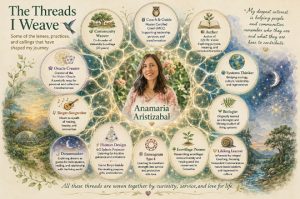
Click here to contact Anamaria Aristizabal.

Guest Authors are contributors who are not COIF members (for various reasons).




Leave A Comment