


“A moment of grandeur comes to everyone when they act out of their humanness without need for acceptance, exhibitionism or applause. An audience knows this and responds accordingly.”
Viola Spolin.
We had made a new friend, he and Michael became very close, an extraordinary man, Ed Maxcy. He had worked for some years on Broadway, an actor who had grown up in California and learned his craft in Los Angeles. Also, a gifted Drama Teacher and an astrologer of some significant knowledge. Ed played a sort of Merlin/Jester role in the life of the community, he had a very dry wit and a profound sense of humour and between them, Michael and Ed became the catalysts for a theatre group.
Ed told us how he came to the community, information was a different story then and hard to access, except in cases of notoriety. Interest in the ‘New Age’ was not yet public property, we had found the place thanks to an obscure little magazine that could only be subscribed to, other peoples’ stories were more bizarre but this was all to change very soon. Ed kept hearing the word Findhorn and thought it was some kind of coded message from his higher consciousness that had to do with finding the ‘horn of plenty’ greater abundance in his life – the mythic cornucopia – so he used it as a mantra in his daily meditations for several months before hearing from some friends – as word began to travel on the new age grapevine– that it was an actual place and at that time, becoming known to a few, thanks to its giant cabbages that were apparently being grown in sand in a hippy commune! somewhere in Scotland. He didn’t think it sounded too promising but booked a flight and arrived unannounced.
The theatre group, like all good things, began in a small way, like a tiny seed, planted in good soil, sprouting and growing in strength, open to anyone who wanted to join in the fun and let down the barriers. Ed used many exercises developed by the American pioneer of improvisational theatre, Viola Spolin; starting off quite simply and playfully they increase in complexity over time encouraging the players to actualise every aspect of themselves, using the voice, physicalisation, imagination and all our creative capacities to the max. Also, what is extraordinary about her work is the emphasis on non-competitiveness, cooperation, and play, virtues that enhance the interaction of the group process, the outcome being authenticity rather than simply acting; the fiction of theatre coming alive, the principles of good stage craft becoming apparent. Viola was truly inspired and ahead of her times as her book – containing her thoughts and over three hundred exercises published way back in nineteen sixty-three – clearly shows. Ed had extensive knowledge and experience of working in theatre and showbiz, a remarkable capacity to draw out people’s latent talents often setting up scenes between players where there would be a real edge thanks to diverse personalities, the outcomes unexpected, educational and often very funny.

Michael, Crispin, Simone, Lynn, Alice, Joy and fellow Thespian
Those workshops became a hub of creativity where people would often arrive exhausted from a day’s hard work and after some ‘warm ups’ and theatre games, to get the creative juices flowing, sparks would begin to fly and we would be so fired up by the end of the evening that sleep would be hard to come by till the wee small hours. Peter, being a great patron of the arts had created a tradition, taken from our local Scottish culture of Ceilidh nights and every fortnight on a Saturday, we would gather in the Community Centre and share a talent, a song, some music, a sketch. I could be gasping with admiration or squirming in my seat, but it was all good fun and this is what they were eventually called, Fun Nights. These became a good venue to showcase new material from the ‘impro’ workshops, by then scripted, blocked and polished up.
Ed nurtured Michael’s talent for acting and as a writer for the stage and Peter was quite delighted to see how Performing Arts could act as a voice and a bridge to convey the spirit within the community and some of the concepts of ‘The New’ – out into the world, even so, there was no chance of The Arts usurping the activities of building community in the daily routines and it was relegated to the evenings, in our spare time.
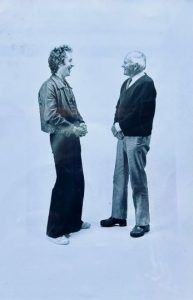
Michael Worth and Peter Caddy
Ed Maxcy had a great fascination for all human interactions and relationships. He was working on a book about archetypes saying how they would all be drawn to this place, as we were entering a time of collective awakening and a synthesis was taking place, whereby the archetypal energies, manifesting through our human personalities, would learn to blend together creating something new (as well as maintaining their integrity) in order to gain understanding of the whole human spectrum – no longer polarised or too distant to comprehend different points of view. He showed me a chart one day made up of the four elements and relating to the twelve main archetypes; a circle of disparities, the logician across from the shaman/seeress, the patriarch opposite the joker/fool. Ed said how we all needed to learn how to actualise the rich and varied aspects of these archetypal energies into our beings – in some measure – spurning none, in order to be enriched empathic human beings. By experiencing our kinship with the whole human family humanity would, evolve and grow in compassion. This is what Ed taught in his workshops, seeing all life as a stage and constant opportunities to actualise our potential as entirely human beings by creating a new synthesis of archetypes.
There was, at that time, a rather random and chaotic element to community life. Structures were slowly emerging in which to direct the many elements, and there were always unexpected arrivals, unstructured work projects, yet this lack of organisation kept a door open for something else to enter, elements of magic and miracle, the unknown. It was a marvel to me that Peter and Eileen, with their orderly military type backgrounds, had the spiritual foresight and tolerance, to allow things to unfold as they did, rather than imposing limits and overly organising things, especially as more and more people arrived and wanted to stay. Many camped on the lower site during those early years in the warmer weather as there was limited guest accommodation and most of the time, all of it overcrowded, but happily so.
I think it was a lesson for us all to see, when things were allowed to develop in a synchronistic way, they unfolded their own patterns organically, creating the miracles of manifestation to occur; living in faith, Peter and Eileen would say. There was ample room for everyone to make their own unique contributions without endless rules and somehow everything would fall into place, without effort it seemed. There would always be enough food for the unexpected numbers, enough hands to prepare it, with laughter and song, at times, enough materials and money for the next step in development and skills and people to implement it – this was the magic, the miracle.
David used to stress that we were entering an age of ‘synthesis’, and the community acted as a centre of synergy – the blending of many different elements, evolving new patterns of relationship through harmony and co-operation – in order to create new ways of being and doing, “Unity in diversity”, Peter would say, one more community catchphrase.
As well as the gardeners, another group of people arriving at Findhorn, with a definite role in mind, were the crafts-people and they were doing all the work of assembling their studio spaces at Pineridge, a ten-minute walk to the east, from the Community Centre. There was Dorothy and Jonathan Snell and their baby boy, the weavers of remarkable cloth, and Jenny and Nigel with their two youngsters. Joy and John Drake and their son Damien who were candlemakers of great skill and diversity, and Brian who founded the pottery. They formed a core of artisans, highly experienced in their crafts eventually drawing other crafts people to come and share their gifts and business acumen, not simply as ‘artists’ but as well-balanced people, willing to also give in other – more prosaic! – areas of community life.
Peter had a stricture that he sought to implement on a daily basis and that was morning Sanctuary. He liked to see everyone attend with parents taking turns and I’m sure I could see him in the Sanctuary with half closed eyes, doing a sort of head count! He felt it had a unifying effect on the direction of the community. Peter made no pretence of being a keen meditator himself, saying he found it hard to still the mind and be reflective, to simply sit with closed eyes for twenty minutes, though he wouldn’t deny its beneficial effects in stepping back from the time bound and observing from the level of ‘Being’ – gaining a sense of perspective and spaciousness. Daily meditation as part of community life had nothing to do with visions or ‘navel gazing’ but observing without judgement the mind’s constant activity – knowing that this is its nature, seeking the peace and presence of our source, beyond the chatter.
For everyone, meditation is different, for me it’s about focusing on my breath, bringing my awareness – as much as possible – to the Self beyond the egoic mind, coming into the present of that presence. The coming together in stillness and silence was a daily affirmation of our commitment to inner and outer peace.
People often asked me over the years, where the money came from to build the Sanctuary, the Community Centre, Studios, and Bungalows. Not being much of a materialist, I wasn’t the person to ask. Many of the early stalwarts who came to reside, had their own money, a few, I think, were quite affluent. Some money was gifted by wealthy donors who wanted to further the work of the community.
There was no ‘flaunting’ of wealth in those early years, the few cars people owned were mostly undistinguished and well worn, as were people’s work clothes. Housing gave no indication as such to class distinctions, being either caravans or ‘portopack’ bungalows, both lacking any signs of elitism, this lent a sense of egalitarianism to the place, a sense of equality.
Peter often said that if you make your needs known, the universe would respond, as long as it is a genuine need and beneficial, not simply a self-indulgence or a whim. We began to make it known that we needed our own caravan. There was a thirty eight footer for sale on the lower caravan site, that was run by a Captain Gibson, who, by the way, owned the entire and substantial piece of land on which we were – as a community – expanding and renting from him, this would all change later (but that’s another story.) The lower site teemed with life in the brief summer months, when people from all over Scotland and the U.K., mostly, rented the holiday caravans and camped on the site.
Michael and I were surprised and delighted when Joanie offered to lend us the money, saying we could pay her back gradually, over the years, an interest free loan. We were very grateful but it seemed we hadn’t expressed it sufficiently, as Peter tapped on our door that evening, saying how important it was to express gratitude in order to fulfil the laws of manifestation; Joanie was profoundly deaf in one ear, even so we were mortified and regaled her with “Thank yous” for days to come and each time we made our modest weekly payments.
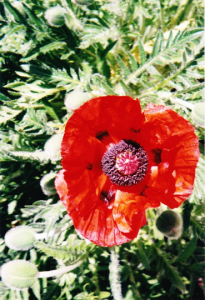 It was good to have our own home and after living for a year or so within its linear lines, patterned carpets and Formica furniture all within twelve foot by thirty eight, we gutted it and a carpenter friend helped Michael to lay pine floors and build pine fittings, everything was softly rounded and wooden, I painted the walls and ceilings in warm colours. It was a dear little home and we lived there for seven years till we began to knock elbows as the girls grew bigger. Our caravan was the first to be moved to lower Pineridge directly overlooking a plantation of small pine trees, beyond that, miles of sand dunes and the Moray Firth; the Scottish wildlife became even more apparent with rabbits and roe deer, the frequent sightings of raptors, small lizards in warmer weather and a myriad of lovely butterflies, not to mention the varied bird life, it was a rich and diverse ecosystem and far removed from anything I’d known before.
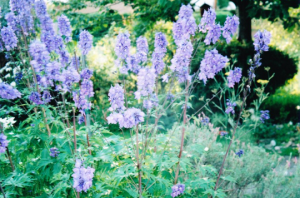 I had a lovely time planting my first garden. With Ruby’s help we planted young rowan, birch and scots pine trees, some native shrubs and hardy perennials; Michael laid turf for a small lawn and built the girls a ‘Wendy’ house. The soil in this area was really sandy about eighty percent sand, but we were fortunate in having access to wheel barrow loads of the finest compost on the planet, made by Peter and the gardeners and all willing hands (every few months) to a particular recipe involving animal manure, kitchen waste, sea weed, leaf mould, straw or hay, wood ash, and probably more besides, a sort of ‘mulch’ compost that was assembled in giant heaps about nine feet high and steamed away under old carpets for months. This stuff was the bedrock of the garden enabling the sandy soil to hold moisture and ‘root’ the young trees and shrubs. The ‘Soil Association’ had come to investigate the news of a myriad variety of vegetables, fruits and herbs flourishing in sand! They acknowledged the benefits that the ‘compost’ added and decided there had to be a factor X at work, as they put it. The love and respect shown to the plant kingdom on the human side as well as our conscious appreciation of the devic realm, was, as any keen gardener who truly loves their garden, knows, the factor X, at work in the community gardens.
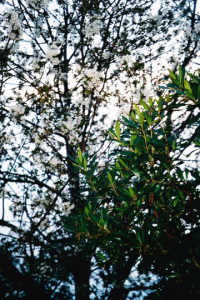 People didn’t dash through the gardens in those days or walk eyes down, hypnotised by their mobile phones. We lingered and gazed, breathing the fragrances and marvelling at the blooms, for everything growing then, really did have a special radiance, unearthly and quite glorious. Also, we collectively acknowledged nature’s rites of passage, the equinoxes, solstices, full moons, new moons and more besides, with festivals and celebrations, song, dance, music and poetry, seeking to be in tune with nature’s rhythms and when we could, we held our festivities outside, under the sun, under the moon and the trees in true ‘hippy’ fashion!
Peter, Eileen, Dorothy and ROC couldn’t emphasise enough, the important work of the community, in our acknowledging the ‘devic’ realm and welcoming them into our lives each day. In our attunements, before a work shift or a workshop; I found it oh so refreshing that these ordinary looking, wise older people thought this way and encouraged us younger ones to perceive in some measure, the overlighting intelligences behind form, the designers and architects of all we behold, in the natural world. By giving credence to the unseen dimensions, angels, nature spirits, essences, energies, my life became a richer more loving place.
The arts began to develop some momentum and somehow I managed to be involved thanks to willing babysitters. Music took off first. David Spangler, with a background in singing, had a great voice and together with friends formed a vocal group, later to be known as the ‘New Troubadours’, all musicians in their own right, guitarists a double bass and with the help of Milenko, a professional musician from former Yugoslavia, composed lovely songs, folksy in nature – using verses written by David and other talented singers, in fact we all had a shot at creating a song.
Sitting in the garden one day, humming a tune that had come to me, Milenko encouraging my latent musical abilities on his guitar, a door opened up for me and I suddenly perceived the inherent joy and transforming power of shared creativity, not as something remote and glamourous, removed from everyday life, but something anyone could explore and enjoy. The arts at Findhorn were to share and there would be nothing elitist about them. For the New Troubadours, the songs that truly came alive were made into one of the community’s first music tapes.
Another musician, Hans Poulsen, who had made a name for himself in his native Australia came to live and work in the community, making a big contribution with his congenial light hearted personality and upbeat musical talent, composing songs that conveyed the ideas and dynamics of our everyday lives with humour, heart and insight. Hans helped to form a band that later made a great contribution to the multimedia aspect of performing Arts, as well as Saturday night raves and gigs outside of the community.
A gifted professional cello player and mother of four, Gillian Lubach, would sometimes play Bach in the Sanctuary of an evening, thrilling us to bits. The musical aspect of the Arts had really ‘landed’ and was alive and well.
Around that time, a few of us working in the drama workshop put together a piece concerning the poor quality of relationship between humanity and nature – highlighting ecological degradation and humankind’s abuse of the planet. It was serious, full of conflict and Nature was portrayed as vengeful – it was pretty flaky and created a real sense of discord and confusion on its debut performance in the CC; I may be wrong but I seem to recall Peter actually halting the performance, and saying how “This was not what theatre in the New Age was meant to be”.
Later, ROC (Robert Ogilvie Crombie) met with us and being a bit of a thespian and having experienced some profound moments with the nature kingdom, he had some wisdom to share. ROC said that nature sought only to implement God’s will – good will – and was not capable of ill will or revenge. Also, how all conflict in the theatre context needed to have a resolution, not necessarily a happy ending but a sense of completion – something Ed spoke of in his workshops, but in our haste to create we hadn’t quite grasped. ROC spoke of Shakespeare’s plays and I’m not entirely sure that it was ROC who said that, in his comedies, the characters became enlightened before the play ended and, in a tragedy – they didn’t! and what did we want to focus on in our work? Needless to say, from that point on our direction was clear and we were duly chastened. The main thrust of the work would concern transformation, there would be no proselytising or emphasis on getting a ‘message’ across, no highlighting conflict either. Looking back, it was as though the ‘muses’ did a lot of directing of the work when we allowed them – putting our ego’s out of the way; the emphasis was on levity rather than gravity – and a ‘light’ touch.
ROC, an occasional visitor and wise friend of Peter and Eileen’s, came from a scientific background, yet nevertheless had been granted some remarkable encounters with the spirits of nature.
From the early variety shows that we performed in the Lollypop Theatre in the summer seasons of 1974/5/6, to the more professional and carefully crafted shows performed later in the Universal Hall, our audiences spoke of being uplifted – as well as entertained – which in our view was what the arts were all about, to lift the spirits and open the heart.
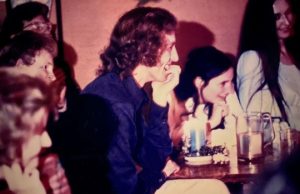
Michael, Catherine, Simone, Janice and ‘fun night’ audience
It was around this time that a professional dancer came to stay for a while; Ann, a lovely willowy girl had been working with Dennis Stohl. He had spent much time in meditation and study in the Egyptian tombs, channelling ‘early ritual’ dances and training a company of dancers to perform them, Ann wanted to share some of these dances with the community and worked with myself and a friend, teaching us some choreography which was graceful and mesmerising, just as I imagined, having seen friezes of the temple dancers, in a book about ancient Egypt. After rehearsals I felt strange and in a sort of trance state and at the next session I asked David to sit in, being a profound sensitive he could see, perhaps, what was being invoked. After the rehearsal, he told us we were rousing and inviting in, an ancient Egyptian king as well as other ancient energies. They were not too pleased about it apparently and David was very clear that the power of the dances were all about funereal ritual and quite inappropriate in the community; we were literally ‘raising the dead’ not very New Age! It was becoming very clear just how powerful the arts are in a light centre and probably anywhere; needless to say, we began to create our own dances, connecting to the changing season and the devic realm, using poetry, verse and music and always asking for the blessings of the muses rather than ancient kings.
-
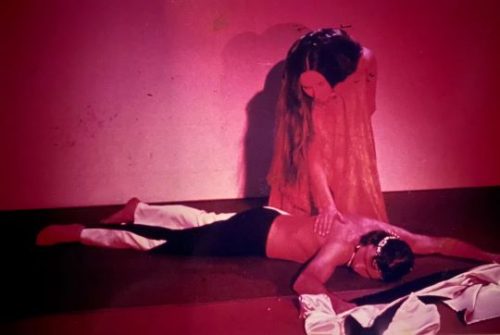
- Craig and Simone
-
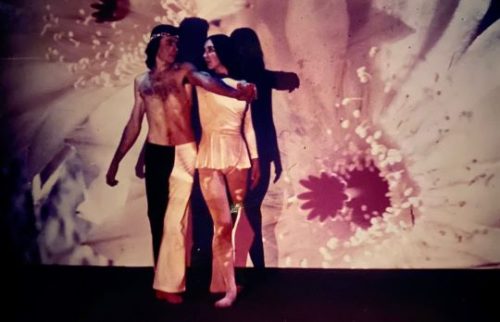
- Craig and Simone
One of the Troubadours, an American, Lark Batteau, was a gifted dancer and teacher and gave classes in ballet and contemporary dance in the evenings. I did my best to attend them, at first, a real stretch for most of us after a busy day. I had no ambition at that point to be a dancer, I just wanted to lose some weight, especially since I’d been asked to fetch Peter to the office phone one day, and he, working the other end of the gardens, and I found I couldn’t run! I was still carrying so much mummy fat.
I am forever grateful to Lark for all her encouragement, telling me I was a natural dancer and helping me to build confidence, muscles, stamina, a new sense of identity. The sheer joy and energy of the dance was activated in my blood, bones and heart, it was to become a total visceral experience that made me hungry for more, and as I learned to spin, jump, leap, stretch and do things I never thought possible with grace and skill, my dreams were full of flight and movement, and my days more joyous. Creativity enriched my daily routines and family life simply because I felt more alive.
Within a few months I was involved in creative projects, also, a number of individuals with dance backgrounds, joined in the life of the community sharing their talents in the evenings, Indian dance, Flamenco, Martha Graham, Laban, and more, it was an intense learning curve that became an exciting cycle of creativity over the next few years.
***
About the photos: Many individuals were involved in the performing arts during the 1970s at Findhorn. Much of the work was well documented by seriously talented photographers. As I only have access to my own album of the ’70s, many of the images above are of a more personal nature, and sadly I don’t know whom to credit for the photos.
A big Thank You to my grandson Ziggy for enhancing the appearance of many of my somewhat battered and ancient photos from the ’70s.

I live very simply in this land I love. On returning to the area with my daughter Jade, I found joy in volunteering in the life of the Community; until Covid, then everything changed.


I really enjoyed reading this, Anniese.
I didn’t visit the Findhorn Community until 1999 but I’d actually been holding the idea for many years.
I knew it had always been a creative community but your account and descriptions are full of energy – they really bring that era to life. Thank you!