


The following article was first published in One Earth Magazine Issue No 14 Summer 1994.
***
This past year has been a tough year financially for the whole Findhorn Foundation Community and the Findhorn Pottery, which is currently struggling unsuccessfully to support the material needs of those who service it, is no exception. As Brian Nobbs retraces here the development of the Pottery, from limited company to Foundation department to leased, independent venture, we may ask ourselves as he does, ‘Where will it go from here?’
When in 1971, in response to Eileen’s guidance, Peter initiated work on the three studios at Pineridge, the mood of the studios’ team was one of excitement and optimism. From these studios, it was predicted, would come expressions of the traditional arts and crafts, which would not only be of the highest aesthetic quality, but would carry into the world with their purchasers the special energy of the Findhorn Community – to work subtly on the consciousness of all those with whom they came into contact and to speed up the universal change predicted for the Aquarian age. As well as this, sufficient income would be generated to support the craftspeople themselves.
In those early days there was a good measure of success. What is now the Phoenix Shop was a Spar Grocery. One of the rooms inside the building was remodelled to house the crafts, and it glowed with the colours of handweavings, candles, enamels, macrame hangings, silk-screened fabrics, jewellry and pottery. The effect was magical. Visitors bought eagerly and the future seemed assured. For a while, the most difficult thing faced by the Studio Managers was how lovingly to deflect ‘born again’ craft enthusiasts from demanding bench space in the Middle Studio to produce tissue paper flowers or paintings of kittens on black velvet. However, for the most part, harmony and understanding prevailed, the studios were intensely productive and the work sold well.
The Pottery was energetically marketed by Nigel Hicken, himself a skilled potter, to craft shops all over Scotland; so successfully in fact that the rather small kiln we started with was quickly found to be too small. So plans were made to build an annex to house a much larger kiln, in fact a huge oil-fired kiln. As Manager of the Pottery, I found myself with the job of doing rough layout plans for the extension, which were then professionally developed by Elizabeth Grindley. It was at this rather unsuitable moment in the development of the studio that I became smitten with a nostalgic desire to have another shot at being a Benedictine monk! I had loved the life and had suffered real sorrow at not being able to persevere. So I applied to Quarr Abbey, where I had been a student monk. They lovingly suggested that a second try in the same community would be prejudiced from the start. So I ended up in the novitiate of Pluscarden Abbey, almost a neighbour of the Findhorn Foundation.
I left the Foundation in August 1972, knowing that there were adequate potters to continue the studio’s work – Nigel Hicken, Hans Ullrich and a number of others. However, sometime during the first two or three months after my departure, things began to go wrong. A combination of financial anxiety and impatience led the craftspeople to request that they be allowed to derive their personal support from the crafts income which was, by now, considerable. This provoked resentment from those members for whom there could be, at that time, no question of any payment since they worked in the kitchen, homecare or the garden. So rather than allow bitterness and division to spoil the still vulnerable community, virtually the whole crafts team was told it was time to move on.
For several months the studios closed down and Findhorn Studio Ltd, the company, was dissolved. In the spring of 1973, Craig Gibsone, appointed by Peter Caddy, started them up again, this time as a Foundation department. Craig worked in the Pottery for several months but later that same year had to move on when he became Peter Caddy’s assistant. The Pottery was left in the able hands of Scotty Goldberg, David Sutherland and Sarah Mariott who, between them, ran it successfully, through to the middle of 1975.
By the autumn of 1975, this team had moved on, and once again the studios were closed down. So later that year, Craig left Core Group and the administrative work he had been doing, to go back to the Pottery. This time he decided to start afresh: he gutted and totally refashioned the building, creating in the process a more colourful and living environment in which to work and hold workshops. Infused with this fresh energy, the Pottery began to flourish. The next three years brought a period of intense activity, with Craig, Mimi Luft, Scotty, Gay Smith and Andrew Murray producing, amongst other things, some of the wonderfully designed work that looked resplendent on the tables in the Community Centre and, eventually, Cluny Dining Room. But again, by 1979, most of these people had left and once again the Pottery was only in occasional use, without a proper team to cherish it.
Peter Caddy began at this time inviting me to come back. I had left the monastery in 1976, recognising finally that I had no vocation to the life, despite the fact that in many respects I still loved it. I’d been reluctant to run back to the Foundation. That would have been too easy and might have left me feeling that I couldn’t make it in the ‘real’ world. However, by 1978 I was feeling very dissatisfied with my life as a teacher and had eagerly accepted a year’s residency as the potter at the Salisbury Centre in Edinburgh. So at the end of that year, in 1979, I agreed to return to the Findhorn Pottery and train five community members to run it.
It happened that the team included some really talented individuals, so by the end of 1980 I felt able to accept an invitation from a small group in America to discuss the possibility of setting up a pottery for them in Pennsylvania. For various complicated reasons, nothing turned out as expected, although I had a very good seven years in the USA! But I was chagrined to learn that, one by one, my carefully trained team left for other ventures.
Craig arrived back in March 1983, and, together with Gay Smith, dedicated the next few years to obtaining funding for a new kiln to replace the oil-fired kiln which, a year earlier, had been declared a health hazard and could no longer be used. Gay ended up building the kiln that is in use today, and she also rebuilt the wood-fired kiln. During this period I visited several times and had discussions about possible ways in which I could be involved again.
The idea of leasing the studio first came up in 1983 and was initially agreed to, but withdrawn when the simpler idea of using the studio educationally was put forward by Craig. Due to this and other circumstances at the time, it became obvious that the idea of leasing was out of timing. However, by 1986, Gay knew that she would be leaving and suggested that I try again with the lease idea. Finally, in May 1990, when I had more or less given up on any sort of definite answer, Gay called to ask if I was still interested; it turned out that another artist, Colin Caffell, was also interested. She asked if I thought I could work with him and my response was positive, especially after a couple of conversations with him.
So in August 1990 I returned to the Findhorn Foundation for the third time to see what might be made of the Pottery as a leased business. Colin and I got on very harmoniously and we were soon busy trying to arrive at a shared design style and defining our work space to make possible his sculptural activities alongside the traditional ceramics. But by October of that year it began to be evident that the trouble-free marketing of twenty years before was no longer a reality. Tourist shops abounded, but the craft emphasis had been lost entirely. They were now looking for cheap, mass produced and superficially attractive items. The few remaining genuine craft shops had, in consequence, a huge choice to draw upon but a very limited market. Our attendance at the Aviemore Show made clear to us that we could not expect to become part of that market easily, even though many buyers looked regretfully at our work, were very complimentary, but declared themselves unable to sell such things in sufficient volume any more.
Financial pressures soon forced both of us to consider what emergency action to take. For Colin, it meant a return to London and deeper involvement with Dr. Kubler-Ross’s ‘Death and Bereavement’ workshops. I had the luck to be offered a teaching post at the Moray Steiner School in Forres, beginning in January 1991. I was determined to keep the Pottery going, so I negotiated a teaching programme that enabled me to spend roughly half of my working time at the Pottery. The school has generously supported this ever since.
Unfortunately, it is nearly impossible to make a satisfactory job of running a studio with these kinds of constraints. It feels like an enormous achievement that we have managed at all to pay the rent and cover our material costs out of sales from the studio and occasional orders from the Phoenix. Without the constant assistance of Sharona Parker, who arrived in 1992 wanting to learn the craft as an apprentice, and my partner Franck, the Pottery would long since have had to be closed.
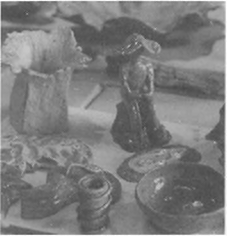
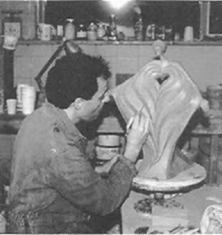
“I cherish the ambition to produce ceramics of a quality and beauty that, in giving new life to age-old values and qualities, makes them not self-consciously ‘New Age’, but rather a truly living invitation to marvel at the beauty of God and Creation ”
Many positive trends have emerged in the years since 1990. It is very heartening that people are attracted to take classes here, both young and old, so that there is a lively sense of the studio as a place of creative growth that offers a welcome to all. Casual visitors in the summer often comment on the atmosphere in the Pottery as something very special: ‘Welcoming’, ‘Like a church!’, ‘So peaceful’, etc. These are often people with no ‘New Age’ connections or expectations. We find it a beautiful and significant confirmation of the original vision for all the studios of twenty four years ago. That vision affirmed that beautiful artifacts made with skill and love made possible a special kind of communication with those who saw and handled them. This constitutes the primary reason for continuing to put so much energy and effort into an enterprise which seems, on the surface, unable to provide any material rewards. My personal belief is that everything possible should be done to support the continuance of the Pottery, and indeed the other surviving but struggling craft, Weaving.
Early in the summer of 1993 I had a meeting with Patrick Nash, Loren Stewart and Klaus Sorensen (Members dealing with management and finance) about some possible futures for the Pottery. In that meeting, for all the above reasons, they affirmed the desirability of the Pottery continuing to develop. They also wanted to support me as its current focaliser. The possible scenario we discussed was that the Foundation would reassume financial responsibility for all the costs, using the income from sales to offset these, and in addition support me financially with a wage, or its equivalent in food and/or accommodation. I was to prepare a financial statement for the Pottery and indicate in detail my current budget for personal needs.
The confident optimism of our meeting was such that I felt it entirely prudent to notify the Steiner School that this would be my last year with them. Unfortunately nobody involved realised that the Foundation was due for a difficult summer, financially, and that numerous existing budgets were to be cut, making it out of the question to take on a new major expense. This resulted in a decision early this year that, for the time being at least, arrangements would have to continue as they are. My teaching job is gone but, to tell the truth, I am ready for a change of pace, no matter what else happens. I also feel confident that, because the Pottery and indeed all the Arts remain an important part of the overall ‘Plan’ for the Findhorn Foundation Community, they will in the end emerge vigorous and healthy and capable of supporting those who service them.
At a glance, a very simplified budget for the Pottery indicates that average running costs since 1990 have amounted to roughly £5,000 per annum, with the income for the same period averaging between £4,300-£5,300. These costs do not include wages for myself, but do reflect a steadily increasing amount of commission earned by Sharona on sales of her own work. The amount, however, remains insufficient for her support and means that she virtually works for nothing. There is an obvious short-fall in these figures which always means a nervous winter period. So far, we have always managed to make up any deficits during the summer, but clearly there is the need for us to make at least another £10,000 per year just to have enough to live on.
My personal vision for the future of the Pottery is for it be a creative workspace, welcoming everyone, from the beginner to the master, and offering classes for children and adults, as well as residential workshops with a variety of aims, approaches and presenters. (Ceramic artists with ideas on this, please present your proposals!) One overriding aim has always been to bring participants into touch with deeper aspects of their own being and, through that, to God and the manifold hierarchy of beings that serve Creation. Alongside the purely educational aims, I cherish the ambition to produce ceramics of a quality and beauty that, in giving new life to age-old values and qualities, makes them not self-consciously ‘New Age’, but rather a truly living invitation to marvel at the beauty of God and Creation. The studio itself already embraces with a special quality of love and peace those who enter it; may that long continue so that the vision – for which the Arts exist and without which ‘the people perish’ – may never vanish from the land.

Meanwhile, the Pottery team faces the future with confident expectation that, ‘all is very, very well’ and that, ‘all our needs will be most wonderfully met’ and I am thankful to God that this is so. I plan to diversify my own activities in the coming year and will, in fact, be taking some of my own workshop ideas abroad, initially to Florida. These workshops are not necessarily tied to ceramics. As a painter, I would be able to operate with less need for an equipped studio space. I am also preparing workshops on communication with the other Kingdoms of Nature: Devas, Fairies, Elves and other Elementals; all of these I am prepared to try out with groups anywhere in the world. Let me know if you are interested!

Grew up in England, came to the Community in 1970, after having been a Benedictine novice monk for 5 years, and an art teacher. Founded the Findhorn Pottery, gifted potter, painter and cook.


Leave A Comment