


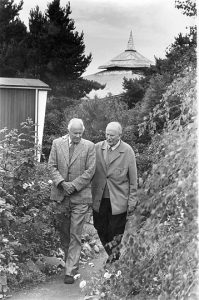
Peter Caddy & Richard St. Barbe Baker photo Findhorn Foundation
I first met St. Barbe (as he was called by everyone who knew him) in 1979, during one of his several visits to Findhorn. At the time I was quite young and relatively new in the community, having joined in October 1978, and was living at Cluny. Most of St Barbe’s time was spent at The Park, but he had expressed an interest in visiting Cluny, and I was asked to host him for the time he would be there. We had lunch together in the dining room, and I remember being somewhat in awe of this tall imposing man, who was a friend of Peter Caddy’s and had a significant reputation as a leading advocate of the urgent need for more trees in the world. We had a stimulating conversation and I was very receptive to his ideas, as I had travelled extensively before moving to Findhorn and had seen both the then-untouched forests of British Columbia in Canada, and the destruction of the tropical rainforests in the Amazon in South America.
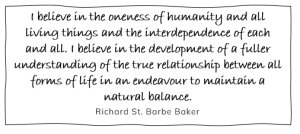 I was impressed by the fact that Peter and St Barbe seemed to get on so well together, and I’m sure that was due in no small part to the fact that St. Barbe was a deeply spiritual man, and a member of the Bahai faith. He also a had a large-scale vision for the positive action that he felt was needed to change the direction the world was headed in, which involved planting lots of trees. That resonated very well with the spiritual values of Findhorn, and especially the Deva messages that Dorothy received in the early years of the community.
St. Barbe’s visit in 1979 was timed to coincide with the publication of the paperback version of his autobiography, ‘My life, My trees’. That book had originally been published as a hardback by another publisher, but the paperback version was printed by Findhorn Press. It included a foreword by Peter Caddy, and in that he quoted a message that Dorothy had received from the Leylands Cypress Deva:
‘There is great rejoicing in our kingdoms as the Man of the Trees, so beloved of us, links with you here. Is it not an example in your worlds, that it is one world, one work, one cause under God, being expressed through different channels?
I am speaking on behalf of all the tree devas, who have long been overlighting the Man of the Trees, and we wish to express our deepest thanks to him. We hope he has always known of our gratitude for what he has done for us. We should just like to emphasise it in this way. He brings hope for all the world’s future. What contribution could be greater?”
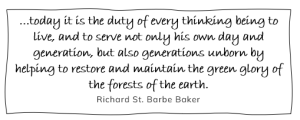 I was one of many people in the community who were inspired by the presence, vision and spirit of St Barbe. Another was Vance Martin, and he responded by setting up the tree nursery at Cullerne, using the name ‘The Tree Project’ and he also coined the term Trees for Life, as the title of the lead article in a brochure about the environment that he put together.
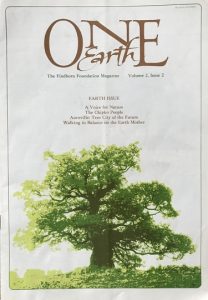
One Earth magazine – Earth Issue 1981 Findhorn Foundation
In 1981, Vance organised a week in ‘Celebration of the Tree’, the climax of which was a presentation by St Barbe in the Universal Hall, during another of his visits to the community. By that time I was working in Cluny Garden, and had already visited the Caledonian Forest in Glen Affric on several occasions. There, I had felt the forest’s inner call for help, as it consisted only of old trees, many dying at the end of their long lives without being replaced by any new ones because of overgrazing by deer. Once again I was asked to host St. Barbe during his time at Cluny, so I had some more very meaningful quality personal time with him.
Because I was more established in the community I also felt confident enough to offer to Vance that I could put together a slide show of photographs I had taken of trees, both here at Findhorn, as well as in Canada and during my travels in South America. I was rather surprised and just a little daunted when Vance arranged for this slide show to be the introduction to St Barbe’s talk in the Hall at the end of his visit.
 I had never done anything like that in the community before, and was rather shy, but it felt like the right thing and a great opportunity. At the end of the show, when St. Barbe got up to speak, he spent the first few minutes praising my photographs and how they conveyed the presence and spiritual essence of the trees. He then said that his organisation, the Men of the Trees (now the International Tree Foundation), had formerly published an annual calendar about trees, but they had stopped doing so and that had created a major gap in the market. He went on to state that the world needed a calendar about trees, and, looking and pointing straight at me, he said ‘and you’re the man to do it’.
At the time I already had an idea for producing a calendar that featured photographs of Nature combined with one of the Deva messages for each month, but I hadn’t spoken a word about it to anyone. Now it was out in the in the open and after St Barbe’s talk finished several people came up to me and while appreciating my photographs they also said they thought the calendar idea was a good one, that I should follow it up.
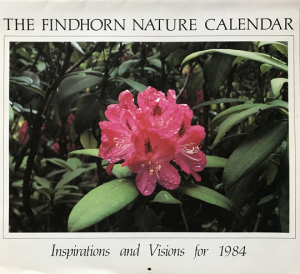
First Findhorn Nature Calendar 1984 photo Alan Watson Featherstone
I duly did that, and as result in 1983 I put together the first edition of the Findhorn Nature Calendar, for 1984. That sold well, as did subsequent editions for 1985 and the following years. This was achieved largely through the dedication and hard work of Constance Marcham, who handled all the sales and accounts etc in the first years, before the establishment of the Trading Centre (which brought together the calendars with the mail order sales of books, audio cassettes of music and lectures given in the community etc.).
After Vance had left Findhorn the tree nursery at Cullerne was taken on and developed by Linda Parker, and a ‘tree group’, including Linda, myself and some others, that had formed, adopting the name Trees for Life for it. Linda and I also led a week long workshop with that name as part of the Foundation’s summer educational programme in 1985.
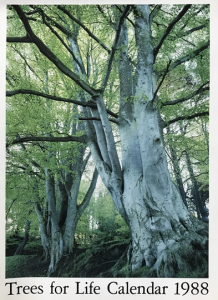
First Trees for Life Calendar photo Alan Watson Featherstone
However, I was still holding St. Barbe’s suggestion of a tree calendar, especially after I made a public commitment in the Hall at the end of the October 1986 conference, One Earth: A Call to Action’, to launch a project to restore Scotland’s Caledonian Forest. So it was that in 1987 I put together the first edition of the Trees for Life Calendar, for the year 1988. It featured photographs of trees and forests from around the world, combined with information about the threats they faced and groups working to protect them, as well as inspirational quotes from various well-known people including St. Barbe. It was the right product at the right time, and WWF-UK ordered an initial 8,000 copies, which they sold quickly, so they ordered another 8,000! The money made from those sales went partially towards the then-nascent project to restore the Caledonian Forest, and in 1990 part funded the 50 hectare Coille Ruigh na Cuileige fenced exclosure in Glen Affric. That was the first significant action of Trees for Life and established a partnership with the Forestry Commission (now Forestry and Land Scotland) for native forest recovery in Affric, which continues to this day.
So for me there’s a very clear link between meeting St Barbe here at Findhorn and the work of Trees for Life. I am one of many, many people around the world who were inspired by meeting him, and who are helping to translate his vision into reality now.

Born in Scotland, travelled the world over for nature, photography and nature conservation. I walk my talk through my lifestyle and my work – both professional and volunteering. Proud father of Kevin.


Leave A Comment