


This article was first published in One Earth magazine Volume 5 Issue 3, March/April 1985.
The past two years have seen a considerable improvement in the Foundation’s finances—the story of which has been well reported in these pages—and there is now much discussion and speculation based on a belief that this period of growing strength and stability is likely to be the springboard for a step into a new phase of economic and social organisation.
The purchase of the Caravan Park may turn out to be more significant than providing us with the means to repay our debt and the space to expand our activities. It is also an important statement about our permanence and our commitment to the development of a sustainable and holistic lifestyle on a long-term basis. There is now a growing feeling that the last 18 months or so represent a transition phase between the stage of community and a new stage of village.
In the context of the Foundation and its spiritual work, the idea of ‘community’ has come to imply a structure which embraces a group of individuals with common goals and lifestyles, living and working together in a single legal and economic framework. ‘Village’, however, tends to indicate a greater diversity. Villages have independent, even competing shops and businesses, more diverse and individualised lifestyles, dwelling places, financial circumstances, and a plethora of legal structures to cover the butcher, the baker and the candlestick-maker. Village may also imply a less transient state of affairs than the idea of a community.
Expressed in this way, Findhorn has found itself between two stools for some time. The lifestyles of Cluny Hill, the Park and Erraid are different as well as physically distant from one another. The Cluny baker and the Erraid candlestick-maker may have similar spiritual goals and aspirations, but their daily experience of community differs radically. However, until recently almost all the ventures spawned by the community have been under one legal heading—the Findhorn Foundation as a charitable trust. Furthermore, all staff members have received the same ‘wage’ (an allowance of currently £10 a week); and mobility between, say, departments has been both swift and easy to accomplish.
Nonetheless, the last few years have seen a flourishing diversity of new concerns which are associated with, but not part of the Foundation itself. These include Weatherwise Solar (now an independent company under the name ‘Appropriate Energy Systems Ltd’); Findhorn Bay Caravan Park, a division of New Findhorn Directions Ltd, the company owned by the Trustees of the Foundation; as well as Newbold House, Minton House, and the ‘Lollipop Shop’ (which is now owned by friends of the Foundation), plus a variety of independent and semi-independent individual members.
This trend towards greater diversity appears to be the result of several influences. First of all, the Foundation is beginning to ground a number of activities that have until now had only a peripheral or occasional profile in the community’s work. These include various healing techniques, sacred dance and a primary school. Others for the future may be work with youth, a recording studio, a research faculty and a building school.
These in turn have resulted partly because of the increased length of time that community members are now living here, a circumstance which obviously encourages such diversity. Another factor is the lesson learnt in an earlier period of our growth, between 1975 and 1979, when the community membership expanded rapidly from around 130 to over 300—a lesson concerning the difficulties of communication and decision-making in a large group. This experience, shared by many other organisations, is that breakdown in established channels of information-sharing occurs in groups of 300 or more, as face-to-face contact becomes increasingly impractical. Conflict between the need to involve everyone as much as possible in major decisions, and the need to take such decisions quickly and decisively, becomes fairly common.
As the membership declined to around the 200 mark, such problems largely disappeared, and now that a new period of growth is envisaged a more varied structure may resolve this dilemma.
This process is a logical step along the route of cellular growth that the community has been experiencing, but it does not mean that the Foundation will mitotically divide into small independent units, and that the village structure will completely replace the present community. Few members would wish to see the Community Centre become a restaurant, Cluny Hill a separate college or the studios turned into private businesses.
Indeed, it is likely that the Foundation will remain as the central core, both the entry point for new energies/individuals/ideas/emergent businesses, and the keeper of the spiritual message that forms the seed-bed for the surrounding activities of a more independent nature. Although no comparison can be fully adequate, perhaps the structure will be a little like that of a small university town, with the Foundation still the key point, but no longer the totality.
At this point, it might be appropriate to offer a rough sketch of the Foundation’s economic history over the past 22 years (see Chart 1). It is hardly a seminal work; at best, it is a rough approximation. It is also important to point out that each phase is contained within the next. Nonetheless, I hope it is a helpful guide; the key point being that a long period of retrenchment is over, and a new phase is about to begin.
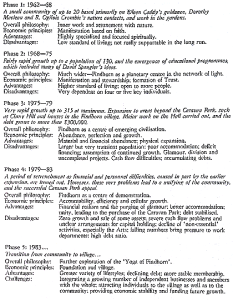
Chart 1
The first four phases are all encompassed within the general framework of ‘community’; the fifth phase, on which we are now embarking, moves us into the ‘village’ context. Although opinions on the subject vary, it is not my personal belief that there is a fixed blueprint which we are pre-programmed to follow in detail. Rather, I see certain externally induced impulses affecting the group being of Findhorn, and within the ebbs and flows of these impulses we are free to exercise considerable choice as to how, where and when we advance. It is therefore both difficult and perhaps somewhat presumptuous to make predictions about our future course.
However, various developments are currently emerging which may help give some indication as to the likely characteristics of the fifth and current phase of development. The most important appear to be financial diversity (which I have addressed to some extent above); financial stability; a building programme; debt reduction; and the creative use of capital.
A key characteristic of phase 4 (caused in part by the overheating of the economy in phase 3) was our communal inability to make ends meet on a regular basis. Over the four years 1979—82, there was a net operating deficit of around £30,000. We made no reduction in our overall debt—in fact, our indebtedness increased from £307,000 to £350,000. In comparison, 1983 and 1984 have shown a net surplus of close to £60,000, without including the Caravan Park appeal or any of the income from our operating the Caravan Park as a business.
Although the future will no doubt bring its challenges, we seem to have moved out of a period of crisis management into one of increasing prosperity and options, where there is more to consider than the imperatives of economic survival. One of the most important of these subjects worthy of attention is the building programme.
In becoming the owner of the Caravan Park, the Foundation has made a very powerful statement about its permanence, and our next step for this particular property is likely to be the replacement of the present mobile homes and temporary structures with more durable buildings. However, the village context implies first and foremost a way of life, and the physical structures that we create will reflect rather than impose a lifestyle. Whilst the two will obviously grow in tandem and form intertwined parts of a co-creative process, it would be more accurate to suggest that the construction programme will be housing the village rather than building it.
The outline of the programme has been discussed at great length in the community, particularly since the October 1982 ‘Planetary Village’ conference, but the planning stage is not yet at its zenith. It may be some months, perhaps a year or more, before the first new foundations are laid. As always, it will be necessary to gain a clear and united vision of what we are trying to create before any tangible results can be effected.
It can be a frustrating task to spend long weeks of discussions and paper-shuffling with little to show at the end of it, but the knowledge that the resources will flow when this preliminary phase is over lessens the burden.
The two most pressing needs are improving and expanding our accommodation, and replacing or expanding the Community Centre. The need for the first is fairly self-evident. Housing for our growing membership is insufficient for current needs, while many of the caravans are now coming to the end of their useful life. Accommodation for guests is also stretched to its limits for many weeks of the year. If we are to expand our membership and educational programmes at all, a programme of new building is essential.
The Community Centre has been a faithful servant for many years, but it too is now beginning to show the stress and strain of this service. During the busiest weeks of the year it is filled to—and perhaps beyond—capacity. If our numbers are to increase and if the Universal Hall is to be used to its full capacity, the Community Centre must be substantially renovated and enlarged. A new building might include a new reception area, a larger lounge, a food production/preserving area as well as an expanded kitchen/dining room.
Clearly both these major new developments will require financing as well as envisioning, and financing that is currently beyond the scope of our own operating resources. As always, we move forward in faith….

Chart 2
In relation to our debt, the graph of the history of the Foundation’s indebtedness shows that the growth of this indebtedness occurred during two brief but explosive periods (see Chart 2). The first was during the third phase of expansion when structural debt first emerged and quickly rose to over £300,000. The second was at the end of phase 4 when the completion of the Hall and the purchase of the Caravan Park sent the debt soaring again to just short of £500,000. Since then the CP loan has been entirely eliminated and debt is now once more at the £300-350,000 mark.
One of the prime financial reasons for wishing to purchase the Park was to have a means of paying off the balance of our outstanding debts, for although the rise in debt had been accompanied by a concomitant rise in our fixed assets (Cluny Hill, Cullerne, Station House, the Universal Hall), a number of difficulties began to emerge in the late 1970s. High interest rates made the servicing of this debt a considerable burden. The growth of the community had slowed and even been arrested, making repayment of the capital an increasingly unrealistic task. Another important influence has been a growing feeling that loan financing may no longer be appropriate for the community. It is not that borrowing money is thought to be wrong per se: rather that its role is perhaps more useful in business where return on capital is a major motivation.
Spiritual communities have of course to pay some homage to mammon if they are to survive and have relevance in the modern world, but the order of priorities is nevertheless different from that of a limited company. It is now widely believed that we can function effectively and well without the encumbrance of a debt.
We therefore intend to place £50,000 per year from the profit of the Caravan Park business towards debt reduction. This, with a little help from other sources, should entirely eliminate the debt by the end of the 80s.
The debt itself has come in a variety of guises, and today the three most important are the bank overdraft (£100,000); loans from private individuals on the Cullerne property (£46,000); and general private loans (£190,000). At this time it is not yet clear which debt we will attempt to eliminate first, as the constantly changing financial circumstances of our personal and corporate lenders make prophecy a risky business.
However, a paradox emerges. Whilst the motivations of those lending money to the Foundation have no doubt been as varied as the individuals concerned, an important factor has certainly been the desire to invest money in a concern they personally supported, as opposed to placing their assets in morally neutral profit maximising ventures.
It is hoped that the Foundation’s drive to reduce its debts will not remove this particular option. As more and more people begin to question the ethics of the businesses their money is tied up in, a strong movement for ‘socially responsible investing’ has emerged. Our role in this field is still nascent, but we hope to have concrete proposals soon.
Currently there is over £300,000 of private capital in the community’s hands. This includes the members’ savings club, now standing at over £100,000. Other than direct investment in the Foundation’s work, which will take less and less of this sum as the overall debt is reduced, there are two other possibilities available:
1) Investment in village activities/businesses outside the Foundation.
2) Making use of the Foundation’s stock-broking facilities to re-invest monies in other socially responsible ways. We are registered clients of Phillips and Drew of the London Exchange, and we are exploring methods of extending this facility to members and friends of the community.
In many ways we are in a similar position to the one we faced just after the beginning of the last period of expansion in 1975. We have borrowed a substantial sum of money to purchase assets with considerable financial potential; now we are anticipating the return which will clear those debts. That previous period was in many ways highly successful, but it left a residue of difficulties which took several years to clear up. If we have learnt the lessons of that time well, we can look forward to the emerging village of abundance.
New challenges will no doubt emerge, and amongst them will be finding clear ways to encourage and communicate with groups and individuals who are of the village but not of the Foundation, and of keeping a clear message alive in a diverse structure. One thing does seem fairly certain, and that is that the only stability will be in accommodating change. Standing still is not an option that seems to be available for the Findhorn Foundation.





Leave A Comment