


Have We Evolved?
It was the last five minutes in the fourth of the monthly Foundations of Findhorn evenings scheduled for our 50th birthday year. A final questioner asked: Have we evolved?

Not all that big a topic for the remaining time available …
The evening was focusing on the mid-70s, and the question, as I understood it, was Have we evolved since then? I gave a brief answer but the question was still with me when I woke the next morning. Have we evolved? I think the answer depends on what we’re looking at and what we’re looking for. Maybe also where we’re looking from. Here’s my take on it.
It seems to me that our job today is the same as it was back then. Bring heaven down to earth. Do God’s will. Co-create with spirit and nature.
Embody a holistic consciousness. Be the change we want to see in the world. Different words for different times, but all of them describing in one way or another a process of accessing deeper levels of ourselves, of spirit, of life, and giving them shape and embodiment.
 We human beings are amazing creatures; we live in and have the capacity to attune to, engage with and bridge different dimensions, metabolising and alchemising them within ourselves and bringing forth new creation. We span both physical and non-physical worlds, with the capacity to move along a kind of spectrum of consciousness and expression, from the long waves of soul to the short waves of the details of our daily lives. There is something timeless in us, and something also able to engage with the specifics of time and space. We can bridge and honour all of it.
Have we evolved? If there are more of us practising and able to be these bridges, then I would say yes. When someone that evening asked how many people felt they and we were guided today, most of the people in the hall raised their hands. That suggests to me that most people, in whatever ways work for them and however they describe these, are accessing the levels of soul in meaningful ways that affect and support and find expression in their everyday lives. That they are practising being bridges.
Something new is birthing and unfolding in humanity and the earth. Because it’s new, we don’t fully have the language for it yet. We can’t fully know and describe what it is until we’re in it. Also, not fully knowing what it is, it’s difficult to say whether or not we’re evolving in line with it, or where we are in the process. So in the meantime, we do the best we can, learning to attune to and describe and live it, one step at a time. We’re somewhere in the middle of a process. A lot of what was ‘new’ in the 70s is now mainstream, both in consciousness and in form. But there is more.
And it does need to live and find expression in us. It’s not going to happen magically with the wave of a wand or just because we reach a particular date. And because it is new, we don’t know how to be and do it yet. So we can’t expect ourselves to have it all together, or to do it right. We can only practise.
For me, Findhorn is a centre of practice rather than (as it used to be called) a centre of demonstration. When you practise something, you don’t always get it right. But you do get better. If I practise playing the piano, I’m likely to become a better piano player. If I practise dancing, I’m likely to become a better dancer. If I practise being a bridge between the worlds, I’m likely to become a better bridge. A living bridge, bringing heaven and earth together in me. And also, because I’m a fractal of something much larger, contributing to bringing heaven and earth together in that larger field. Our capacity to attune to the subtle levels of soul, to the generative unfolding patterns of the source and the sacred (or whatever names we give this essentially un-nameable presence), and then to give it expression in our individual and collective lives, is what will bring new forms into being.
Perhaps we are demonstrating something. We’re demonstrating a practice, not so much a result, at least not a result in itself. Although the result is also important. The practice of co-creation with nature in the early days of the community resulted in extraordinary gardens and the legendary 40 pound cabbage. But those early Findhorn pioneers didn’t set out to achieve that result. They set out to practise co-creation. A vibrant garden – and that 40 pound cabbage – was a result.
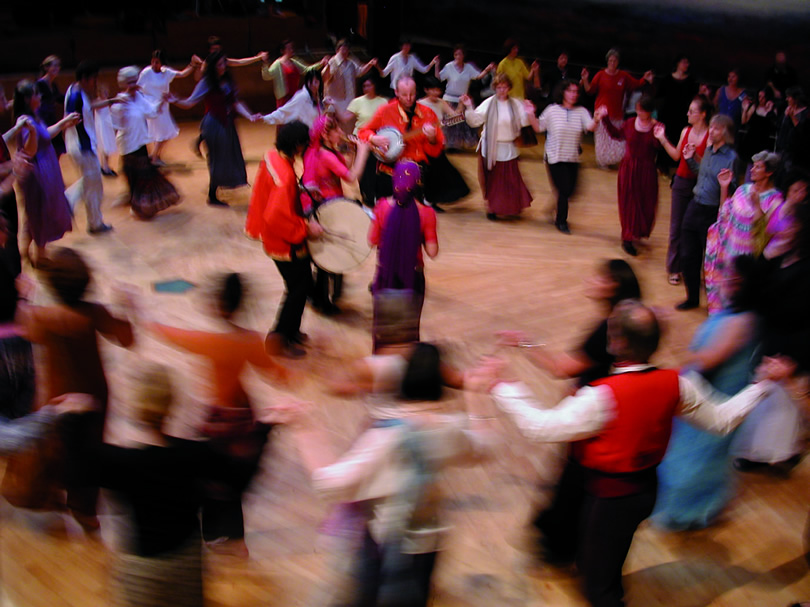 David Spangler once called the Findhorn community a place of inspired muddling. I like that image. For me, it has both hope and humility in it. And it’s kind. It allows us to practise, and not to have to get it right first off. It allows us to play wrong notes, to notice this and not beat ourselves up for it, to give it another go and to play better next time. To learn to play wonderful songs … and then go on to other songs we haven’t mastered yet, and practise those.
The songs of today are different than the songs of the 70s. But the essentials of the practice are the same. And it’s the practice that will enable us to play more complex songs and allow more complex songs to emerge. And of course each of us has to start with practising and mastering the simple scales. Practising being able to access and play and harmonise the different dimensions of ourselves, from the most specific and particular parts of ourselves, to the most expanded and cosmic, plus everything in between – the fullness of our whole incarnational selves.
Is evolution the increasing complexity of the songs? Maybe. Or is it the increasing capacity to bridge and harmonise and partner with the different dimensions of ourselves, of our environments, our families, our groups and organisations, our cultures, our gardens, our homes, our planet – so we can play and sing these songs? Maybe. Maybe both. Something co-arising – a symphony that emerges and writes itself and sings itself through us, with us, in us, because of us, and because of all life on all levels of existence.
Mary Inglis

Came to join the Findhorn Foundation in 1973. Born in Scotland, grew up in Lesotho, educated in South Africa. Still lives in the Findhorn Community.


Leave A Comment