

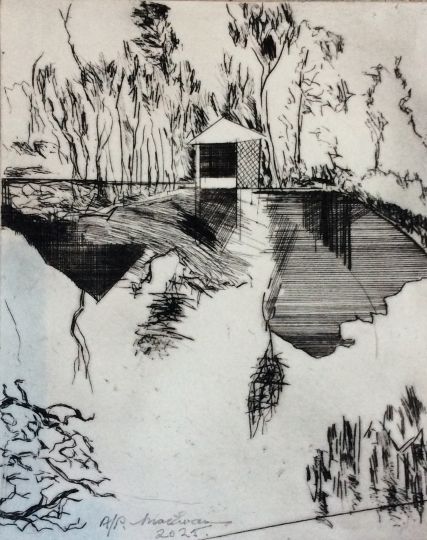
During the winter of 2024-5, the artist Geoff MacEwan produced six etched copper plates inspired by his discovery of the pond at Cullerne Gardens and the World War II relics on the shore of the Moray Firth.
‘Almost from the first moment I set foot in this Moray landscape I started to draw as if this was the only way in which I could settle down,’ Geoff says. ‘My subject became the pond at Cullerne Gardens with its small wooden summer house and its surrounding trees whose winter profiles were reflected in its still waters. It was November and the days were becoming shorter. The water lilies had died back and the stems of the bullrushes had grown pale and brittle. Day after day, I sought out this peaceful place where I could rest, meditate and draw. I concentrated on capturing reflections from the trees and the way the slightest breeze ruffled the water and stirred them into jagged movement. I had to start somewhere, and the pond at Cullerne Garden became my somewhere.’
The pond is situated in what was a productive garden once upon a time, which supplied the tables of the former Findhorn Foundation Community Centre. Two large poly tunnels still stand, cared for by dedicated volunteers, but the surrounding vegetable beds and garden ground lie sadly neglected, awaiting the resurrection of Cullerne Gardens.
‘It fascinated me that every time my experience of the pond was different,’ Geoff continues. ‘Sometimes a little bit of breeze disturbed its surface, scattering reflections in the water of winter trees and sky. At other times the surface of the pond was completely still and perfectly mirrored the arboreal tangle on its banks. I became interested in the way in which the trees seemed more real in reflection than in actuality.’
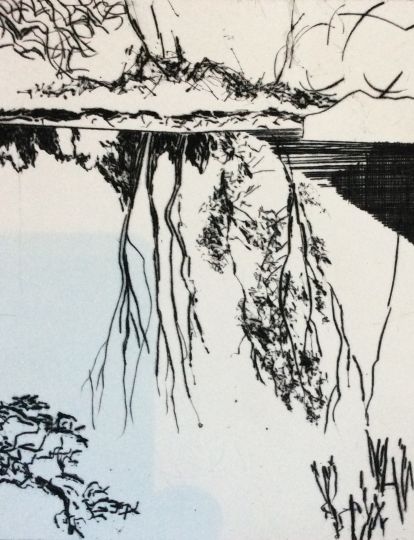

Simple observations like these inspired Geoff to make different sorts of marks in his sketch book. ‘When you’re a painter, your subject matter is often determined by the marks you’ve become used to making, but when other places inspire, you’re forced to develop a different sort of mark to describe them. To capture the pond in preparation for the copper plates I intended to etch, I first made drawings, and I also took photographs as aide-memoires for the next stage.’
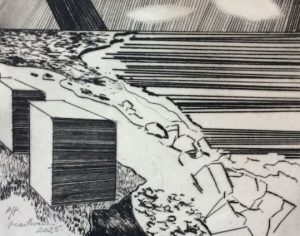
Findhorn Beach
Often, after his sojourn beside the Cullerne pond, Geoff walked on to Findhorn Village and the sea, to where the bunkers, relics of World War II, lie scattered on the shore. ‘This particular portion of coastline has a long history of erosion and the seaward fringe of its expansive hinterland is lined with an array of concrete pill boxes or bunkers,’ Geoff observes. ‘Many of these obstructive wartime cubes have been slowly undermined and have collapsed into the sea. At low tide the sea retreats for a considerable distance, laying bare large areas of fine sand. In other places they have been overrun by the landscape’s invasive gorse, and their concrete surfaces are stained with vivid white streaks and cracked so that they have become an almost natural, and yet ominous, feature in the landscape.’
The next stage in the work became ‘the laborious but infinitely satisfying’ task of etching the copper plates with the marks stored in Geoff’s mind, his sketch book, and his camera. Then, at the Edinburgh Printmakers, the plates were inked up, wiped, and ready to print as in the examples shown in this post.
***

Geoff MacEwan self portrait print
Brief biography: Geoff MacEwan’s mother hailed from the fishertown of Findochty. ‘Perhaps that’s why I’m drawn to Findhorn and the North,’ he says. His mother became a nurse during World War II in Edinburgh where Geoff was born. Following a postgraduate degree from The Slade School of Art, London, he had a remarkable career as a painter and printmaker in the Netherlands, Spain, and the UK. He studied printmaking with Joan Miro’s printmaker, Joan Barbara, and exhibited widely in Spain. In 2011 he had a solo show ‘From Scotland to Spain’ at the Moray Art Centre. These days he divides his time between Edinburgh and the Ecovillage Findhorn.
***
Prints are available from Geoff, they measure 10×8 inches. For enquiries and/or orders please leave a Comment below.

I am a published Author and live in Edinburgh these days with my partner, the artist Geoff MacEwan


Lovely story. I wonder if he was at the Slade with Bartolomeu dos Santos?