


This article of Jonathan Caddy interviewed by Michael Hawkins was previously published in Network News Issue 32, Winter 2002.
***
While the story of Findhorn’s early years is well chronicled I have often wondered what it was like to be one of the Caddy boys growing up in that caravan and atmosphere of spiritual magnetism, so I asked Eileen and Peter’s middle son, Jonathan, to travel through the past lightly and tell us the story through the eyes of a child.
Can you remember that faraway November day when your family’s caravan pitched up here?
Oh definitely, I remember it very well. I was six years old and, unusually for me, I was off school and sick in the caravan. We had to move from the Findhorn village seasonal caravan park and arrived at this little hollow in the Findhorn Bay Caravan Park while I was still in the caravan. I remember looking out the tiny window at this grassy sandy plot that was to be our new home.
We were in one of the corners of the caravan park, the only caravan there and later Dorothy came and joined us in the annex so there were three adults and three boys. I have a big connection with that caravan; I was born there, in the front room, 46 years ago.
We had grown up in hotels, Cluny Hill and the Trossachs and that was great fun as there were big indoor spaces for games including hide and seek, but we boys loved the change from hotel to caravan. We spent an awful lot of time outdoors and I am sure that my lifetime love of the great outdoors has come from that time. It must have been difficult for our parents who were used to other things; socially, I know it was a come down for them to live in a caravan. As children, you don’t see it that way, the change was great for us. lt really was a wonderful place to be brought up; we were next to the Bichans’ farm with its fields of barley to the south, the sand dunes and the shores of the Moray Firth to the north and close to Findhorn Bay and the sea to the west. For us it was a terrific place to grow up; for our parents it must have been a very different story.
At the time my elder brother Christopher was seven, and my younger brother David was four. My mother had two batches of children, we were the second and each son was born within a year of each other.
How was it when your homestead grew and all these open, exciting adults descended on you?
It’s important to understand that when you’re a child you think other people live the same way as you do and you don’t understand your upbringing might be different from other people’s. Only later do you look back and think it might have been a bit strange. To us we saw all the pluses. My parents were definitely involved in setting up the community and doing a lot of different things within that community.
But we had second parents. John and Janet Willoner took us out into the mountains and on camping trips. They had moved here in the late sixties and taught at local schools, but were also involved in the community. There were many positive aspects to having so many different people around, we learned some German for example. There was such a richness we could draw on and we did. It’s strange how things happen but after 30 years away John Willoner has now returned: I have a different relationship with him now!
“I do think it is quite appropriate
that we take some time to reflect
and ponder on what has
happened and start to dream of
what is the future.”
Did you and your brothers ever help out in the gardens or were you out of reach in the dunes?
Oh yes, the magic of Findhorn was, take it from me, rooted in child labour! The Findhorn Garden was built on an ancient shingle ridge and it was basically all stones and many, many of those stones were taken out by we boys and the couch grass too. As for the size of those big cabbages, well it was us that picked off the cabbage white butterflies to make sure they didn’t leave their eggs and grow hungry caterpillars. So Devas, nature spirits and compost might have been involved but so were we.
I’m being a bit tongue in cheek but we did do a lot of things in the garden, like harvesting, podding peas, picking raspberries. We enjoyed the benefits too of looking out of our tiny caravan window onto the garden. It was very special, nurturing and nourishing looking out on the apples and the redcurrants and just being in that simple environment, close to the earth.
Do you have any special memories of that time?
Collecting horse muck for our compost with our galvanised bathing tub was one! We used the same tub at other times to bathe in, in front of the caravan fire. Seeing smoke on the horizon and hurrying there to explore for wood ash, again for the compost, was another. It was a simple life you see, we were not a rich family, we had free school meals, but we didn’t think that we were poor.
We were definitely kings because we had plenty from the garden and the landscape but in terms of money we didn’t have much at all. I have so many deep friendships all over the world with people that I met then. Much later I spent two years travelling the world and reconnecting with those deep connections cultivated here.
Did you boys go to sanctuary and were you interested in all the activity that was going on?
We couldn’t avoid it. There were things the adults were doing that caught our attention like the big globe housed where the main sanctuary now stands. Pins showed the network of light centres around the world. Later on my father would play classical music in the sanctuary after meditation on a record player and this interested us as we didn’t have a gramophone in the caravan. It was quite special then because music wasn’t so readily available and it brought people together in the sanctuary. It’s something I clearly remember, sitting listening to inspiring pieces of music by Bach, Beethoven or Tchaikovsky. Dressing for
dinner was another thing my father introduced to the community and the formal dressing up was a lot of fun.
Did ROC (Robert Ogilvie Crombie) ever sit you on his knee and tell you wondrous stories?
No, by the time that ROC came on the scene we would have been young teenagers and it would have definitely not been good for the image to cuddle up for a story at that age! We were aware of the important missions that my father and ROC would go on visiting mountains and places of power and linking up with a whole host of people, but these were simply things going on in the background of our lives. I do remember staying at Ogilvie’s flat in Edinburgh and wondering how anyone could ever have more books in a single dwelling than he had! No toilet in the flat but books lining every conceivable space and a large piano in the middle of the living room. He was a quiet, cultured and likeable man who was just another person in our busy and interesting lives.
What was it like, the contrast between all these open, questing adults and the local school? Were you bullied because you were so different?
We started at the local village school in Findhorn which is now closed. Difficulties like bullying came more at secondary school especially when there was media attention on the community. I can remember some of the teachers making jibes, saying “you are away with the fairies” and that sort of thing. That hurt a bit. We were a little bit separate but generally we got on with the rough and tumble of secondary school. At university, studying Ecological Science, it was alright as few people knew my connection with the place.
I suppose it is something I’ve had to live with all my life, not being seen for who I am but being seen in connection with the Findhorn Community and my parents. There’s been a lot of growing up and working out I’ve had to do in that area. I had to come to an understanding that if the Findhorn Foundation and what it stands for does really make a difference, it’s not in the words that are used. No, not in the jargon that’s bandied about or the things that we think we do, but it’s actually how we relate to other people in our daily lives and how we relate to things around us which are very fundamental basic things to do with how we live our lives. So that’s something I’ve had to come to terms with. lt’s easy to think you might be doing great things that change the world but actually it’s what we do, how we personally live life that’s important.

Caitlin, Jonathan, Eileen, Alison photo by Kate Bewick
What did you make of the fact that your mother spoke to God?
I thought it was normal as I thought other people’s mothers spoke to God. It was only later that I realised it wasn’t normal. My mother was my mother! And yes, there was all this attention about my mother receiving guidance and my father acting on it. Some incredible things were happening and yes, I was questioning things in the back of my mind.
One particular event that remains in my mind concerns a spiritual teacher named Liebe Pugh who lived in England at that time. My mother used to get up at three in the morning and write her guidance in her blue books. This particular night she received a message about Liebe passing on. Late in the afternoon of the following day we received a telegram about Liebe’s death which had occurred at the time my mother had received the guidance. I did have that little ‘doubting Thomas’ feeling and these sort of events affirmed my awareness that something very unusual was going on here.
A lot of unusual things happened when we were growing up where guidance would be received and acted on even if it seemed beyond the realm of possibility. The magic did happen. My father helped because he was a master at knowing how to use the talents of the different people who arrived on our doorstep unannounced, in a way that would serve not just them but the general wellbeing of the fledgling community.
What was your relationship with your parents?
At the time my mother was my mother, my father my father, my brothers my brothers! My mother had eight children, I was number seven. I was the middle one of the second batch. Whatever else she was doing in the community she was a great mother. She always kept the home feeling warm and nourishing, and no matter what the difficulties, there was always food on the table. Sometimes we’d have to look for the meat in the stew but it gave us an early appreciation of the importance and blessing of having food on the table.
As a family our parents never stifled us. They were both outward looking with so many things going on for themselves, that when it came to career and university, it was very much up to us; they didn’t push us in a particular direction.
My father. He was truly someone who lived his life to a different drummer because the principles by which he lived were different. Some might think he lived for the glory of himself but it was quite the reverse. In truth, he had learned to control his ego so that most of the time he was selfless in what he did, but it might not have come across to people like that. He had social qualities too. Yes, he was a strong personality, but he knew how to work with people and draw the best out of them.
My younger brother David is a builder and worked on our home several years ago; we have a good friendship. My elder brother Christopher is a consultant plastic surgeon in Sheffield. I see less of him now and he has four children. We don’t talk an awful lot about what happened up here but it was certainly something that has bonded us and will keep us together.
“I am sure I will be amazed at what physically will happen here in the next 40 years; God willing, I may even get to see what happens. I am sure reality will be far more incredible than my wildest dreams; if you had seen as much change in this little place as I have, you would know what I mean.”
How do you feel about the community reaching its 40th Birthday ?
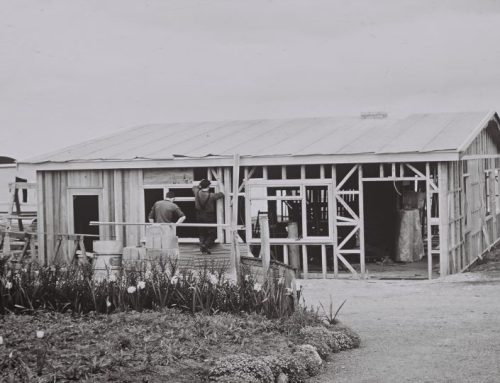
40 years seem to have just flashed by. The place is unrecognisable in many ways. Physically the old RAF site of Pineridge with its corrugated Nissan huts and block house mess hall etc and the rather desolate open, main part of the caravan site have been transformed by now quite large trees and garden spaces. Permanent structures in the form of the ecological buildings have started to replace the rather worn out original caravans and a plethora of people and businesses now populate this area. By now hundreds of thousands of people have been touched and become involved with the goings on of this place.
Looking at the larger dimension, a new, modern day, transformative myth has been created here that questions man’s materialistic relationship to nature and promotes people looking at the spiritual dimension of what life is all about. Difficult to believe that all this has happened here over the past years but I suppose it was all in my mum’s visions right from the beginning. Even so, it still is incredible that it all has really happened.
I do think it is quite appropriate that we take some time to reflect and ponder on what has happened and start to dream of what is the future. Having a 40th Birthday Party is a great idea and a great excuse to have people return, wonder and re-engage with this place.
I am sure I will be amazed at what physically will happen here in the next 40 years; God willing, I may even get to see what happens. I am sure reality will be far more incredible than my wildest dreams; if you had seen as much change in this little place as I have, you would know what I mean. But I suppose it is the unseen positive transformations that happen in the lives of people who have had contact with this place that will bring most change to the world. I am sure the world will be a happier and healthier place
from whatever goes on. It is an incredible ongoing story, isn’t it!?

Grew up here, studied Ecological Science, worked as primary school teacher most of my life; travelled widely; passionate about nature, community, sustainability. Father of Caitlin and Jay.


Leave A Comment