

 RITUALS IN COMMUNITY

The Wheel of the Solar Year
Before chronological time, mythic time was counted in cycles that reflected the movements of the cosmos. So the Celtic wheel of the year is the story of the sun’s journey through the heavens, the waxing of the Sun God’s energy from Winter Solstice to Midsummer, and the waning of his cosmic virility from Midsummer back into the dark of the Winter again.
 The Celtic peoples celebrated the cyclic flow of the year at eight points during the year. Each point marks the outward physical manifestation of the changing seasons and rhythms of nature and also honours the energetic changes that happen in synchrony with the subtle realms of our inner landscapes. The four fixed points of North (Winter Solstice); South (Summer Solstice); East (Spring Equinox) and West (Autumn Equinox) form a cross known as the Quarter Points. In turn these are crossed again (as in Scotland’s St Andrew’s Cross) with the Cross Quarter Festivals. These are the great fire festivals and they fall at the seasonal peaks so we can connect with the power of the energy of the incoming season.
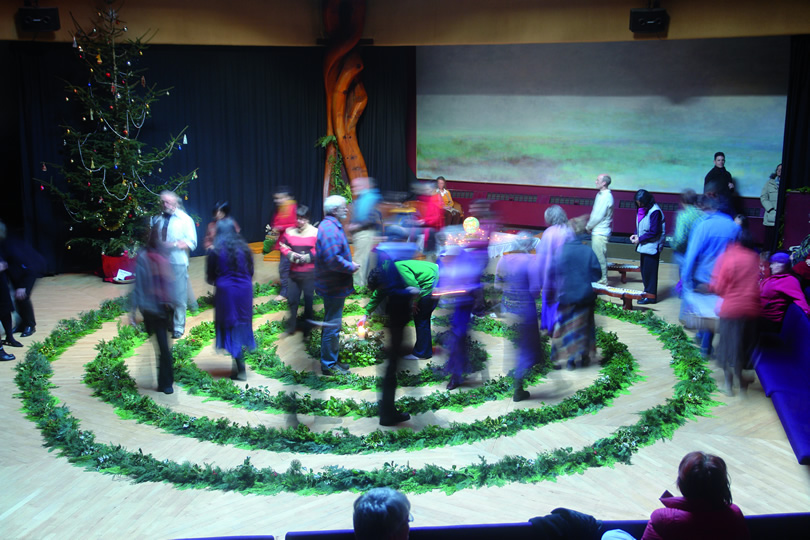
At Findhorn we celebrate these Celtic festivals, and at the time of writing we have passed the time of the longest darkness (the Winter Solstice) which the Community marks with a Solstice Spiral and meditation. Now we are moving towards Imbolc on February 1st. At Imbolc we experience mythical and natural time in the marking of the season of the ewes coming into their mother milk, in preparation for the spring lambs. As the earth slowly warms, we celebrate the Feast of Bride, or St Brigit, and welcome Bride in as the goddess of the land in her maiden aspect. Celtic legends of her as the midwife for Mary and nurse of the Christ Child lead her to be known as the Mary of the Gael.
As the Earth’s energy gathers apace, we celebrate with twin Beltane fires on April 30th, when we fire leap and seign (purify and strengthen) ourselves for the fulfilment of the year’s harvest to come. In Celtic Pagan tradition Beltain is the night of the Greenwood marriage between the Horned God and the fertile Goddess and we dance around the maypole on the Community’s Village Green on May morn.
Midsummer Solstice usually sees dancing and singing, games and a sharing time for the Community when the weather is warm and the days long.
Lammas or Lughnasadh at the end of July, and the Autumn Equinox, in the Community tend to be subsumed into a celebration of harvest and thanksgiving. Carts of home-grown produce from the gardens are decorated with flowers and laden with fruits and vegetables and processed to the Community Centre, where there is a big harvest supper.
Samhain, which begins the Celtic New Year, is celebrated with another big bonfire on Halloween (31st October), when Celtic Pagan and the more modern ‘trick or treat’ meld together with a night procession of ghouls and witches ending with fireside stories and singing. It is also a time when we honour the passing over of loved ones as the ancients would also honour their dead. Myths retold of the shaping of the land by the ancient crone mother goddess the Cailleach, remind us once again of the primal way of hearing the world into being, long before time and the written word gave form and shape to our modern life.
By remembering and re-enacting the old ways I feel we as a Community connect with ancient forms of wisdom that ground us in the deep memory of the Earth and its peoples. May it be always so.
Sue Clutterbuck

Professional career spanning over 40 years in Education since 1978- Academic Profile with various Universities in England and Scotland; Music, the Arts, Celtic Festivals Ancient History interests





Leave A Comment