


This post has been compiled from hardcopy minutes and notes provided by Alex Walker. We are very grateful for his diligence to keep these files for such a long time. As the documents are often not dated we may have gotten some of the sequencing wrong and hope that our collective memory will help to straighten out any mistakes. Please leave a Comment at the bottom of this page with more information.
For ease of seeing the extent of the sections we have used the function to collapse some of the text – just click on the arrow on the left to expand that section.
Summary
Initially there were two parallel processes in the Findhorn Foundation (FF) and in the Open Community.
The process in the FF resulted in a reinvention which is described in Robin Alfred’s article The Reinvention of the Findhorn Foundation in the 50th Birthday Book ‘Spirit of the Future’.
In the Community one initiative was championed by Mo Willett and another by a group of Community members, some working in the Findhorn Foundation, others in Community organisations. The latter was called The Circle and many invitations to those meetings was signed by Alex Walker.
Those two strands merged into the Findhorn Bay Community Association Task Force by September 1996. The Preamble of the Proposal to create a Community Association states:
Since the early spring of 1996, a group has been meeting weekly to explore the formation of an ‘umbrella’ community association, to include all those living in the area who are (or wish to be) engaged in the spirit and practice of the Findhorn Foundation Community. Recent years have seen the growth of a bewildering array of categories to describe these people — Foundation Staff and Students, NFD employees, Independent Members, Open Community, Ex-members, NewBold House, et cetera — and this has often led to confusion, divisiveness and feelings of separation. There was a clearly felt need to reaffirm ‘unity in diversity’ and return to the basics of spirit, service and sociability that informed the original members of the FF Community.
The process in more detail:
In February 1996 Mo Willett produced a paper proposing a group to come together to “seriously brainstorm a sustainable structure” to move beyond the Open Community set up by Amanda Lumbley.
Read Mo’s paper
(The formatting of the document was lightly edited to improve legibility.)
(1) The Foundation is a business with
a) potential and actual income
b)possessor of financially valuable assets.
(2) The Foundation is a Charitable Trust with the ability to fund raise under that flag.
(3) To run most of the departments, both at Cluny and the Park, the F. relies on a great amount of
a) paying labour
b) unpaid labour, relatively small amount of c) paid labour.
COMMUNITY AT LARGE – amount of heads?
APPROX 500….Open Community, ex-members, independant, others.
(1) So that the Foundation did not have any more to think about other than its own members, it passed on to Amanda the Open Community. When a subscription levee was asked for BY THE FOUNDATION, this automatically excluded everyone other than Open Community (in the form presently suggested)
(2) The COMMUNITY AT LARGE is a different entity from the being invoked by the Foundation, I see this being vibrant, clear, with locked up energy in all forms just waiting to expand, flourish.
(3) I recently spoke to Judy Buhler McAllister along these lines; The literal BUSINESS STRUCTURE of the FOUNDATION is a being struggling to find its new form. The POTENTIAL BEING of the Community, if it could find its form, definition, purpose, be a self regulating, self responsible, self financing unit with clear aims and structure, then the FOUNDATION would know exactly what it was dealing with, with respect to
a) how many hours voluntary service it can realistically expect from volunteers
b) how much money it may expect as a donation towards the supply of services and
c) what it DID NOT HAVE TO FUND RAISE FOR i.e. the COMMUNITY WOULD FUND RAISE AND BUILD MANY OF THE SERVICES REQUIRED BY a community. She heard me, and agreed in principle.
(4) STEPS TO TAKE.
(1) Form a group to seriously brainstorm a sustainable structure and see where Amanda has got to in her set up. This group to address subjects such as a) what level of donation would be required to be enough to meet the needs of
a. the Foundation
b. the group administration,
c. the needs of participants,
d. looking at card which would cover Phoenix, busses, hall, etc.
(2) How can we keep alive the STREAM OF SPIRITUAL PURPOSE the place was founded on?
(3) How can we educate the new stream of people coming in to preserve that purity?
(4) Looking at new ways of organisation that allows fluid management, leading to self empowered leadership to get a job done.
(5) Open access to information, NO SECRECY
(6) Group work, co-operation is the key, alongside totally open and honest communication of facts and feelings.
(7) Leaving aside at the moment how the Foundation is going to restructure, I think the entity of, the wider community is
a) where direct action is taking place and
b)where, in the future the real sustainable community living will take place.
OTHER JOBS
(8) Identifying skills of wider community so that directory can be drawn up. This could lead to;
(9) Wider community running its own education streams.
(10) a clearly stated time, place for meditation as a focus for the community.
(11) Purpose clearly defined in terms that can be heard and understood by the public.
(12) Active networking, information by means of a community new-sheet on public sale (or subscription) n.b. out of 65 people answering my questionnaire, 52 agreed to support a magazine, in whatever form that might take. This seemed to have universal support, the idea of a support/information/skill/help network.
(13) Can we use LETS*) more
*) LETS = Local Exchange and Trading System
A clipping refers to an Update on Trustees Meeting with FF and Community April 29th 1996
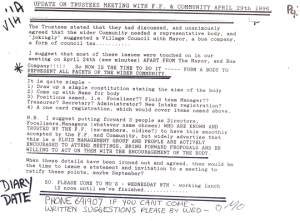
and Mo invited members to join her for a “working lunch 12 noon until we’ve finished … to draw up a constitution for a body representing all facets of the wider community.
The Circle
A Draft constitution was drawn up
FINDHORN COMMUNITY ASSOCIATION
or
A Council of Elders
Purposes
To encourage the realisation of the vision held by the Founders of the Community.
To maintain the integrity of the Community.
Conditions of Membership
Members shall strive to maintain a daily routine of ten minutes silent spiritual practice.
Members shall achieve this aim at least three times per week.
Members shall strive to maintain a compassionate, loving, wise, empowered and caring attitude toward all beings and act with integrity in all their affairs to the best of their abilities.
Decisions
Decisions at all meetings shall ideally be made by unanimity, failing that by consensus.
If consensus cannot be reached, a decision may be made by a two-thirds majority of those present and voting.
Steering Committee
The members shall appoint a steering committee of up to six persons, chosen from their own number, who shall organise the affairs of the Association. The members shall then appoint a chairperson from amongst their number. The Committee will be re-elected on an annual basis.
Chair
The chair of the Association shall keep a record of all members past and present. This record shall be open to inspection by all members.
The chair of the Association shall keep an up-to-date copy of this constitution. This document shall be made available to all members.
Appointment of Members
New members shall be appointed at a plenary meeting open to all members.
A member may be expelled from the Association at a plenary meeting open to all members.
All members shall be admitted for two years. A member may apply for re-election after this period has expired.
Collective Assets
The Association shall not accept any goods or monies by donation, for services rendered, or for, or by any other means.
Plenary Proceedings
The steering committee shall organise plenary meetings from time to time.
The proceedings of these meetings will not be confidential, unless explictly stated otherwise.
Non-members of the Association may be admitted to attend and speak at plenary meetings at the discretion of the chair.
Council of Organisations
An organisation may affiliate to the Association. Such affiliation shall not imply any rights or privileges of any kind save that:
a) such an organisation may advertise its affiliation to the Association in a discreet way.
b) Such affiliated organisations may organise a meeting of representatives of their number (two shall be members or associates of the Association) to discuss matters of mutual interest.
Any disputes amongst the Council shall be resolved by a plenary meeting of the Association.
Such affiliation shall be admitted for two years. An affiliated organisation may apply for re-election after this period has expired.
Affiliated organisations who lack a representative who is a member or associate of the Association shall be deemed to have had their affiliation lapse.
Associates
The conditions for and appointment of associates shall be those for members.
Associates may not however vote in any of the proceedings of the Association. For the avoidance of doubt, associates are not Members of the Association.
The first plenary meeting of ‘The Circle’ was held on 18th March 1996.
For a meeting on the 30th September 1996 the Findhorn Bay Community Association Task Force presented
The Proposal to create a Community Association
Preamble
Since the early spring of 1996, a group has been meeting weekly to explore the formation of an ‘umbrella’ community association, to include all those living in the area who are (or wish to be) engaged in the spirit and practice of the Findhorn Foundation Community. Recent years have seen the growth of a bewildering array of categories to describe these people — Foundation Staff and Students, NFD employees, Independent Members, Open Community, Ex-members, NewBold House, et cetera — and this has often led to confusion, divisiveness and feelings of separation. There was a clearly felt need to reaffirm ‘unity in diversity’ and return to the basics of spirit, service and sociability that informed the original members of the FF Community.
This group — now calling itself the Findhorn Bay Community Association Task force — made toe-in-the-water presentations to a number of groups and individuals, and was encouraged by all to continue its task. Its present membership represents almost a cross-section of the Community today, in terms of years of experience, background, management and education: it includes Fabien Barouch, Judith Berry, Jeni Cave, Joycelin Dawes, Roger Doudna, Alexander Heybroek, Marion Leigh (formerly Stoker), Christopher Raymont, Jeremy Slocombe, David Steel, Eve Ward, Carmen Weaver, Mo Willett, and Howard Wood.
Aims & Purposes
The Community Association is to be a simple organization to which individuals may subscribe, according to their means, talents and services, in which the founding vision, principles and practices of the Findhorn Foundation Community may be maintained and furthered. It aims to serve the Foundation through the provision of functions and facilities for the common good of the whole, assisting the establishment of a sustainable community lifestyle. It aims to ensure clear and open communication and information among its members. It aims to organize communal work parties and celebrations; to provide access to Foundation-owned facilities; to welcome and monitor newcomers; to sponsor educational programmes outwith the published programme of the Foundation: to create an internal economy, probably incorporating a LETS system; to coordinate ecologically sound and aesthetic building projects; to represent, support and work to the common good of all those in the local area who feel a spiritual and social connection to the work which Peter and Eileen Caddy, and Dorothy Maclean initiated here in 1962.
Structure
- The immediate legal structure of the Community Association will be that of a social club, with duly appointed Secretary, Treasurer and (if desired) Chairperson. It will call itself ‘Findhorn Bay Community Association’ to distinguish itself from the village of Findhorn as well as to include those living in the broad geographical area of Findhorn Bay (say, a 30-mile radius).
- There will be a steering, coordinating committee to perform executive functions; this will replace the present Task Force, upon formal Association.
- There will be a wider ‘village council’ of representatives and some individuals, meeting, say, monthly, to debate community-wide issues.
- There will be open meetings for all members as and when needed.
Task Force Projects Already Underway
As mentioned above, the Community Association Task Force has already been meeting weekly since the spring of 1996, and maintains close communication with the Trustees and Management of the Findhorn Foundation, which has itself its own Restructuring Task Force. A number of sub-committees, each with a minimum of three members, meet and report back to the FBCA Task Force:
FINANCES AND LETS *)
Investigating a fair subscription rate to the FBCA, in return for use of Foundation-owned premises and facilities as well as administrative costs for the Association itself
VIA
Providing an ongoing programme of educational presentations (principally on Tuesday nights), and community service projects, to introduce many of the diverse spiritual perspectives and practical skills present in or attracted to the Community.
COMMUNICATIONS
A questionnaire, cover letter and newsletter is being prepared for all those who may be interested in joining the FBCA, so that the Task Force may assess their needs and what they have to offer before formalizing its proposals
PROJECT: TART-UP
A series of work parties on Wednesday and Saturday afternoons to improve the physical state of the central (residential) area of the Findhorn Bay Caravan Park; longer-term consideration is also being given to a caravan replacement scheme by the year 2000.
MEMBERSHIP PROCEDURE
In close communication and cooperation with both the Community Core Group and Foundation Management, the development of appropriate personnel procedures for admission to the FBCA, and care taken for people after that, to ensure that individual and community needs are matched as best as possible.
STRUCTURE
Using Robert Gilman’s map (among others) as a guide, to devise those administrative structures that best embody the founding principles of the Findhorn Foundation Community; to keep these as simple and non-intrusive as possible; to work towards the formation of a ‘village council’ that meets once a month, and is made up of representatives of the different properties that constitute our wider community, as well as selected individuals; to convert the existing Task Force into a working, effective group of those chosen from and by the whole community to achieve the ends of the FBCA.
Timetable
We’re working towards certain dates:
- Draft proposals for presentation and feedback with the Elders’ Circle on September 30
- Questionnaire/mailing to be done at this time (ie end of September)
- Formal proposals for publication and distribution before November 17, with possibility of open meeting at Minton House on Saturday November 16
- The FBCA to be formally established in late January/early February 1997
Proposals
The Task Force will clarify its proposals by the end of September (Monday 30th).
*) LETS = Local Exchange and Trading System
On 18th April 1997 The Findhorn Bay Community Association Steering Group proposed to the FF to engage with the next phase of the steering of the FBCA. The letter opened with a quote from Mike Scott’s song lyrics “There’s something wonderful on the move . . . Building a City of Light” (You can listen to the song here).
Letter to the Findhorn Foundation Management and Trustees
Dear Management and Trustees,
Yes, there is something wonderful on the move as we build this City of Light, both on the inner and the outer. We cannot truly create it in form until we have clarified the vision and are actually ready for it to appear. The following proposal is a suggestion of what the future could hold, perhaps more detailed than it has been in the past, and still staying true to Eileen’s initial impulse of expressing unity within our diversity. We hope that the Findhorn Bay Community Association will help to provide the grease of the wheels that turn this Centre and some of the glue to bind us in this expanding enterprise of Love, Light and Truth.
With this proposal we have created a framework for an Association and begun to show how such an Association might work. Our aim is to give form, coherence and definition to what is and has already been known to ourselves, our neighbours and the world as the Findhorn Foundation Community. The framework we have chosen is based upon one which was suggested by Foundation Fellow Robert Gilman (founder of the Context Institute) during his extended stay here nearly two years ago.
The creation of the proposal has been fairly slow but steady. The process has been organic and could not be rushed, as events throughout the whole Community (including the Foundation) have needed to unfold in tandem with it. A stage has now been reached in the formation of the FBCA where we can go no further until the Foundation and representatives of the other potential members sit down together, agree a framework, and begin the task of putting the clothing on the frame, or as Roger would say, the meat on the bones.
If the FBCA is truly to be a Community Association, then the Foundation must now become involved in helping to create it. This is important as it moves us all away from thinking in terms of, “What does the Community want from the Foundation?” towards a more unified “Can we discover together the ways in which all the Community can benefit from association with each other if we join forces”.
We, the original Steering Group, have nearly completed our task as architects and now the builders (potential organisation members of the FBCA — see the explanation of this term) need to come in and actually get the FBCA on the ground. The current Steering Group will need to dissolve and a group composed of some of the architects, plus some of the builders, will need to be formed. The commitment required from the Foundation at this stage is to appoint a ‘builder’ to engage in this next phase of the steering of the FBCA, and perhaps internally to refine what its role in such an Association would look like. Every potential member of the Community (FBCA) must now begin to engage in doing the same.
Our feeling is that the journey to the FBCA Community will unfold in its own time and take its time. It is up to us to take each step as it comes. We hope the enclosed proposal will be informative and inspiring.
With best regards,
Eva Ward
For the Findhorn Bay Community Association Steering Group
The letter was accompanied by the
FBCA Initial Proposal
Findhorn Bay Community Association
FBCA INITIAL PROPOSAL
In the spirit of service
Fabien Barouch Judith Berry Joycelin Dawes Roger Doudna
Alexander Heybroek Simon Ludgate Marietta Olsen Jeremy Slocombe
David Steel Eva Ward Carmen Weaver
The FBCA Steering Committee
FINDHORN BAY COMMUNITY ASSOCIATION
The Findhorn Bay Community Association is a framework within which individuals, businesses and organisations who are associated with the Findhorn Foundation Community may relate with one another to organise existing structures, share responsibility for the well-being of the Community, administer and communicate within the Community, and mutually support new initiatives.
Those who wish to be part of the Community and share in its privileges are also responsible for supporting the Community through service on all levels, including spiritual, physical and financial. Attuned/elected representatives from all areas of the Community will form the governance and administration of the Association. The Association will have authority over those aspects of the Community with which the Community empowers them, including membership criteria, guidelines, governance procedures, benefits, responsibilities.
Spirit, Service, Sustainability, Sociability, Synergy
PROPOSED AIMS OF THE ASSOCIATION
- To create unity, on all levels, within the diversity of the Findhorn Foundation Community, through the practice of love and service.
- To provide a legal, financial and organisational framework for persons who wish to be part of the Findhorn Foundation Community.
- To provide, sponsor and/or develop educational programmes.
- To encourage community service and work projects.
- To provide a framework for celebrations, festivals and social events.
- To seek to create an internal economy and encourage innovative business enterprises.
- To provide open communications and information.
- To encourage ecological responsibility.
- To promote and encourage a variety of creative expressions as part of community life.
- To support individuals, including children, parents and elders, in their diverse roles in creating community.
ADVANTAGES OF FORMING AN ASSOCIATION and Advantages of Membership
- A clear structure to formalise the sense of belonging to the Findhorn Foundation Community which already exists; community identity
- Clearly defined boundaries for the Findhorn Foundation Community
- Definition of privileges and responsibilities (financial and social) of Association members (organisational and individual)
- Equitable sharing of social responsibility and financial commitments within the Community
- Widening of the pool of resources (skills, financial, creative) upon which members may draw
- Framework to administer the promotion of the Findhorn Foundation Community name (already in use) and the benefits gained from that
- Vehicle for coordinated action on initiatives (social, business, educational)
- Common (enforceable) code of ethics
- Avenue for communication among groups within the Community
- Avenue for negotiation within the Community
- Avenue for arbitration within the Community
PROPOSED ADMINISTRATION AND STRUCTURE
Proposed Membership Constituents of the FBCA
Organisation members
The organisation members are groupings for convenience and do not necessarily have to form themselves into actual groups or organisations, but might wish to do so either now or in the future. However they will need to gather periodically for the purpose of electing/attuning to an individual to represent them on the Association Council. These organisation members are the doorways through which individual (people) members join the FBCA. Suggested organisations are
- Findhorn Foundation — students, employees and Open Community
- NFD — employees
- Communities — such as Minton, NewBold House, Woodhead
- Businesses/ Charities — such as Findhom Press, Trees for Life, Holistic Health Centre
- Ex-Members of the Findhorn Foundation
- Residents of the Caravan Park
- Local Friends — including long-term Community guests
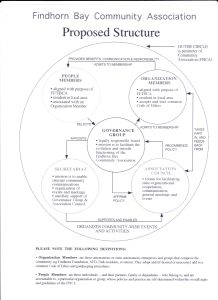
To understand how these organisation members of the FBCA interact with each other and with individual (people) members, please see the structural diagram (below).
People Members
The organisation members, having together defined and agreed the rights and responsibilities of individual membership, would themselves be the means of admitting individual members. To join the FBCA an individual must be associated with an organisation member. (Therefore eliminating the need for an extra layer of ‘personnel’ administration within the FBCA.)
Association Council
Representatives from each of the organisation members form the Association Council, which recommends policy to the Governance Group. It is the forum for facilitating cooperation between organisations.
Governance Group
This group is an elected/attuned body which is the legally responsible board of the FBCA and containing its office bearers and other members up to a suggested total of nine. This group affirms policy recommended by the Association Council and ensures its implementation. Its members are selected by the People Members of the FBCA. This group appoints the Secretariat.
Secretariat
This supports and enables internal Community communication and administration, including meetings.
Membership of the Council and Governance Group is voluntary and supported by the organisational members. The Secretariat will be a paid position(s) and supported by FBCA subscriptions.
Proposed Membership Procedure
People Members
FBCA membership is appropriate for those who are connected and contributing to the aims of the Findhorn Foundation Community (FBCA) or any of its associated organisations. Full members must be 18 years of age or older.
To join the FBCA (as a people member) an individual must be associated with an organisation member. This in itself goes a long way to ensuring that those who join are already involved with the Community and supporting it. Not everyone associated with an organisation member may wish io join the FBCA, but they would not then be eligible for the benefits of people membership. It is up to constituents of the organisation members to create a Code of Ethics (recognised by the FBCA) by which people members agree to abide.
To become a people member, after an individual has an appropriate doorway, the criteria of the FBCA has to be met. This may include experience of the Community (a Community Orientation Programme?, Foundation Experience Week?) and willingness to abide by FBCA aims and principles, and its Code of Ethics.
To establish the Local Friends doorway, the other proposed organisation members need to agree its parameters and agree its administration.
Organisations/Businesses
These need to be established businesses/organisations who wish to be connected with the Community (FBCA) and who support and contribute to its aims and principles.
These organisations are admitted by the Governance Group and abide by an FBCA recognised Code of Ethics.
Proposed Membership Rules
Obeying the laws of the land.
Proposed Benefits of People Membership
- access to agreed Community services and facilities
- voting and debating rights at full FBCA (Community) meetings
- eligibility to stand for election to Governance Groun and/or represent a group or organisation on the Community Council
- information pack and regular communications
- opportunity to engage in FBCA projects
- information regarding Community initiatives, eg recycling, LETS, Earthshare, VIA, sub groups and contacts. Holistic Health
Proposed Subscriptions
People members pay an initial joining fee of approximately £10 and an annual subscription of approximately £20. Donations above this figure are appreciated and some bursaries may also be available.
All adult individuals join and, where there is a dependent (eg child under 18, or elder), the dependent has membership rights (bar voting) the same as the individual paying the subscription.
Organisations can join with a £20 fee and/or a donation above that amount, with an annual subscription of £20. This does not include individuals within the organisation (except in the case one person or very small businesses/organisations) but will include representation on the Community Council.
Proposed Allocation of Subscriptions
- An agreed payment to those individual organisations which provide benefits to other FBCA members for access to premises and facilities
- An amount for initial setting-up costs of the FBCA, eg solicitor’s fees, office stationery, photocopy etc
- An amount to cover Secretariat expenses eg administrator’s salary, office, newsletters, accounting etc
PROPOSED NEXT TASKS FOR STEERING GROUP
- Definition of privileges and responsibilities of FBCA membership, such as
- Access to FBCA name and endorsement
- Access to FBCA communication channels
- Access to funds collected by “Community Tax” (part of yearly subscription fee)
- Services willing to be provided to other FBCA members
- Creation of Code of Ethics for organisational members, then people members
- Creation of Grievance/Arbitration Procedures
We suggest that the growth of the FBCA might initially be slow and therefore its membership small at the beginning. This would allow for organic growth over time. Initially people membership might extend to roughly 120 from Foundation (including Open Community), and another 100 made up from the other organisational members. It is envisioned that within the next five years membership will not exceed 400 people members (this was the number who turned up to celebrate the Foundation’s birthday party at Cluny last year. and included guests).
It is important to point out that it is possible to define privileges and responsibilities differently for each of the organisational members, as long as all the organisational members agree to this arrangement.
DRAFT CONSTITUTION
(This is a second draft, based on the first one which was prepared by Jane Ferguson of R
& R Urquhart, Solicitors, Forres)
The name of the association shall be the FINDHORN BAY COMMUNITY ASSOCIATION or such other name as shall be determined by the association in general meeting.
PURPOSES
The purposes of the Association shall be:
- To provide a coordinating, facilitating and organisational framework for persons who are or seek to be part of or associated with the community known as The Findhorn Bay Community Association;
- To provide a service for obtaining access to and the use of facilities of or within the Findhorn Bay Community Association;
- To provide, sponsor and/or develop educational programmes originated by the Findhorn Bay Community Association;
- To seek to create an internal economy within the Findhorn Bay Community Association through innovative business enterprises;
- To publish a newsletter including a diary of events and directory of contact names;
- To provide a social framework for events and for the fostering of a community spirit, and to encourage community work and projects.
MEMBERSHIP
Membership shall be open to all persons over the age of eighteen interested in furthering the purposes of the Association upon application to the Committee and upon payment of such subscription as shall have been determined by the Association in general meeting.
MANAGEMENT
The Management of the Association shall be under the control of a Committee to be appointed in accordance with this constitution.
ANNUAL GENERAL MEETING
An Annual General Meeting of all members shall be called each year and at all events by 7th February in each year and notice thereof shall be given to Members in writing not less than 21 days beforehand. A quorum shall be not less than(15%) of the membership. In the event of there not being a quorum the meeting shall be adjourned and re-called within one month on 21 days notice and such meeting shall be deemed to Sily convened notwithstanding the number of members present. The Meeting shall elect its own chairperson who shall have a deliberative vote but shall not have a casting except in the event of equality of votes.
The business of the Annual Meeting shall be:
- To elect office bearers namely a Chairperson, a Secretary and a Treasurer whose offices shall not be combined; such office bearers shall be ex officiis members of the Committee;
- To elect not less than two nor more than nine ordinary Committee members except that in the event of fewer than three office bearers having been elected, the number of ordinary members to be elected shall be increased by a like number;
The office bearers and committee members shall hold office until the next Annual Meeting when they shall be eligible for re-election but no Committee member shall serve on the Committee for more than three years in succession without a break of at least one year; - To receive a report from the Committee on the activities of the preceding year;
- To receive the accounts of the Committee for the preceding year;
- To fix the annual membership subscription;
- To conduct any other business except that no business shall be conducted to alter this constitution without the terms of the motion for such alteration having been given with the Calling Notice for the Meeting.
SPECIAL GENERAL MEETINGS
A Special General Meeting may be called at any time. No business shall be conducted at a Special General Meeting other than that of which notice shall have been given along with the Calling Notice. The Calling Notice shall be the same as for the Annual General Meeting, the Quorum for a Special Meeting shall be as for the Annual General Meeting and the same provisions regarding adjournment in the event of a quorum not being present and the rules relating to a Chairperson shall also apply.
A Special General Meeting may be called by decision of the Committee or on request of not less than 15% of the membership of the Association.
THE COMMITTEE
The affairs of the Association shall be managed by the Committee who shall appoint its own Chairperson from its own number unless a Chairperson has been elected by General Meeting of the Association. The Chairperson shall have a deliberative vote but not a casting vote except in the event of equality of votes.
The Committee shall meet at least twice in each calendar month. A quorum shall be four.
In the event of a vacancy arising in an Office Bearer the Committee may appoint any member of the Association to the office but such member shall not have a vote and such member’s presence shall not count towards a quorum until such appointment has been confirmed by the membership of the Association in General Meeting.
The committee may co-opt any member of the Association to be present at a Committee Meeting who shall be entitled to speak but not to vote. The Committee may appoint sub-committees to assist the conduct of the Association’s business which sub committees shall be answerable to the Committee.
Any property of the Association shall be held in the names of the Office Bearers as Trustees ex officiis.
The Committee shall be responsible for the calling of General Meetings of the Association, for the keeping of proper books of accounts of their intromissions on behalf of the Association, for the presentation of a report and accounts to the Annual Meeting and for the auditing of the accounts at least once a year.
The time and place of meetings shall be determined by the Committee. At each Committee meeting the time and place of the next shall be agreed prior to the close of the meeting. A Committee meeting shall be called on the request of three Committee Members.
The Committee shall be empowered to authorise the Treasurer to open such bank accounts, etc, as shall be deemed suitable and shall determine the requirements for operation thereof. The Committee shall be entitled to require the books of accounts to be presented to the Committee on demand.
In the event of a Committee member being absent from five successive Committee meetings without satisfactory explanation being given to the Committee at or prior to the fifth absence, such member shall be deemed to have resigned and a vacancy shall arise.
PUBLIC ANNOUNCEMENTS
No member of the Association shall be entitled to make any announcement or publish any statement in name or on behalf of the Association except where an announcement is made by an Office Bearer after approval by three members of the Committee and providing always that such announcement or statement shall not contain anything which is at variance with any decision or opinion already made by the Committee.
ALTERATIONS TO CONSTITUTION
No alteration shall be made to this Constitution except upon the vote of two-thirds of members present and voting at a General Meeting of which notice of the resolution to be presented shall have been given along with the Calling Notice of the Meeting.
DISSOLUTION
No resolution to dissolve the Association shall be made except upon the vote of two- thirds of members present and voting at a General Meeting of which notice of the resolution to be presented shall have been given along with the Calling Notice of the Meeting. In the event of dissolution the assets of the Association shall be made over to the Trustees of the Findhorn Foundation or such other body supporting the aims thereof.
Diagram of Proposed Structure
By September 1997 the group started the inauguration process of the Community Association and approached the Community’s organisations to highlight the essential role they play in the governance structure: It stated:
- it is you, the organisations and businesses, who decide for yourselves how you want this new Community Association to run
- The Organisation Members of the FBCA who form the Association Council play a vital part within the Community Association. In fact they are key. They form the natural gateways or portals through which individual members are able to join.
Letter sent to Community organisations on 16th September 1997
FBCA Governance Group
The Park
Findhorn Bay
16 September 1997
As we have begun the process of inaugurating the Community Association using a specific organisational structure (sometimes called the Gilman diagram), and have moved forward with a temporary Governance Group, Secretariat and Membership, it is now time for those who are interested to begin to form the fourth wing of the Association, the Association Council.
The purpose of the Association Council is to be a forum to facilitate cooperation between all of the organisations within the FBCA. It is made up of representatives from all the organisations and businesses within the FBCA and it is the job of the Association Council to recommend policy to the legally responsible Governance Group.
The Association Council is the place where it will be decided which aspects of cooperation members wish to organise across the community: for instance creating a united public relations effort, or a visitors centre. Here members negotiate which benefits will be offered to each other and what remuneration each will require. The Association Council decides on membership criteria and the admittance of new Organisation Members of the FBCA, who will then be represented on the Association Council. It is the place where possibilities and practicalities can be explored.
What this means is that it is you, the organisations and businesses, who decide for yourselves how you want this new Community Association to run. The current Governance Group has provided (and most likely will for a while longer) some of the initial impetus and a structure with which to begin, but it is the Association Council who decides how to work with, change or make new structures and who negotiates within itself to create Community-wide cooperation.
As with the inauguration of the Governance Group, it was decided it was best just to start. Therefore we invite you, along with representatives of some of the other organisations and businesses most likely to be interested (listed below), to become the first Organisation Members and form the first Association Council. You are invited to attend a meeting with each other and the FBCA Governance Group on Thursday evening September 25th at 8pm in the Community Centre and begin the discussion: Do you want to join the FBCA as an Organisation Member? What are your ideas about how to move the FBCA forward? In what areas would you like to see Community cooperation? Who should be part of this Council?
The Organisation Members of the FBCA who form the Association Council play a vital part within the Community Association. In fact they are key. They form the natural gateways or portals through which individual members are able to join.
If all of the above sounds ambitious, somewhere in the future or just plain crazy, we invite you only to be part of the dream. Inspired by those who have gone before us in this place, we are simply following orders from inside: “If you build it, they will come ..
With love,
Eva Ward
Chairperson FBCA Governance Group
cc: Minton House, NewBold House, Findhorn Foundation, Findhorn Press, Holistic Health Centre, Phoenix Stores, Posthouse Printing and Publishing, Earthshare, Eco-Village Ltd, Innerlinks, Findhorn Bay Caravan Park, Moray Steiner School, Trees for Life.
In 1999 the FBCA was replaced by the New Findhorn Association (NFA).
The Constitution of the New Findhorn Association
(15 March 1999, as updated March 2000 and March 2005 and April 2007 and March 2013)
INSOMUCH as we individually and collectively have responded to a call within ourselves to live and work together in this place, in resonance with its founders’ vision and their demonstration of that in daily practice; and that we choose voluntarily to do so and take personal responsibility for our own individual ideas, beliefs and actions in furtherance of that vision: we acknowledge that we are members of a unique, intentional community and agree that this is our formal Constitution.
Definitions
The following definitions (some of which are repeated again in their appropriate sections) shall apply in this Constitution:
a) “The Association” refers to the body created by this Constitution.
b) “Set by policy” means decided upon by the process described in Section 4.6.
c) An “organisation” shall mean a named entity formed by the voluntary, intentional, and on-going grouping of two or more people.
d) An “Organisation-Member” is an organisation which has become a member of the Association (see Section 3.2).
e) deleted
f) The “local area” shall be that geographic area which is within 50 miles of the Universal Hall, The Park, Findhorn, Forres, IV36 3TZ, Scotland.
g) deleted
h) A “Petition” is a formal written appeal addressed to the Council and signed by Full Members.
i) “Policy” means 1) any rule, guideline, or procedure; or 2) the adoption of any program or activity.
Article I — Type and Name
This Constitution creates an Unincorporated Association under Scottish law. The name of this association shall be the New Findhorn Association or such other name as is set by policy. The New Findhorn Association shall also be referred to as “the Association” within this Constitution.
Article II — Purpose
Section 2.1 – Purpose: The purpose of the Association is to be a diversity of people showing by example a way of living in the world in alignment with Spirit, in co-operation with each other, and in service to the Earth. The purpose of this Constitution and the bodies it creates is to enable and facilitate that purpose.
Section 2.2 — Non-profit Status:
The income and property of the Association shall be used solely for the promotion of the purpose of the Association as set out in Section 2.1. The Association shall not pay any dividend, bonus or other form of profit to its members. This shall not prevent any member or employee of the Association, including the Listener Conveners and Councillors, being paid fair and reasonable remuneration for services rendered to the Association and being reimbursed for expenses incurred on behalf of the Association, except that Councillors shall not be remunerated for performing the normal duties and functions of Council members. A Councillor who works in any paid capacity for the Association shall not vote on any issue related to remuneration for such work. The Council may pay commercial rates of interest on any money lent to the Association by any member, and reasonable and proper rent for the use of premises let by any member to the Association.
If the Association is wound up, any property remaining after payment of all debts and liabilities shall not be distributed to the members of the Association, but shall be given to another Association or Associations with similar objects to the object of this Association, and which similarly prohibits the distribution of its or their income and property among its members. Such Association or Associations shall be chosen by the members of the Association at or before dissolution.
Article III — Membership
Section 3.1 — Types of Membership: There shall be two types of membership, 1) Organisation-Members and 2) Individual Members.
Section 3.2 — Organisation-Members:
Section 3.2.1 — Definitions: For the purposes of this Constitution, an “organisation” shall mean a named entity formed by the voluntary, intentional, and on-going grouping of two or more people.
Section 3.2.2 — Admission to Organisation-Membership: The Council is empowered to admit to Organisation-Membership those organisations which apply for such membership and satisfy the membership requirements (see Section 3.2.3) according to the judgement of the Council.
Section 3.2.3 — Requirements for Organisation-Members: An Organisation-Member shall:
a) be aligned with the purpose of the Association as described in Article II.
b) agree to abide by this Constitution and all policies duly established on the basis of this Constitution (Section 4.6). Application for Organisation-Membership shall be considered as implicit agreement to so abide. c) have formally decided, within its own decision-making procedures, to apply for Organisation Membership.
d) provide the Council with the name and contact information of a contact-person within the organisation, and shall inform the Council when the contact-person or any of the contact information changes.
e) deleted
f) deleted
g) have a public Code of Ethics (or equivalent code) of its own choosing which is consistent with the Community’s Common Ground.
Section 3.2.4 — Rights of Organisation-Members: An Organisation-Member is entitled to:
a) full participation in the Forum of Organisations (see Section 4.5.1)
b) indicate in its public communications, according to guidelines set by policy, that it is a member of this Association.
c) make use of all services provided by the Council for Organisation-Members.
d) deleted
Section 3.2.5 — Withdrawal from Organisation-Membership: An Organisation-Member may withdraw from Organisation-Membership on 60 days written notice to the Council and to its members. All outstanding obligations of the organisation to the Council must be honoured.
Section 3.2.6 — Expulsion of an Organisation-Member: An Organisation-Member may be expelled from membership on the grounds of failing to meet any of the requirements in Section 3.2.3 and based on the process described in Section 3.4.
Section 3.2.7 — Term of Organisation-Membership: The term of Organisation-Membership shall be for as long as the Organisation-Member meets the requirements of Section 3.2.3.
Section 3.3 — Individual Members
Section 3.3.1 — Definitions:
a) deleted
b) The “local area” shall be that geographic area which is within 50 miles of the Universal Hall, The Park, Findhorn, Forres, IV36 3TZ, Scotland.
c) deleted
d) deleted
Section 3.3.2 — Categories of Individual Members: There shall be at least two categories of Individual Members, 1) Full Members, and 2) Temporary Members. Other categories of non-voting members may be set by policy.
Section 3.3.3 — Requirements for Full Members: Full Members shall:
a) abide by this Constitution and all policies duly established on the basis of this Constitution. Acceptance of membership shall be considered as implicit agreement to so abide.
b) be current in the payment of whatever membership fee, if any, is approved by the Full Membership.
c) deleted
d) be resident in the local area for at least six months or have a non-local exemption set by policy;
e) be at least 13 years of age.
Section 3.3.4 — Rights of Full Members: Full Members shall have the right to:
a) vote in all referenda and all elections based on this Constitution
b) full participation in all General Meetings, including the right to vote in such meetings
c) petition the Council as described in Section 4.2.1
d) if over 16 years of age, stand for election to be a Councillor or a Listener-Convenor
e) make use of all services provided by the Council for Full Members.
Section 3.3.5 — Admission of Full Members:
Section 3.3.5.1 — Any person who satisfies the requirements for Full Membership (Section 3.3.3).
Section 3.3.5.2 deleted
Section 3.3.5.3. deleted
Section 3.3.6 — Withdrawal from Full Membership: Any person who would otherwise be a Full Member may withdraw from Membership by sending a written notice to Council or any one of the Listener-Convenors.
Section 3.3.7 — Expulsion from Full Membership: A Full Member may be expelled from membership on the grounds of failing to meet any of the requirements in Section 3.3.3 and based on the process described in Section 3.4.
Section 3.3.8 — Term of Full Membership:
Section 3.3.8.1 — The term of Full Membership shall be until the time for membership renewal as set by the Council, or until the Full Member no longer satisfies the membership requirements, whichever comes first.
Section 3.3.8.2 – Full Membership is automatically renewed so long as the requirements of Section 3.3.3 are met at the time of renewal.
Section 3.3.9 — Requirements for Temporary Members: The requirements for Temporary Members are the same as those for Full Members (Section 3.3.3) except that Section 3.3.3d is replaced by: — be resident in the local area for at least one week and at most six months or have a non-local exemption set by policy.
Section 3.3.10 — Rights of Temporary Members: Temporary Members shall have the right to make use of all services provided by the Council for Temporary Members.
Section 3.3.11 — Admission of Temporary Members:
Section 3.3.11.1 — Any person who satisfies the requirements for Temporary Membership (Section 3.3.9) Section 3.3.11.2 deleted.
Section 3.3.12 — Withdrawal from Temporary Membership: Any person who is a Temporary Member may withdraw from Temporary Membership by sending a written notice to Council or any one of the Listener Convenors.
Section 3.3.13 — Expulsion from Temporary Membership: A Temporary Member may be expelled from membership on the grounds of failing to meet any of the requirements in Section 3.3.9 and based on the process described in Section 3.4.
Section 3.3.14 — Term of Temporary Membership: The term of Temporary Membership shall be until the time for membership renewal as set by the Council, or until the Temporary Member no longer satisfies the membership requirements, whichever comes first.
Section 3.4 — Process for Expulsion of Members:
Section 3.4.1 — Formation of the Investigative Committee: If the Council has reason to believe that an Organisation-Member, a Full Member, or a Temporary Member (hereafter in section 3.4 referred to as “the Member in question”) is failing to meet any of their respective membership requirements, the Council shall appoint a committee (hereafter in section 3.4 referred to as “the Investigative Committee”) chaired by a member of the Council to investigate the case, including communicating directly with the Member in question, in accordance with guidelines set by policy. The services of the Peacemakers (see Section 4.5.2) shall be available to the Member in question and the Investigative Committee.
Section 3.4.2 — Actions of the Investigative Committee:
a) If the Investigative Committee determines that the Member in question meets the appropriate membership requirements, the case shall be dropped.
b) If the Investigative Committee determines that the Member in question is, in good faith, taking agreed upon steps to meet the appropriate membership requirements, the Investigative Committee shall monitor the completion of those steps, following which the case shall be dropped.
c) If the Investigative Committee determines that the Member in question fails to meet any of his/her/its membership requirements and is not taking or completing agreed upon steps to meet those requirements, the Member in question may choose to withdraw from membership. If the Member in question does not so choose, the case shall be referred to an Expulsion Hearing (Section 3.4.3).
Section 3.4.3 — The Expulsion Hearing:
Section 3.4.3.1 – Process: General guidelines for the process of these Hearings shall be set by policy.
Section 3.4.3.2 — Roles:
a) A Peacekeeper (see Section 4.5.2), agreeable to both the Member in question and the Investigative Committee, shall preside over the hearing and rule on questions of procedure. If the Member in question and the Investigative Committee cannot agree on a Peacekeeper, the Council shall choose a Peacekeeper for this role.
b) The Investigative Committee shall present its case to the Hearing, in accordance with the process established on the basis of Section 3.4.3.1, for why it feels that the Member in question is not in good standing with regard to the requirements of membership and should be expelled.
c) The Member in question, with the assistance of representation of the Member-in-question’s choosing, shall present his/her/its case to the Hearing, in accordance with the process established on the basis of Section 3.4.3.1, for why he/she/it feels he/she/it should not be expelled.
d) The Council, with at least a quorum of Councillors present, shall hear these presentations and decide the case.
Section 3.4.3.3 — Outcomes: The Council may decide:
a) to drop the case, or
b) if the Member in question is willing, to establish a series of steps, with time limits, through which the Member in question can return to good standing, or
c) expel the Member in question.
The decision of the Council is final.
Section 3.5 — Readmission of Expelled or Withdrawn Members:
An Expelled or Withdrawn Member may apply to the Council for readmission to the Association. The Council shall take the Member’s history into account and require evidence that the conditions which led to the expulsion or withdrawal have since changed. Expelled Members shall wait at least 6 months before applying for readmission. All of the appropriate membership requirements must be satisfied for readmission.
Article IV — Governance
Section 4.1 — Jurisdiction
Section 4.1.1 — Subordinate to Scottish Law: This Constitution is subordinate to Scottish law and shall be interpreted according to the laws and within the courts of Scotland.
Section 4.1.2 – Domain: This Constitution has jurisdiction over matters which concern the Membership as a whole, over the conditions of Membership, and over the affairs of the bodies established by this Constitution.
Section 4.1.3 — Limitations: This Constitution and all policies duly established on the basis of this Constitution shall not interfere with the rights or internal affairs, as recognised in Scottish law, of any of its Individual Members or Organisation-Members.
Section 4.2 — Powers of the Full Membership
Section 4.2.1 — Petition:
Section 4.2.1.1 — Definition: A “Petition” is a formal written appeal addressed to the Council and signed by Full Members.
Section 4.2.1.2 – Topics: Petitions may be made for requiring that:
a) a Policy Item be categorised as a Major Policy Item (Section 4.6.2.2); such petitions require signatures by at least 5% of the Full Members to be valid; such petitions must be delivered to the validating Peacekeeper (Section 4.2.1.3b) no more than 21 days after the Council Meeting at which the item in question was identified and not categorised or categorised as a Minor Policy Item, or as set by policy;
b) a Constitutional question be referred for decision to the Peacekeepers (see Section 4.5.2); such petitions require signatures by at least 10% of the Full Members to be valid;
c) a Major Policy Proposal Under Consideration (see Section 4.6.5) be referred for decision to the next General Meeting; such petitions require signatures by at least 15% of the Full Members to be valid; such petitions must be delivered to the validating Peacekeeper (Section 4.2.1.3b) no more than 21 days after the start of the Comment Period for the Major Policy Proposal Under Consideration, or as set by policy; d) a Special General Meeting be convened at a specified time, date, and place to deal with topics specified in the petition; such petitions require signatures by at least 20% of the Full Members to be valid; such petitions must be delivered to the validating Peacekeeper (Section 4.2.1.3b) no less than 35 days before the date of the Meeting specified in the Petition, or as set by policy.
Section 4.2.1.3 — Procedure:
a) Petitions shall begin with a written proposal that concerns one of the topics permitted under Section 4.2.1.2. This shall be followed by a space for signatures and whatever other information is set by policy. Succeeding pages for signatures may be attached to the first page and shall clearly identify the topic of the Petition at the top of the page and be numbered. Multiple copies of the same Petition may be circulated for signatures.
b) The initiator(s) of the Petition shall find a willing Peacekeeper to oversee the validation of the signatures against the current list of Full Members. Signed Petitions shall be delivered to this Peacekeeper who, after validation of the signatures, shall certify the percentage of Full Members who have signed the Petition and deliver the Petition to the Council.
c) The Council shall act according to the requirements of any certified valid Petition. In the case of a Petition concerning a Major Policy Proposal Under Consideration, the Council shall refer the decision on that policy to the next General Meeting. In the case of a Petition for a Special General Meeting, the Council shall call the specified Meeting according to the duly established policies for calling General Meetings.
Section 4.2.2 — General Meetings:
Section 4.2.2.1 — There are two types of General Meetings: 1) the Annual General Meeting (see Section 4.2.2.8) and the Special General Meeting (see Section 4.2.2.10)
Section 4.2.2.2 — General Meetings shall be open to all Full and Temporary Members, and to all others whom the Convenor of the Meeting allows to attend.
Section 4.2.2.3 — The decision-making procedures used for General Meetings shall aim for consensus and the inclusion of all relevant points of view. If consensus can not be found in a reasonable period of time as determined by the Chair of the Meeting, decisions shall be by simple majority of those present unless otherwise specified by this Constitution or set by policy.
Section 4.2.2.4 — A quorum shall be not less than 15% of the Full Members.
Section 4.2.2.5 — One or both of the Listener-Convenors, or, if neither are available, a Councillor, shall be the Convenor of the Meeting and preside over, as the first item of business, the election of a Chair of the Meeting.
Section 4.2.2.6 — The Chair of the Meeting shall have a deliberative vote and shall have a casting vote in the event of equality of votes.
Section 4.2.2.7 — Notice of a General Meeting shall be given in writing not less than 21 days beforehand. The Calling Notice for the Meeting shall indicate the business to be addressed at the Meeting. No business shall be addressed at a General Meeting which is not indicated in the Calling Notice unless it is an item of business required by this Constitution.
Section 4.2.2.8 — The Annual General Meeting shall be held within one month before or after the Spring Equinox, or as set by policy. In the event of there not being a quorum the Meeting shall be adjourned and re called within one month on 21 days notice and such Meeting shall be deemed to be duly convened notwithstanding the number of Full Members present.
Section 4.2.2.9 –– The business of the Annual General Meeting shall be:
a) to receive reports from the Council on the activities of the preceding year, including a financial report; b) to receive a proposed budget for the coming year from the Council;
c) to fix the budget for the coming year;
d) to fix the schedule of annual membership fees;
e) to decide any policy issues which have been referred to the Meeting;
f) to conduct any other business, consistent with this Constitution, which has been included in the Calling Notice for the Meeting.
Section 4.2.2.10 — A Special General Meeting may be called at any time by:
a) the agreement of both Listener-Convenors; or
b) a 2/3rds vote of the Council; or
c) a valid Petition for a Special General Meeting (Section 4.2.1.1d).
Section 4.2.2.11 — In the event of there not being a quorum, the Meeting shall be adjourned. In the case of a Meeting called on the basis of a Petition, the Meeting shall be re-called. In the case of a Meeting called by the Listener-Convenors or by the Council, recalling of the Meeting is at the discretion of the Council. If the Meeting is recalled, it shall be done so within one month on 21 days notice and such Meeting shall be deemed to be duly convened notwithstanding the number of Full Members present. In the case of the Meeting not being recalled at the discretion of the Council, all the business intended for this Meeting shall be carried forward to the next General Meeting.
Section 4.2.2.12 — The business of a Special General Meeting may include:
a) adjusting the budget by more than a threshold level set by policy;
b) deciding any policy issues which have been referred to the Meeting;
c) conducting any other business, consistent with this Constitution, which has been included in the Calling Notice for the Meeting.
Section 4.2.2.13 — Additional guidelines and procedures for General Meetings consistent with this Constitution shall be set by policy.
Section 4.2.3 – Referenda: Definition: A Referendum is a secret ballot election to accept or reject this Constitution or amendments to this Constitution (see Section 5) or to accept or reject policies referred to a referendum for decision (see Section 4.6).
Section 4.3 — The Council
Section 4.3.1 — Composition and Terms:
Section 4.3.1.1 — Number: The Council shall be composed of not more than 12 and not less than 3 Councillors depending on the numbers standing for election (see Section 4.3.2.5).
Section 4.3.1.2 — Term: The term of office of a Councillor shall be for two years and renewable yearly at an Annual Election.
Section 4.3.2 — Election:
Section 4.3.2.1 — Election Date: The Annual Election of Councillors shall be complete on the Spring Equinox or as otherwise set by policy.
Section 4.3.2.2 — Election Overseer: The Peacekeepers (see Section 4.5.2) shall choose one of their number to be the Election Overseer responsible for the process of the election. The Listener-Conveners may recommend one or more candidates to the Peacekeepers.
Section 4.3.2.3 — Qualifications: Candidates for Councillor shall be:
a) Full Members;
b) 16 years of age or older;
c) in good standing with the laws of the country;
d) planning to be absent from the local area for not more than a time period set by policy; e) willing and able to serve if elected; and
f) whatever other qualifications are set by policy.
All candidates shall submit to the election Overseer with their nomination a written declaration that they have read and understood the Constitution of the Association and agree to be bound by it if elected.
Section 4.3.2.4 – Nominations: Any qualified individual shall become nominated by informing the Election Overseer of their willingness to stand. The closing time for nominations shall be set by policy.
Section 4.3.2.5 Election Process: The single transferable voting system for Councillors will only be used if the total number on Council would exceed the maximum of twelve. If there are less than twelve candidates, then all candidates can be elected by show of hands at the AGM with a minimum support of 75% each from the voting members present.
Section 4.3.2.6 — Too few nominations: If the number of candidates at the close of nominations is less than 4, then the election shall be postponed until the next Annual General Meeting or a Special General Meeting. If that Meeting is not able to elect, by a process set by policy, at least three Councillors then the Association shall be dissolved (Section 6.1).
Section 4.3.2.7 — Election Process: see 4.3.2.5
Section 4.3.2.8 — Exclusive Role: A Full Member may stand for election for both the Council and Listener Convenor, but if elected to both offices must serve only as Listener-Convenor.
Section 4.3.3 — Withdrawal, Removal, Vacancies and Conflicts:
Section 4.3.3.1 – Withdrawal: A Councillor must withdraw from office if he or she ceases to be a Full Member or is absent from the local area for a time period longer than set by policy. A Councillor may withdraw for whatever reason upon 30 days written notice to the Council, or as set by policy.
Section 4.3.3.2 — Removal: A Councillor may be removed from office
a) for negligence, failure to do his or her duty, bringing the Association into public disrepute, or other specific offence set by policy and;
b) by an 80% majority of those Full Members present at a duly constituted General Meeting which included this question of removal as an item of business in the Calling Notice and;
c) after a fair hearing at said Meeting under procedures set by policy.
Section 4.3.3.3 — Vacancies: If, for whatever reason, a Councillor vacates his or her position, the Council shall decide to either:
a) Allow the position to remain vacant until the next election provided there remain at least three members; or
b) Hold a by-election.
Section 4.3.3.4 — By-elections:
a) The date of any by-election shall be set by Council.
b) The by-election shall be postponed until the next Annual Elections if these are within 90 days. If there are more than 90 days to the next Annual Election, a Special General Meeting shall be called to elect a Councillor according to the procedures set by policy in relation to section 4.3.2.6.
c) The procedures for the by-election shall be the same as those for the Annual Election as set out in sections 4.3.2.2 to 4.3.2.4 and 4.3.2.7.
Section 4.3.3.5: In the event of a conflict between Councillors, the Listener-Convenors shall call upon the services of the Peacekeepers to mediate.
Section 4.3.4 — Officers:
Section 4.3.4.1 – Co-Chairs: The Co-Chairs of the Council shall be the Listener-Convenors or as otherwise provided for in Section 4.4.5.2.
Section 4.3.4.2 — Other Officers: The Council shall appoint a Treasurer, a Secretary, and such other officers as are set by policy.
Section 4.3.5 — Powers: The Council shall have the following powers:
Section 4.3.5.1 — General: All the affairs of the Association shall be managed by the Council unless otherwise specified in this Constitution or set by policy.
Section 4.3.5.2 — Policy: The Council shall address all policy issues within the jurisdiction of the Association according to the process described in Section 4.6.
Section 4.3.5.3 — Membership: The Council shall decide on the admission of any organisation to Organisation Membership as described in Section 3.2.2. The Council shall be involved in the expulsion of Members as described in Section 3.4. The Council shall decide on the readmission of expelled or withdrawn Members as described in Section 3.5.
Section 4.3.5.4 – Accounts: The Council shall be empowered to authorise the Treasurer to open such bank accounts, etc., as shall be deemed suitable and shall determine the requirements for operation thereof. The Council shall be responsible for the keeping of proper books of accounts on behalf of the Association. The Council shall be entitled to require the books of accounts to be presented to the Council on demand.
Section 4.3.5.5 — Budget: The Council shall be empowered to collect and to spend those funds specified in a duly approved budget, and to accept donations and grants on behalf of the Association. The Council shall prepare a proposed budget for presentation to the Annual General Meeting. The Council shall be empowered to adjust the budget by less than the threshold level, set by policy, referred to in Section 4.2.2.12.
Section 4.3.5.6 – Contracts: The Council shall be empowered to negotiate contracts with other parties for any purpose consistent with the duly approved budget, including the borrowing of funds. The Council shall be empowered to appoint a Guarantor or Guarantors to act on behalf of the Association as part of a contract should such be required.
Section 4.3.5.7 — Property: The Council shall be empowered to appoint a Trustee or Trustees to hold property on behalf of the Association.
Section 4.3.5.8 – Personnel: The Council shall be empowered to create any sub-committee (hereafter referred to as a “Subgroup”) to assist in the conduct of the Association’s business. The existence and membership of each Subgroup may be reviewed by Council at any time, and especially following each annual election. Any such Subgroup shall have at least one Councillor as a member, be answerable to the Council, and the Council shall be responsible for its actions on its behalf.
In addition, the Council shall be empowered to:
a) appoint and dismiss the members of any such Subgroup;
b) to appoint and dismiss the members of the Global Elders group (see Section 4.5.4); c) to appoint and dismiss the members of the Neighbourly Relations group (see Section 4.5.3); d) to appoint the members of the Peacemakers group (see Section 4.5.2);
e) to appoint and dismiss the staff for any activity or function administered by the Council.
Section 4.3.5.9 — Research: In support of these powers the Council shall be empowered to carry out, and to delegate to its subgroups the carrying out, of research within guidelines set by policy. The Members, both Individual Members and Organisation-Members, shall assist in this research by supplying pertinent information within the constraints of Scottish law.
Section 4.3.5.10 — Delegation: The Council shall be empowered to delegate any of its administrative or managerial functions, or other functions as set by policy, to other parties of its own choosing, who shall be answerable to the Council and the Council shall be responsible for their actions on its behalf.
Section 4.3.5.11 — Other Powers: The Council shall have all other such powers as are granted to it by the Membership through a General Meeting or a Referendum and which are consistent with this Constitution and Scottish law.
Section 4.3.6 — Meetings:
Section 4.3.6.1 – Openness: All meetings of the Council and its subgroups shall be open to Full Members as silent observers except that the Council and its subgroups may go into closed session for the discussion of personnel and contracting items, or as otherwise set by policy. All decisions of the Council and its subgroups are to be made in open session. Participation beyond silent observation by attending Full Members shall be at the discretion of the Chair of the Meeting. Minutes shall be kept and made available to the Membership for all open sessions and shall include all decisions. The files and records of the Association shall be open to the Membership except as set by policy.
Section 4.3.6.2 — Quorum: A quorum shall be the nearest whole number, with .5 rounded up, to 50% of the total number of Councillors at that time.
Section 4.3.6.3 — Frequency: Meetings of the Council shall be at least once per quarter.
Section 4.3.6.4 — Special Meetings: Meetings of the Council may be called at any time by a) the agreement of the Listener-Convenors, or b) by agreement of a majority of the Councillors.
Section 4.3.6.5 — Decision-Making: The decision-making procedures used by the Council shall aim for consensus and the inclusion of all relevant points of view. If consensus can not be found in a reasonable period of time as determined by the Chair of the Meeting, decisions in the Council and its Subgroups shall be by simple majority of those present unless otherwise specified by this Constitution or set by policy.
Section 4.3.6.6 — Conflict of Interest: Any Councillor with a significant personal interest in a topic under discussion will disclose that interest to the Council. The Council will decide whether any Councillor should stand aside from the decision-making concerning a topic because of a conflict of interest. Guidelines concerning conflict of interest will be set by policy.
Section 4.3.6.7 – Procedures: Additional guidelines, procedures and rules for Council Meetings and meetings of subgroups appointed by the Council shall be set by policy consistent with this Constitution.
Section 4.4 — The Listener-Convenors
Section 4.4.1 — Composition and Terms:
Section 4.4.1.1 – Composition: There shall be two Listener-Convenors, a man and a woman not in a primary relationship with each other. Should they choose to form a primary relationship with each other during their term one of the pair shall resign.
Section 4.4.1.2 – Terms: The term of office shall be for two years except that, of the two Listener-Convenors elected in March 1999, one shall serve for only one year. The Listener-Convenor elected at that time with the highest rank shall choose either the two-year or the one-year term. Thereafter terms shall be staggered so that the election for the male Listener-Convenor shall alternate, year by year, with the election for the female Listener-Convenor.
Section 4.4.2 — Role: The Listener-Convenors serve the Association by listening to the members, sensing the pulse of the Association, being spiritually attuned to its purpose, identifying key issues, and focusing appropriate Association attention on these. Their function is to accelerate the evolution of the Association and its members toward their highest potential through the achievement of the Association’s Purpose (Article II).
Section 4.4.3 — Election:
Section 4.4.3.1 — Election Date: The regular election of Listener-Convenors shall be at the same time as the election of Councillors (Section 4.3.2.1). Should a Special Election for a Listener-Convenor be required, the date shall be set by the Council.
Section 4.4.3.2 — Qualifications: Candidates for Listener-Convenor shall be: a) Full Members; b) 16 years of age or older; c) in good standing with the laws of the country; d) planning to be absent from the local area for not more than a time period set by policy; e) willing to serve if elected; f) after March 1999, of the same gender as the Listener-Convenor they are a candidate to replace; and g) whatever other qualifications are set by policy.
Section 4.4.3.3 — Nominations: Any qualified individual shall become nominated by informing the Election Overseer of their willingness to stand. A closing time for nominations shall be set by policy.
Section 4.4.3.4 — No nominations: If there are no candidates at the close of nominations, then the election shall be postponed until the next General Meeting or a Special General Meeting. If that Meeting is not able to elect, by a process set by policy, a Listener-Convenor, then the Meeting may consider the following items even if they were not included in the Calling Notice for the meeting: proposing amendments to the Constitution according to the process in Section 5.1, and proposing Voluntary Dissolution according to the process in Section 6.2.
Section 4.4.3.5 — Election Process: If there are more than two nominations, the election shall be by secret ballot using the Highest Average Rank system (Section AA.2). The Peacemakers (see Section 4.5.2) shall choose a person who is not a member of the Association to serve as an Observer during the vote counting. If there are two candidates the election will be by show of hands and the candidate supported by the majority of voting members present shall be elected.
Section 4.4.3.6 — One nomination: If there is only one nomination the election shall be by show of hands and the candidate will need the support of 75 % of the voting members present to be elected. If no candidate is elected the process described in Section 4.4.3.4 shall be invoked.
Section 4.4.4 — Withdrawal, Removal, Vacancies:
Section 4.4.4.1 — Withdrawal: A Listener-Convenor must withdraw from office if he or she ceases to be a Full Member; or is absent from the local area for a time period longer than set by policy. A Listener-Convenor may withdraw for whatever reason upon 30 days written notice to the Council, or as set by policy.
Section 4.4.4.2 – Removal: A Listener-Convenor may be removed from office:
a) for negligence, failure to do his or her duty, bringing the Association into public disrepute, or other specific offence set by policy and;
b) by an 80% majority of those Full Members present at a duly constituted General Meeting which included this question of removal as an item of business in the Calling Notice and;
c) after a fair hearing at said Meeting under procedures set by policy.
Section 4.4.4.3 – Vacancies: If, for whatever reason, a Listener-Convener vacates his or her position, the Council shall hold a by-election for that position unless there are fewer than 60 days to the next annual election, in which case it may be left vacant for that period.
Section 4.4.4.4 — By-elections:
a) If there is no candidate, the election shall be postponed until the next Annual Elections if these are within 60 days. If there are more than 60 days to the next Annual Election, a Special General Meeting shall be called to elect a Listener-Convener according to the procedures set by policy in relation to section 4.4.3.4. b) The procedures for the by-election shall be the same as those for the Annual Election as set out in sections 4.4.3.2, 4.4.3.3 and 4.4.3.5.
Section 4.4.5 – Powers: In addition to any powers granted elsewhere in this Constitution or powers set by policy, Listener-Convenors have the following powers:
Section 4.4.5.1 — Initiate Awareness-Raising: The Listener-Convenors, by their joint agreement, may convene meetings or initiate other processes within the Association to focus attention on key issues they have jointly identified.
Section 4.4.5.2 — Co-Chair Council Meetings: The Listener-Convenors shall jointly or, by their joint agreement, individually chair the Council Meetings. They shall have no vote in the Council or in any Council Subgroup. The Listener-Convenors may, by their joint agreement, delegate all or part of the chairing of a Meeting to a person or persons of their choosing.
Section 4.4.5.3 – Unavailability: If the Listener-Convenors are unavailable, unable to delegate, and have not delegated the chairing at the time of a Council Meeting, the Council shall elect one of its members as Temporary Chair. The Temporary Chair shall not vote and shall not participate, while Temporary Chair, as a member of a Council Subgroup. The Temporary Chair shall be empowered to make the decisions which this Constitution and duly established policy requires of the Listener-Convenors. The Temporary Chair shall not assume any of the other aspects of the Listener-Convenor role unless set by policy. The role of Temporary Chair shall cease as soon as a Listener-Convenor is available.
Section 4.4.6 — Rules:
Section 4.4.6.1 — Decision-Making: In all places in this Constitution where it calls for the Listener-Convenors to make a decision by “joint agreement” both Listener-Convenors must agree on the decision for it to be properly made except in such cases where 1) there is only one Listener-Convenor because of an unfilled vacancy or 2) only one Listener-Convenor is available and the Council has decided by a 2/3rds vote of at least a quorum of Councillors that a decision by the Listener-Convenor must be made.
Section 4.4.6.2 — Procedures: Additional guidelines, procedures and rules for Listener-Convenors shall be set by policy consistent with this Constitution.
Section 4.4.6.3 — Proxy Listener-Convener: Whenever a Listener-Convener is absent from the Community for any reason or is otherwise unable to carry out his or her duties, or whilst there is a vacancy for a Listener Convener, the Listener-Conveners may appoint a Proxy Listener-Convener from amongst the Councillors. Such proxy shall have all the duties, privileges and powers of a Listener-Convener. He or she shall not have a vote on Council or Subgroup decisions whilst acting as a Proxy. In the event of prolonged absences, Council may consider remunerating the Proxy for his or her work as Listener-Convener.
Section 4.5 — Other Mandated Groups
Section 4.5.1 — Forum of Organisations:
Section 4.5.1.1 — Membership: All and only Organisation-Members shall be members of the Forum of Organisations and entitled to send representatives of their choosing to Meetings of this Forum.
Section 4.5.1.2 — Governance: The Forum of Organisations is free to organise its internal affairs according to the wishes of its members and to call on the assistance of the Listener-Convenors and the Council in so doing. At the request of a majority of the Organisation-Members, the rules governing its internal affairs may be set by policy.
Section 4.5.1.3 — Role: The Forum of Organisations advises the Council and undertakes activities, consistent with the Purpose of this Association, which are for mutual benefit of its members.
Section 4.5.2 — Peacekeepers:
Section 4.5.2.1 — Composition and Term: The Council shall appoint at least three people, Full Members of the NFA, with skills in mediation and conflict resolution as Peacekeepers. Peacekeepers cannot be Listener Convenors. The Council shall appoint a Councillor to serve as the Council’s liaison with the Peacekeepers.
Section 4.5.2.2 — Withdrawal, Removal, and Vacancies:
a) A Peacekeeper must withdraw from office if he or she ceases to be a Full Member. A Peacekeeper may withdraw for whatever reason upon 30 days written notice to the Council, or as set by policy.
b) A Peacekeeper may be removed from office: 1) for negligence, failure to do his or her duty, bringing the Association into public disrepute, or other specific offence set by policy and; 2) by an 80% majority of those Full Members present at a duly constituted General Meeting which included this question of removal as an item of business in the Calling Notice and; 3) after a fair hearing at said Meeting under procedures set by policy. c) If, for whatever reason, a Peacekeeper vacates his or her position and that vacancy brings the number of Peacekeepers below three, then the Council shall appoint another qualified person to fill that position.
Section 4.5.2.3 — Powers: In addition to any powers granted elsewhere in this Constitution or powers set by policy, Peacekeepers have the following powers
a) To mediate disputes within the Association which are not purely within one Organisation-Member.
b) To, as a group, decide disputes over interpretation of the constitution. Constitutional questions requiring resolution can be brought to the Peacekeepers by 1) the joint agreement of the Listener-Convenors; 2) agreement of 1/3 of the Councillors; or 3) a petition of at least 10% of the Full Members.
Section 4.5.2.4 — Rules and Procedures: The rules and procedures governing the Peacekeepers shall be set by policy unless otherwise specified by this Constitution.
Section 4.5.3 — Neighbourly Relations
Section 4.5.3.1 — Composition: The Council shall appoint, and can remove, the members of this group. The Chair shall be a Councillor and at least half of the other members shall be residents of the local area who are not Members of the Association.
Section 4.5.3.2 — Role: This group is to advise the Council on matters concerned with the relationship between the Association and its local neighbours.
Section 4.5.4 — Global Elders
Section 4.5.4.1 — Composition: The Council shall appoint, and can remove, the members of this group. They shall be not more than five persons who are not resident in the local area.
Section 4.5.4.2 – Role: This group is to bring a global perspective to both the Council and the Association through their advice and observations.
Section 4.6 — Policy-Making Process (See diagrams in Appendix C)
Section 4.6.1 — Definitions: For the purposes of this Constitution, “policy” means 1) any rule, guideline, or procedure; or 2) the adoption of any program or activity. Items requiring decisions which are concerned with the ongoing management of the Association as defined in this Constitution (including Sections 4.3.5.3, 4.3.5.4, 4.3.5.5, 4.3.5.6, 4.3.5.7, 4.3.5.8, and 4.3.5.9) and/or as defined in existing policy shall not be considered policy items.
Section 4.6.2 — Major, Minor and Initiatory Policy Items:
Section 4.6.2.1 — The following items shall be treated as Major Policy Items: all policies which are referred to in this Constitution by the phrase “set by policy”; any proposed budget items which differ from the existing budget by more than a threshold set by policy; and all other policy items categorised as Major Policy Items by any of the processes described in Section 4.6.2.2.
Section 4.6.2.2 — Any policy item can be categorised as a Major Policy Item by: a) the joint agreement of the Listener-Convenors; b) agreement of at least 25% of the Council; or c) a petition to that effect signed by at least 5% of the Full Members.
Section 4.6.2.3 — All policy items not explicitly classified as Major Policy Items are Minor Policy Items. The Council is empowered to make decisions on Minor Policy Items in any manner it sees fit provided it is otherwise consistent with this Constitution.
Section 4.6.2.4 — Any policy which is referred to in this Constitution by the phrase “set by policy” and which is needed to allow the application of a part of the Constitution may be temporarily set by the Council as if it were a Minor Policy Item, and, if so set, shall be known as an Initiatory Policy. The Council shall, in the same Meeting at which the Initiatory Policy is set, start the same policy item through the decision-making process for Major Policy Items starting with Section 4.6.4.3. The Initiatory Policy shall stand as Duly Established Policy until the decision-making process for that Major Policy Item has produced a Duly Established Policy replacement for it.
Section 4.6.3 — Identification of Policy Items: The decision-making process for policy items begins by the Council identifying a policy item about which a decision could be made. Such items may be brought to the attention of the Council by any Member, by a Listener-Convenor, by any Councillor, or by instruction from a General Meeting.
Section 4.6.4 — Assignment of Policy Items:
Section 4.6.4.1 — The Council shall proceed with each policy item (except those brought to the Council by instruction from a General Meeting) by deciding (see Section 4.6.2.2) whether the items is: a) a Major Policy Item, in which case the considerations of Section 4.6.4.3 apply; b) a Minor Policy Item, in which case the considerations of Section 4.6.2.3 apply; c) not in its jurisdiction; d) not to be addressed at this time.
Section 4.6.4.2 — Items brought to the Council by instruction from a General Meeting shall be treated as Major Policy Items unless otherwise instructed by the General Meeting.
Section 4.6.4.3 –– The Council shall proceed with each Major Policy Item by either
a) assigning it to a Council Subgroup with the instruction to formulate a proposal or a series of proposals to address the policy item; or
b) immediately formulating a proposal or a series of proposals within the Council to address the policy item.
Section 4.6.5 — Formulated Proposal: Once the Council has a Formulated Proposal, or a series of proposals, on a Major Policy Item before it, the Council is free to discuss, modify, and vote on that proposal according to the Council’s rules as set by policy. The Council may also refer the proposal to a Council Subgroup for further consideration. If the proposal is voted on and gains less than 1/4th support from those Councillors present at the Meeting, no further action needs to be taken on the proposal. If it gains 1/4th support or more, the proposal becomes a Major Policy Proposal Under Consideration and enters the Member Comment Period.
Section 4.6.6 — Member Comment Period: All Major Policy Proposals Under Consideration shall be made available to the Membership by means set by policy. The Membership shall have a period of not less than 21 days from the publication of a Major Policy Proposal Under Consideration to send comments on the proposal to the Council and/or to gather a petition requiring that the decision on the proposal be made at the next General Meeting (see Section 4.2.1.1a).
Section 4.6.7 — Disposition by the Council:
Section 4.6.7.1 — If by the end of the Member Comment Period there is no valid petition requiring that the decision on the proposal be made at the next General Meeting, the proposal shall return to the Council. After whatever discussion and modification of the proposal the Council chooses (in accord with the Council’s rules as set by policy) the Council shall dispose of the proposal in one of the following ways: a) refer the proposal to a General Meeting for decision;
b) refer the proposal to a Referendum for decision, in which case the Council shall arrange for the Referendum which may be held in conjunction with the next general election or otherwise at the Council’s discretion;
c) vote on the proposal according to the Council’s rules as set by policy.
Section 4.6.7.2 — If the Council votes on the proposal and the proposal:
a) does not pass, no further action is required on the proposal;
b) does pass and there have been only minor modifications to the proposal, it becomes Duly Established Policy;
c) does pass and there have been major modifications, it must go through another Member Comment Period (Section 4.6.6).
Section 4.6.7.3 — The Listener-Convenors shall rule, by their joint agreement, or if neither is present the Chair of the Meeting shall rule, that the modifications, if any, to the proposal since its last publication as a Major Policy Proposal Under Consideration are minor for them to be considered minor. This ruling is final.
Section 4.6.8 — Disposition by a General Meeting
Section 4.6.8.1 — If by the end of the Member Comment Period there is a valid petition requiring that the decision on the proposal be made at the next General Meeting, the proposal shall go to the next General Meeting. After whatever discussion and modification of the proposal the Meeting chooses in accord with the Meeting’s rules as set by policy and so long as the proposal, in the opinion of the Chair of the Meeting, still addresses the same Major Policy Item, the Meeting shall dispose of the proposal in one of the following ways: a) refer the proposal to a Referendum for decision, in which case the Meeting shall instruct the Council to arrange for the Referendum, which instructions may include the date and other particulars of the Referendum; b) refer the proposal back for Member Comment (Section 4.6.6);
c) vote on the proposal according to the Meeting’s rules as set by policy.
Section 4.6.8.2 — The Chair of the Meeting shall, within this item of business, entertain only proposals which, in the Chair’s opinion, address the original Major Policy Item.
Section 4.6.8.3 — If the Meeting votes on the proposal and the proposal:
a) does not pass, no further action is required on the proposal;
b) does pass, it becomes Duly Established Policy;
Article V — Amendments
Amendments to this Constitution shall be treated as Major Policy Items except that:
a) the final decision on a proposed amendment shall be made by a Referendum and the amendment must gain at least 2/3rds of the votes cast in the Referendum to pass;
b) if the amendment is referred to the Referendum by the Council, 2/3rds of the Councillors present at the Meeting must approve the motion to do so;
c) if the amendment is referred to the Referendum by a General Meeting, at least 2/3rds of the Full Members present must approve the motion to do so.
Article VI — Dissolution
Section 6.1 — Forced Dissolution:
If under the provisions of Section 4.3.2.6 the Association is forced to dissolve, the General Meeting at which those provisions take effect shall choose one or more organisations with purposes aligned with the purpose of the Association and shall apportion and make over the remaining assets of the Association to those organisations
Section 6.2 — Voluntary Dissolution:
Section 6.2.1 — If the conditions which would require a Forced Dissolution do not apply, a proposal for dissolution shall be treated as a Major Policy Item except that:
a) the final decision on such a proposal shall be made by a Referendum and the proposal must gain at least 2/3rds of the votes cast in the Referendum to pass;
b) if the proposal is referred to the Referendum by the Council, 2/3rds of the Councillors present at the Meeting must approve the motion to do so;
c) if the proposal is referred to the Referendum by a General Meeting, at least 2/3rds of the Full Members present must approve the motion to do so.
Section 6.2.2 — The proposal for dissolution shall specify to whom the assets of the Association shall be made over.
Appendix A — Voting Systems
Section AA.1 — Single Transferable Vote:
Section AA.1.1 — Description: The Single Transferable Vote (STV) voting system is an election method applicable to multi-seat elections (such as for the Council in this Constitution). It is increasingly being used in governmental and organisational elections around the world and has been used for some time in Australia and the Republic of Ireland. Its primary strengths are that, compared to traditional “first past the post” systems, it allows a more refined representation of voter preference and avoids “wasted” votes.
In the traditional system, votes are “wasted” either by voting for a candidate who is so popular that he or she did not need your vote to get elected or by voting for a candidate who does not get elected. In STV, with minor exceptions, every voter contributes a vote to a candidate the voter prefers and who does get elected. Here, in broad terms, is how STV works. (A more detailed set of rules starts in Section AA.1.2.)
In an STV election the voters rank the candidates on the ballot by assigning 1 to their first preference, 2 to their second preference, etc., on down to their Nth preference, where N is the number of seats to be filled in the election. Thus if there are 12 seats to be filled and 20 candidates all together, the voter will put in ranking numbers from 1 to 12 and leave the least preferred candidates blank.
Once the election period is over and all the ballots are collected, the counting process can begin. The first step is to count the total number of valid ballots and then divide this by the number of seats to be filled. This gives the “quota” of votes that a candidate needs to be elected. (E.g. 360 valid ballots and 12 seats to be filled gives 360/12 = 30 for the quota.) The next step is to count the first preference votes (marked with a “1” on the ballot) which each candidate has received. Normally, some candidates will receive more than a quota of first preference votes. These candidates are thereby elected and any votes which they have beyond the quota form a surplus. (E.g. If candidate John gets 40 first preference votes and the quota is 30, John has a surplus of 10 votes.)
The next step is to distribute the surplus votes by transferring each one to the highest ranking candidate on each surplus ballot who has not yet been elected. (E.g. on one of John’s surplus ballots Jane, who has also been elected, is the second preference, but Tom, who has not yet been elected, is the third preference. The ballot therefore gets transferred to Tom.) If this elects still more candidates, their surplus is also transferred and the process continues until all the seats have been filled or (the more likely case) there are still seats to fill but all the surplus has been distributed.
At this point attention shifts to the lowest ranking candidate who is eliminated from the competition and all of his or her ballots are transferred to candidates who are still in the running, again with each ballot going to the highest ranking candidate on that ballot who has neither been elected or eliminated (called a “continuing candidate”). The process continues by distributing the surplus of any newly elected candidates, if there are any, or eliminating the lowest ranking continuing candidate. This goes on until the combination of elected and continuing candidates equals the number of seats to be filled at which point all the remaining continuing candidates are declared elected and the process is complete. The net result is that essentially every ballot has gone towards a candidate who is the highest preference for that voter among those candidates that both needed that ballot to be elected and were electable.
Section AA.1.2 — Rules for Implementing Single Transferable Vote: There are a number of different ways to implement STV, some are more mathematically complicated and suitable for computerisation and others are simpler and suitable for hand counting. The following set of rules, which are a simple form suitable for hand counting, shall be the method used in the Association unless otherwise set by policy.
Section AA.1.2.1 — Definitions:
a) A valid “ballot” is a paper, card, or electronic form, on which a voter has marked one candidate or numerically ranked one or more candidates. A ballot form with no marks or with more than one non-numeric marks is invalid.
b) A “continuing candidate” is a candidate who is not yet elected or eliminated.
c) To “transfer” a ballot is to assign it to its highest-ranked continuing candidate.
d) A “transferable ballot” is a ballot which lists or designates at least one continuing candidate. e) As a noun, a “transfer” is an instance of transferring one or more ballots.
f) “N” represents the number of seats in the election.
g) “The quota” is the number of valid ballots cast in the election divided by N, rounded to the nearest whole number, with .5 rounded up.
h) “A quota” is a vote total numerically equal to the quota.
Section AA.1.2.2 — Vote Counting Process:
With all ballots assembled for counting, assign each ballot, one at a time, to its highest-ranked continuing candidate. If that assignment of that ballot gives a candidate a quota of votes, that candidate is elected and thereafter has no more votes assigned to him or her.
If, after all ballots have been so assigned, there are not N candidates elected, then the candidate with the fewest ballots is eliminated and, one at a time, each of his or her ballots is assigned to its highest-ranking continuing candidate. Again, candidates are elected and no longer assigned ballots as soon as their vote count reaches the quota.
If there are two or more candidates tied with the lowest vote count, the candidate with the lowest average rank on his or her ballots is eliminated first. E.g. John and Tom both have eight votes, the lowest vote count at that time. John has three 1st preference votes, two 2nd preference votes, and three 3rd preference votes, so his average rank is 2, i.e. (3*1 + 2*2 + 3*3)/8 = 2. Tom has five 1st preference votes, one 5th preference vote, and two 7th preference vote, so his average rank is 3. Tom’s average rank of 3 is a lower rank (higher numbers are lower in rank) than John’s average rank of 2, so Tom is eliminated first.
If there are two or more candidates tied on both the lowest vote count and the same average rank, and eliminating them all would not bring the number of non-eliminated (i.e. elected plus continuing) candidates below N, then all of these candidates shall be eliminated together. If eliminating them all would bring the number of non-eliminated candidates below N, the candidate with the lowest average rank on the ballots of the other candidate(s) in the tie shall be eliminated first. If the candidate is not ranked on a ballot the next available rank will be assigned for the purposes of this test. E.g. John and Tom are tied with eight votes and each has the same average rank on their own ballots. On John’s ballots, Tom has the following rankings: two 3rd preference, four 4th preference, and two 5th preference. Tom’s average rank on John’s ballots is thus 4. On Tom’s ballots, John has the following rankings: two 3rd preference, four 6th preference, and two blanks which are then assigned as 13th preference. John’s average rank on Tom’s ballots is thus 7. John thus has the lower average rank and is eliminated.
This process of elimination and transfer is continued until either N candidates have been elected, or until only N candidates remain un-eliminated (in which case those N are declared elected), whichever happens first.
Section AA.2 — Highest Average Rank:
Section AA.2.1 — Description: The Highest Average Rank (HAR) voting system is an election method applicable to single-seat elections (such as for Listener-Convenor in this Constitution). Its strength is that, compared to traditional “first past the post” systems, it gives preference to candidates who have broad support among all the voters as opposed to those candidates who are polarising, with strong support among some voters but strong opposition among others.
In the HAR system, voters rank all the candidates standing for the office, putting a “1” next to their first choice, “2” by their second choice, and so on. Votes are counted by finding the average rank of each candidate on all the ballots. The candidate with the highest average rank is elected. E.g. Suppose that John and Tom are both candidates in an HAR election with a total of six candidates. If John gets 60% of the 1st preference vote and 40% of the 6th preference vote (i.e. a polarised split), his average rank is 3, i.e. 1*.6 + 6*.4 = 3. If Tom gets 100% of the 2nd preference vote, his average rank is 2, higher than John’s, and if no other candidate has a higher rank than Tom’s, Tom would be elected.
Section AA.2.2 — Rules for Implementing Highest Average Rank:
Section AA.2.2.1 — Definitions:
a) A valid “ballot” is a paper, card, or electronic form, on which a voter has marked one candidate or numerically ranked one or more candidates. A ballot form with no marks or with more than one non-numeric marks is invalid.
b) An “incomplete ballot” is a ballot on which all applicable candidates have not been ranked. Incomplete ballots are still valid.
c) “Average remaining rank” is the average value of the ranks which have not been assigned on an incomplete ballot. E.g. Suppose that on a ballot with six candidates, only “1”, “2”, and “3” have been marked. This leaves ranks 4, 5, and 6 whose average value is 5.
Section AA.2.2.2 — Vote Counting Process: Begin by determining the total number of valid ballots. For any incomplete ballots, assign the average remaining rank to all those candidates who were not ranked on that ballot. Next, using all the valid ballots, determine the average rank of each candidate. The candidate with the highest average rank is elected.
Appendix B — Highlights of the New Findhorn Association Constitution
PURPOSE
The Constitution describes the community’s purpose as: to be a diversity of people showing by example a way of living in the world in alignment with Spirit, in cooperation with each other and in service to the Earth. The Constitution creates a community-wide structure designed to facilitate and enable this purpose, primarily by improving communications, understanding, and cooperation within the community.
MEMBERSHIP IN THE ASSOCIATION
Our community is not all on one piece of land and can’t be defined geographically. The Constitution defines the community instead through the organisations that are part of it. These can include charities (e.g. The Findhorn Foundation, Trees for Life); businesses (e.g. Findhorn Flower Essences, Phoenix Community Stores); associations (e.g. Findhorn Bay Community Association); or informal groupings (e.g. The Youth Project, a crafts persons’ network). Organisations that fulfil certain basic requirements and choose to join the community become organisation-members.
The Constitution recognises Full members as the community’s highest embodied authority. We, who have chosen to work and live here in alignment with the community’s purpose, are able, through the Constitution, to exercise our authority through the right to vote in referenda and for candidates, to stand for election, to raise petitions, to amend the Constitution should the need arise, to participate in membership meetings and to use those community services which the new structure will develop.
LISTENER-CONVENORS
The facilitation of better communications and cooperation within the community begins with this unusual role. These two elected, paid, people, “a man and a woman not in a primary relationship with each other”; serve the community by listening to the members, sensing the pulse of the community, being spiritually attuned to its purpose, identifying key issues, and focusing appropriate community attention on these. They have the power to convene meetings, initiate games, catalyse new groups, and in other ways help the community take its next steps in areas as diverse as economic development and connection to Spirit. Their function is to accelerate the evolution of the community and its members toward their highest potential. They are also the non-voting co-chairs of the Council (see below), focusing the Council’s attention on the issues that truly concern the community.
THE COUNCIL
This is a voluntary body of a minimum of three and a maximum of twelve members, elected by the members. It addresses policy issues related to the whole community, prepares the annual budget for approval by the membership, and otherwise manages the community-wide structure. The Council admits Organisation Members and can, as a last resort, with due process, expel individuals and organisations from membership.
The Council also appoints groups with advisory or special roles that serve the community. Chief among these are Peacekeepers, who mediate disputes which are not completely within a single organisation; Neighbourly Relations, a group that includes local non-members and establishes and maintains good relationships with others nearby, in the immediate Findhorn-Kinloss-Forres vicinity; and Global Elders, three to five individuals living further afield who are respected, willing and available to bring a global perspective to community affairs.
FORUM OF ORGANISATIONS
Organisation-members do not have voting rights or decision-making powers in the community-wide structure, but they can participate in a regular Forum with fellow organisations, in order to devise, explore and put into practice mutually beneficial ideas that also serve the community’s Purpose. This Forum will advise the Council on a regular basis.
Appendix C
(Please look at the graphic files “Decision 1” of this page and “Decision 2” for the next page.)
Appendix D — Signatures of the Constitutional Committee
We, the undersigned, confirm that this document is the Constitution which we, as the elected Constitutional Committee, have prepared on behalf of the community who shall now become the members of the New Findhorn Association. With gratitude for our chance to serve in this way, we offer, on this day, 15 March, 1999, this Constitution to that membership, to the larger world, and to Spirit, which has guided us in our process.
Fabien Barouch, Rowan Duczek, Bill Grant, Elizabeth Hill, Malcolm Hollick, Katherine Inglis, Dürten Lau, Richard Mark-Coates, Rory O’Connell, Jeremy Slocombe, Bram van den Berg, Julia Zalazar.

Inspired by CommUnity, a group of NFA volunteers, manages this website. Hearing each others stories, and learning about the history of this community can help us all to find more cohesion and a sense of belonging. Read more.<



Leave A Comment