

 The Birth of Findhorn Foundation College

From its earliest days, the Foundation held a vision of being a University of Light, but this vision did not land until the turn of the millennium. The story of its manifestation starts in the 1990s with an American academic called Andrew Arthur.
The trustees were inspired to back his ambitious proposal despite the management team’s opposition; £25,000 or so later, the scheme collapsed just as the first group of American students arrived. This bitter experience erupted in fresh controversy when management and trustees proposed the establishment of Findhorn Foundation College in 2001.
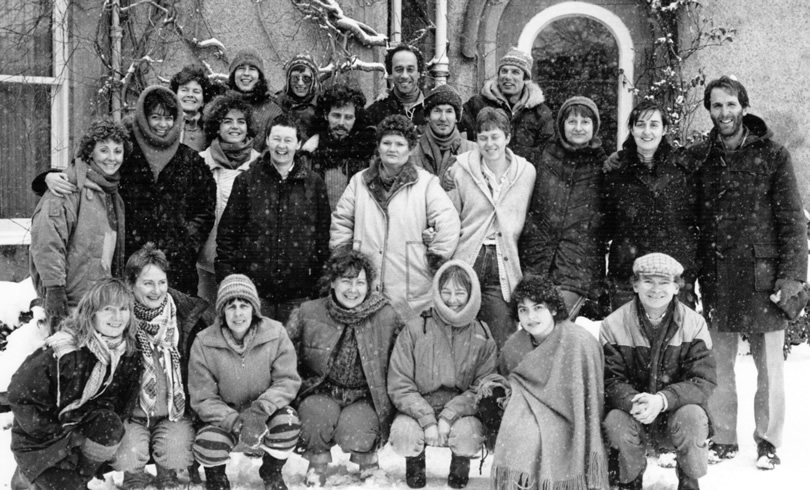
Essence Group 1986
The final impetus for this proposal was odd. It originated in the UK’s minimum wage legislation – to legally run courses in further and higher education, all Foundation members would have had to be paid a wage and then charged for their food and accommodation.
The Foundation had a stark choice between abandoning its accredited education programmes, moving them into an independent organisation, or changing the community’s culture. It chose the middle course, but the idea of starting another college sparked strong opposition and vigorous debate.
While I was a Living in Community Guest in 1997, I wrote a vision for the future of tertiary education at Findhorn. So it wasn’t surprising when I was recruited to set up the new college. However, only when I put forward a detailed proposal did I begin to realise what a minefield I’d entered. Even after the community voted in favour of a modified proposal, the conflict wasn’t over. There was resistance to moving the Ecovillage Training from the Foundation to the college; there was conflict with our US partners over who ‘owned’ the Community Semester; and the college team often seemed to be pulling in different directions. Rather than developing exciting new programmes, such as my vision for a degree in Creating the Future, I found myself ill-equipped to handle the conflicts or to deal with all the legal, financial and management issues of starting a new business. After four years, I burnt out.
Today, thanks to my wonderful successors, Findhorn College is a thriving and accepted part of the Foundation. It is finally realising its potential as a partner of universities in undergraduate and postgraduate education, and professional development.
What can we learn from this saga? First, perhaps, that Spirit’s sense of time is different to ours. Forty years to manifest a vision seems a long time to us, but is short in the larger scheme of things. As Peter Caddy liked to say, we need patience, persistence and perseverance. Why it took so long is another question, but it’s interesting to note that sustainability lies at the heart of Findhorn College programmes. Perhaps this more recent concept is the college’s unique contribution to the world, rather than the first University of Light’s narrower focus on esoteric spirituality.
[ CAPTION ]l: Essence Group 1986. r: poster foundation Year programme (fYp) March 1997 – Sept 2002 (before FP 2003-2011); English in Community 2001.Another lesson relates to guidance. In supporting Andrew Arthur, the trustees may have been led astray by their intense desire for a college, resulting in wounds that took many years to heal. This and other experiences at Findhorn taught me to question deeply any idea that appears to be guidance, and to explore my inner motivations carefully. My years in the college also taught me a lot about my strengths and weaknesses. For several years, I retreated into research and writing, but the wounds are healing and I’m now helping set up a new ecovillage and The Centre for Transition here in Tasmania.
Malcolm Hollick

Digital Routes is a web design and development company based in beautiful Lossiemouth on the Moray Firth of Scotland




Leave A Comment