


I was born in Manchester during WW II. My father was a refugee from Hungary and my mother was a Mancunian. I spent the first year of my life at night under the stairs in our home as it was the safest place as most nights we had air raids. Windows were frequently blown out by bombs and many houses nearby were reduced to rubble.
My earliest memory was when I was just two. I was standing at the top of our staircase looking down to the front door. My father was entering the house, carefully carrying a wicker basket. I asked what was in the basket and I was told ‘it’s your baby sister.’ Life then changed in a major way for me. I was no longer an only child. My sister and I became close and we shared many activities together. I attended local state schools and particularly enjoyed mathematics. At secondary level I was lucky to have an inspiring mathematics teacher. I continued this interest at university.
My parents attended a Quaker meeting so my sister and I were taken along each Sunday morning. From an early age I had to learn to sit quietly during a meeting for worship. I am grateful for the lack of dogma that I experienced. However, Quakerism didn’t answer all my questions about what Life was all about. I remember around the age of eight asking my father this question and he replied that if Socrates hadn’t been able to answer this then he himself had little chance of succeeding. In my teenage years I explored various alternative approaches such as Theosophy and Anthroposophy. I enjoyed reading books written by Rudolf Steiner and Krishnamurti. At the age of 18 I was introduced to my first spiritual teacher, Ronald Beesley who was based at Speldhurst in Kent. He was a healer who encouraged patients to change their thinking otherwise their ailments would return. I found his teachings really spoke to my soul.
I was first drawn to Findhorn in February 1967. I was teaching at a boarding school in Perthshire, about a hundred miles away when I received a postcard from Dennis, a friend whom I had met when we were studying together at Hull University. It said ’27 Findhorn Bay Caravan Park, think you’d find it interesting.’ Knowing our mutual interest in spiritual enquiry this was sufficient for me to follow up. I remember clearly driving one Sunday afternoon to search out this address.

Early years at the caravan park
On my arrival at Findhorn Bay Caravan Park it appeared to be the least attractive site I had ever seen. It consisted of mostly old and dilapidated caravans that RAF personal stayed in for a few weeks as they awaited MOD housing in nearby Kinloss which was an expanding military base. There was a small shop that also acted as the reception office for the caravan park. There were no trees, no flowers and no birds. I was having difficulty locating caravan number 27 so I stopped to enquire. I met two men smashing rocks with sledge hammers and to my surprise one was my friend Dennis. He introduced me to his colleague, a burly suntanned older gentleman called Peter. I was offered a sledge hammer and invited to help with the work. I enjoy physical activity and so I joined in with gusto.
 Peter explained they were preparing a site for a new bungalow that was to be delivered at Easter. (Joanie’s) He also said that ‘Work was love in action’ and they were building a New Age centre. This was hard to imagine as all I could see were old caravans and sand dunes. However, I enjoyed working with Peter and Dennis on their foundation base. Peter was interested in my background and how I had found them. After a couple of hours I was told that it was tea break and I was taken to caravan number 27 (the original caravan) which was located in a hollow, out of sight from other vans.

Original garden, early community.
Here I met two delightful ladies, Dorothy and Eileen. Three young boys, Christopher, Jonathan and David were playing around the caravan. Adjacent to the caravan was an old shed which was equipped with three desks for the boys to do their homework in. Jonathan called it the ‘freezer’ as it had no heating. We all had a drink and a biscuit. I was given a copy of what Peter called ‘Eileen’s guidance’ that she had received that morning. Around the caravan Peter had created a small garden where he was growing mostly vegetables and herbs in very poor sandy soil. However, the plants were extremely healthy and Peter claimed that one cabbage had weighed 40 pounds. He also explained that they were working in cooperation with other realms and that Dorothy in particular was in connection with the devic world.
I only stayed for a few hours on my first visit but I left with a sense of excitement that this was what I had been searching for. There was a ‘field’ that resonated with my being that I had not experienced elsewhere.
A strong inner calling created an urge for me to return the following Sunday for a longer visit. We had a meditation at 11.00am in a tiny caravan that was lived in by Robert Ogilvie Crombie known as ROC, a friend of the community from Edinburgh who visited from time to time. There were six of us initially, Eileen, Dorothy, Lena, Peter, Dennis and me. After twenty minutes of meditation there was space for people to share their visions and insights. Peter never received guidance like the ladies – he would have a gut feeling on which he had been trained to act immediately.
My first first swim in the nearby Moray Firth was in March. It was cold yet invigorating and the overall feeling was that I wanted more! Peter and Dennis and I would run through the dunes before lunch and plunge into the icy water. I loved the activity and work and sharing at Findhorn – I wanted to be there more and more. This felt like real life whereas my time at the school where I was teaching seemed less meaningful. At Findhorn people shared deeply and honestly. Eileen had a vision of a ‘city of light’ even though the only things I could see at the time were sand dunes.
In May 1967 I felt strongly to leave my teaching post at Rannoch so one evening I gave in my notice to the Headmaster before I could sleep. I didn’t know really what was ahead as there was no precedent for people to stay long term at Findhorn. Out of the blue I received a letter from Janet whom I had known for some years and who had introduced me to her spiritual teacher, Ronald Beesley. She was now studying in Durham to become a teacher. She had heard about Findhorn and wanted to visit so we arranged to meet at Pitlochry which was the nearest railway station to where I was teaching. The train arrived but not Janet. I decided to go to Perth for the evening which was about thirty miles away and, passing by the station in Perth, I bumped into Janet who had missed her connection. We continued on to Findhorn the next day. Janet had a teaching post arranged in Africa so was only planning to stay at Findhorn for a few days, however,this extended to many years. We had a tent initially and later moved into Peter’s garage. A friend of Dennis from Yorkshire called Geoff Everatt visited Findhorn. He decided to buy a caravan for himself to stay in when he visited and suggested that Dennis, Janet and I use it when he was away. It was named ‘The Haven’.

Dennis, John, Janet 1967 on the steps of The Haven
Each day was filled with expectancy and fun. We had wonderful visitors. Carl Francis, a healer from London who used to work with Harry Edwards in Trafalgar Square came with his family. Also Albert Best, (uncle of George Best), a healer with the Truth Foundation came on a couple of visits to treat Eileen. Richard St Barbe Baker, founder of ‘Men of the Trees’, came and advised us on the planting of trees suitable for our location. We have today an area known as St Barbe’s wood in which people’s ashes are scattered. Richard Alpert and Timothy Leary visited in early 1968. They were teachers at Harvard University who were experimenting with LSD. After a five minute conversation with Peter Caddy outside the education office they were sent on their way. Peter explained that we didn’t use drugs at Findhorn. The next time Richard came to Findhorn as Ram Das, he was welcomed with open arms.
In 1968 we made contact with Samye Ling in Southern Scotland. This was the first Tibetan Monastery to be established outside Tibet and it was headed by Trunpa Rinpoche and his brother Akong. Trunpa later visited Findhorn.
The education office was erected in the autumn of 1967. It was a ‘garage’ measuring 12’ by 22’. Fake doors had to be built on the back wall to satisfy the planning officer. It was equipped with the best hardware – six desks and an electric typewriter. 3,000 copies of the first publication ‘God Spoke to Me’ containing edited material from Eileen’s guidance were printed then sent out from this office. We had a mailing list of names that had been used by the Universal Link to which these booklets were freely mailed. Donations came back which helped to pay for the exercise.
-

- Peter Caddy digging – garden around cedarwood bungalows photo FindhornFoundation
-

- Peter and Janet W spreading quarry dust on the drive to the Original caravan November 1967 5pm
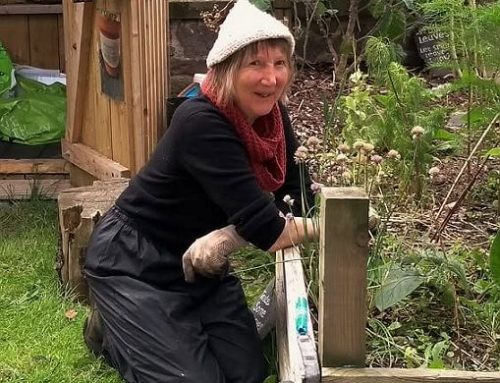
Much of my time was spent digging the ground with Peter, consciously putting light into the soil, and adding materials such as leaves, seaweed and horse manure. We also had to remove every trace of couch grass up to a depth of two spades. Peter was a perfectionist and demanded the very best. We worked long hours with no weekends off. However, Janet and I would sometimes take the three Caddy boys walking and camping in the nearby hills for which Peter was always supportive. The boys helped to repair an old canoe and we used it on the bay and the river.
After almost eight years at Findhorn it was time for me to move on and put into practice the lessons we had been learning. By now Janet and I had our own family. Marian and Alan were the first children to be born in the community.
I was away for 25 years, teaching in schools in England. In 2000 I attended an autumn conference on ‘The Soul in Education’ and it was during this week that I realised it was time to return to Findhorn. Things happened very quickly. I was offered a plot of land on the Field of Dreams on which to build. I contacted David Caddy who then lived in the US and he agreed to help me build. One of my interests was beekeeping and my architect used the fact that bees build in hexagons to design my house which I called ‘Honeypot’. Within a year I moved in. It took me a couple of years to learn the new rhythms of Findhorn which had changed considerably from my early days. I was asked to teach part time in the local primary school at Kinloss, however, within a year I had been appointed to the Conference Office where I continued to work for the next 18 years.
-

- A bee swarm arrives at Honeypot
-

- John Willoner and Craig Gibsone
Now, in 2023 and 56 years after my first encounter with the Findhorn Community, at the age of 78 I live happily in ‘Honeypot’ with my partner Sylvia, kept busy with gardening and maintenance and logging and beekeeping.
Here you can watch John tell some of these stories on video.

Born in England, I joined the Caddy Family in 1967 (aged 22) and pioneered Community living here. Findhorn has been my spiritual home ever since.


Congratulations dear John, for you historical text, and for all dedication to the Village, Park and Foundation. I had already visited Findhorn twice, in 2007 and 2023, everything is fantastic!! Best wishes